

Ultimate Guide to Prepare Free ISQI CPUX-F Exam Questions and Answer
Pass ISQI CPUX-F Tests Engine pdf - All Free Dumps
ISQI CPUX-F Exam Syllabus Topics:
| Topic | Details |
|---|---|
| Topic 1 |
|
| Topic 2 |
|
| Topic 3 |
|
| Topic 4 |
|
NEW QUESTION 27
What is the information architecture?
- A. A sequence of visual frames illustrating the interplay between a user and an envisioned interactive system.
- B. The logical organisation of the units of displayed information that comprise the user interface
- C. A low-cost, simple illustration of a design or concept used to gather feedback from users and other stakeholders during the early stages of design.
- D. A narrative text description that describes an intended usage situation with the interactive system under development.
- E. The information architecture is the naming and structuring of the information that is accessible to users
- F. A representation of all or part of an interactive system that, although limited in some way, can be used for analysis, design and usability evaluation.
Answer: E
NEW QUESTION 28
A human-centred________user requirement is a required level of usability to meet identified user needs expressed in terms of measures of effectiveness, efficiency, satisfaction, accessibility, user experience and avoidance of harm from use in a specified context of use.
Answer:
Explanation:
1. quantitative
NEW QUESTION 29
Which one of the following terms best characterises the drawing below?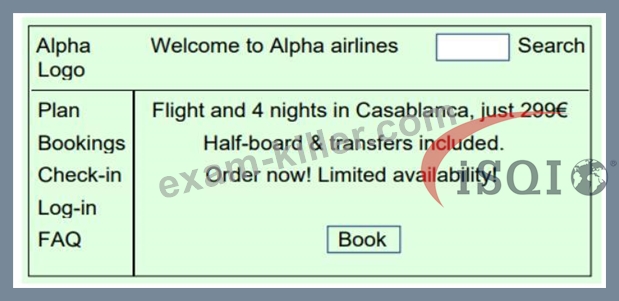
- A. Storyboard
- B. Persona
- C. Design pattern
- D. Wireframe
- E. Use scenario O
- F. Style guide
Answer: D
Explanation:
Explanation
The drawing cannot be a design pattern as suggested by answer A.
According to the Glossary, a design pattern "describes a design problem, a solution, and where this solution has been found to work". The question does not contain a description of a design problem.
NEW QUESTION 30
Which two of the following statements about user needs are correct?
- A. User needs are always quantified
- B. User needs are identical to user goals
- C. User needs are part of the information architecture
- D. User needs for a user group may differ from user needs for another user group with the same context of use
- E. User needs are used to write good error messages
- F. User needs are always expressed from the user's point of view
Answer: D
Explanation:
Explanation
The context of use is described in user group profiles and personas (who are the users), as-is scenarios (how do users currently do tasks), task models (details about what the tasks are) and user journey maps (how users interact with the interactive system and the organisation providing it).
A user group profile is a generalised description of a collection of users with the same or similar personal characteristics and context of use related to the interactive system.
A persona is a description of a fictitious but realistic user and what he or she intends to do when using the interactive system.
An as-is scenario is a narrative text description of the procedure a specific user currently follows to complete one or more tasks, A task model is a list of subtasks for each task which the user has to complete to reach their goals. Task models help the design team to design the right solution for each task. User journey maps provide an overview of the touchpoints where users interact with the interactive system and the organisation providing the interactive system. They help stakeholders and user experience professionals understand and optimise the user experience.
The main purpose of personas and as-is scenarios is to identify user needs and make it easier for designers, developers and other stakeholders to understand who the users are, what they do, what their obstacles are, and to facilitate discussions within the design team.
NEW QUESTION 31
Fill in the blank;
A task is a set of activities undertaken in order to achieve a specific_____________.
Answer:
Explanation:
goal
NEW QUESTION 32
Which one of the following usability findings, on a website that sells train tickets, indicates a problem with satisfaction?
- A. Users liked the modern look of the website
- B. Users with limited vision spent a lot of time reading the tiny fonts used on the website
- C. Users spontaneously said that they considered the animated ads that appear in the right-hand side of most pages annoying
- D. When asked to purchase tickets to Worcester, about 25% of the users gave up because they were unable to spell Worcester correctly and the search for station names was not error tolerant
- E. All users were able to purchase return tickets from Oxford to London very quickly
- F. Only 2 out of 12 users were able to figure out how to obtain a refund for a ticket that they had purchased previously
Answer: C
Explanation:
Explanation
Satisfaction
The extent to which the user's physical, cognitive and emotional responses that result from the use of an interactive system meet the user's needs and expectations.
Notes:
1. Effectiveness and efficiency may influence satisfaction. For example, low effectiveness or low efficiency may lead to low satisfaction. Satisfaction may influence effectiveness and efficiency. For example, frustration may cause users to quit a task, which influences effectiveness.
2. Satisfaction is often measured using a questionnaire. See the examples in the definition of questionnaire.
3. The difference between satisfaction and user experience is that satisfaction results from use, while user experience results from discovering, adopting and using the interactive system, through to final use and recollections of use. In addition, user experience can be influenced by more than just use, for example brand image, price and opinion of others, but it is still related to actual or imagined use.
NEW QUESTION 33
Which three of the following deliverables are created during the activity "Produce design solutions to meet user requirements"?
- A. High-fidelity prototypes
- B. User experience project plan
- C. Evaluation reports
- D. User requirements
- E. Storyboards
- F. Use scenarios
Answer: D,E
NEW QUESTION 34
If a user's mental model of an interactive system is incomplete or contradictory,
- A. then the user cannot easily use the interactive system.
- B. then the user can still easily use the interactive system.
- C. then the user will have to learn to easily use the interactive system.
Answer: A
NEW QUESTION 35
Fill in the blank:
The interviewer should use open and neutral interview questions rather than closed and__________ questions
Answer:
Explanation:
leading
NEW QUESTION 36
Which one of the following must be included in a human-centred design process?
- A. Regular demonstrations to users of the evolving interactive system
- B. Analysis of competitors' products to understand potential pitfalls
- C. A clear commitment from management to usability and human-centred design
- D. Exact timelines for usability milestones so progress can be monitored
- E. An interest from management in innovation
- F. Involvement of users throughout the design process
Answer: F
Explanation:
Explanation
Human-centred design is an approach to design that aims to make interactive systems more usable by focusing on the use of the interactive system and applying usability knowledge and methods. Human-centred design is based upon an explicit understanding of users, goals, tasks, resources and environments. Users are involved throughout the design. The design is driven and refined by usability evaluation. The process is iterative - that is, it continues until the user requirements are met. The design addresses the whole user experience (UX).
Human-centred design means planning for iterations, getting user feedback as early and as often as possible. It is perfectly acceptable to run through the iterations often with lightweight UX deliverables, for example in agile development.
An approach to design that aims to make interactive systems more usable by focusing on the use of the interactive system and applying human factors, ergonomics and usability knowledge and methods. Notes: 1.
The concept "human-centred design" is used instead of "user-centred design" to emphasise the need to consider additional stakeholders who may not be users. 2. Feedback from users through usability evaluation is a critical source of information in human-centred design.
NEW QUESTION 37
Choose the correct order for the human-centred design activities:
1. Design solution meets user requirements
2. Specify the user requirements
3. Analysis: Understand and specify the context of use
4. Evaluate the design and organisational requirements
5. Produce design solutions to meet user requirements
6. Plan the human-centred design process
7. Design solution meets user requirements
- A. 1. 3. 2. 6. 5. 4. 7 or repeat
- B. 6. 3. 2. 1. 4. 5. 7 or repeat
- C. 6. 3. 2. 5. 4. 7. 2 or repeat
- D. 6. 3.2.4.5. 1.7 or repeat
- E. 6. 3. 2. 1. 5. 4. 7 or repeat
- F. 6. 2. 3. 1. 5. 4. 7 or repeat
Answer: E
NEW QUESTION 38
Which one of the terms below best characterises the following description?
Elena Montgomery, Human Resources Coordinator, Fluid Pharmaceuticals
Elena is 35 years old. She shares an apartment with her boyfriend of 4 years - they have no children. Her favourite pastimes are dancing tango and preparing wonderful tapas. She speaks conversational Spanish.
Elena spends most of her day processing forms that are needed to hire, transfer, or discharge employees in the Marketing department. If something is incomplete or unclear, she takes the time she needs to find the answer.
She is an expert in all relevant forms and procedures.
Elena's goals: Advance in HR, excellence through accuracy; helpfulness; do not fall behind.
- A. Prototype
- B. User group
- C. Persona
- D. User group profile
- E. Use scenario
- F. As-is scenario
Answer: C
Explanation:
Explanation
The context of use is described in user group profiles and personas (who are the users), as-is scenarios (how do users currently do tasks), task models (details about what the tasks are) and user journey maps (how users interact with the interactive system and the organisation providing it).
A user group profile is a generalised description of a collection of users with the same or similar personal characteristics and context of use related to the interactive system.
A persona is a description of a fictitious but realistic user and what he or she intends to do when using the interactive system.
An as-is scenario is a narrative text description of the procedure a specific user currently follows to complete one or more tasks, A task model is a list of subtasks for each task which the user has to complete to reach their goals. Task models help the design team to design the right solution for each task. User journey maps provide an overview of the touchpoints where users interact with the interactive system and the organisation providing the interactive system. They help stakeholders and user experience professionals understand and optimise the user experience.
A user group profile is a generalised description of a collection of users with the same or similar personal characteristics and context of use related to the interactive system.
A persona is a description of a fictitious but realistic user and what he or she intends to do when using the interactive system.
The main purpose of personas and as-is scenarios is to identify user needs and make it easier for designers, developers and other stakeholders to understand who the users are, what they do, what their obstacles are, and to facilitate discussions within the design team.
NEW QUESTION 39
Which two of the following are considered stakeholders but NOT users of a car rental website?
- A. A trainer who is teaching staff at a call centre how to use the car rental website
- B. An accounts administrator who receives an email invoice for a reservation from the car rental website
- C. A customer who contacts a call centre employee and asks them to reserve a car for them on the car rental website
- D. A designer who is responsible for the user interface design of the car rental website *
- E. A call centre employee who is using the car rental website to reserve cars on behalf of a customer
- F. A marketing executive who is running a "10% off car insurance" promotion on the car reservation website, for all users who reserve a car directly through the website
Answer: D,F
Explanation:
Explanation
Stakeholders may or may not be users. Stakeholders are not considered to be users if they are affected by an interactive system but don't interact with it or use its output.
Examples of stakeholders who are not users:
1. The non-technical managers of a team of technical users.
2. People affected by the noise produced by an interactive system.
3. Marketers affected by the impact of the use of the interactive system on the brand.
Examples:
1. A customer (user) uses a car reservation website to make a reservation - The customer is a primary user of the system.
2. A customer (user) calls the reservation centre where a customer service representative uses the same system to make the reservation for them -The customer is an indirect user of the system.
NEW QUESTION 40
Which three of the following are good examples of survey questions?
- A. felt confident while using the website (circle one answer) 12 3 4 5 Strongly Disagree Neither agree Agree Strongly disagree nor disagree agree
- B. Please indicate below which chronic condition(s) you have: Diabetes High cholesterol 3 High blood pressure Heart Problems 3 I have none of the conditions listed
- C. How could we improve the National Health Service's website? Fill in:
........................................................................
........................................................................
........................................................................ - D. Do you think that the National Health Service in the UK is very good (circle the most appropriate answer)? Yes No
- E. Would you disagree that our website is hard to use (circle one answer)? 12345 Strongly Disagree Neither agree Agree Strongly disagree nor disagree agree
- F. Have you had a particularly good or bad experience with the National Health Service in the UK? Yes No
Answer: A,B,C
NEW QUESTION 41
10. Fill in the blank:
A ____________ is a representation of all or part of an interactive system that, although limited in some way, can be used for analysis, design and usability evaluation.
Answer:
Explanation:
1. prototype
NEW QUESTION 42
Which one of the following best describes the purpose of a storyboard?
- A. To provide a very early tangible basis for discussions about what the future interactive system could be like for the user, before prototypes are constructed
- B. To identify where encounters between the user and the interactive system happen
- C. To communicate important information about users gathered during observation and interviews to interested stakeholders in a popular and efficient way
- D. To gather information about users, goals, tasks, resources and environments - that is, how things are currently done
- E. To obtain a deep understanding of the context of use, user needs and user requirements
- F. To guide usability test participants who get stuck during a usability test
Answer: A
NEW QUESTION 43
Fill in the blank:
______________is based upon an explicit understanding of users, goals, tasks, resources and environments.
Users are involved throughout the design. The design is driven and refined by usability evaluation.
The process is iterative -that is, it continues until the user requirements are met.
The design addresses the whole user experience (UX).
Answer:
Explanation:
1. Human-centred design
NEW QUESTION 44
Which one of the following best describes a "Post-session interview?
- A. The interview that takes place before the usability test session
- B. The questions that the moderator asks the test participants approximately one week after the usability test session to gauge their long-term user experience
- C. The interview that takes place immediately after the usability test session
- D. The set of questions asked at the end of a contextual interview
- E. The information that the moderator provides to the test participant ahead of the usability test session
- F. The questions that the moderator asks the test participant during the usability test session
Answer: C
Explanation:
Explanation
Stakeholders often observe usability test sessions to see for themselves how the interactive system is performing. Finally, the moderator conducts a brief post-session interview with the usability test participant to understand their overall impressions of the interactive system
NEW QUESTION 45
You have been asked to conduct a usability test of a car rental website. Which one of the following is NOT an appropriate task for the usability test?
- A. Rent a compact car from London Heathrow Airport. You need to collect the car tomorrow morning at 9 and return it to the same location, 4 days later at noon
- B. What is the charge for renting a GPS?
- C. Find a phone number that you can call to talk to someone about your rental contract
- D. Rent a car that meets your needs from a location and for a period that suits you and your budget
- E. Cancel a reservation that you had previously made
- F. Tell me what you think of the website's home page
Answer: F
NEW QUESTION 46
Select four true statements about heuristic evaluation.
- A. Heuristic evaluation is a usability inspection method
- B. A heuristic evaluation is a specific form of a usability inspection that is guided by a list of approximately 10 heuristics.
- C. A usability inspection in which one or more evaluators compare an interactive system to a list of heuristics and identify where the interactive system does not follow those heuristics.
- D. Can be used to evaluate users1 satisfaction with an interactive system and to gather information on the context of use.
- E. Users are asked to report subjective data into a questionnaire based on their experience of using an interactive system
- F. Heuristics are a problem-solving method that uses shortcuts to produce good-enough solutions given a limited time frame or deadline.
Answer: A,B,C,F
Explanation:
Explanation
See page 51 in https://uxqb.org/wp-content/uploads/documents/CPUX-F_EN_Curriculum-and-Glossary.pdf Usability inspection is a form of usability evaluation. It is based on the judgment of one or more evaluators who examine or use an interactive system to identify potential usability problems, and deviations from established dialogue principles, heuristics, user interface guidelines and user requirements. The evaluators base their evaluation on their experience as user experience professionals or as users of the interactive system that is being evaluated.
A heuristic evaluation is a specific form of a usability inspection that is guided by a list of approximately 10 heuristics.
User surveys evaluate users' satisfaction with an interactive system. In a user survey, users report subjective data into a questionnaire based on their experience of using an interactive system. The usability of a questionnaire is important; for example, the questions in the questionnaire must be easy to understand and the questionnaire must keep users informed of their progress.
User surveys are also used to gather context of use information as part of understanding the context of use.
NEW QUESTION 47
......
UXQB Certified Professional for Usability and User Experience - Foundation Level Practice Tests 2022 | Pass CPUX-F with confidence!: https://drive.google.com/open?id=1vRlryIr7LD-Yp_HEc1DnfipFCv00_12c
Online Exam Practice Tests with detailed explanations!: https://www.exam-killer.com/CPUX-F-valid-questions.html
