

Try Free and Start Using Realistic Verified DP-300 Dumps Instantly
DP-300 Actual Questions - Instant Download 343 Questions
Passing the DP-300 exam requires a deep understanding of Azure SQL databases and the ability to perform various administrative tasks. The Microsoft Certified: Azure Database Administrator Associate certification is highly valued in the industry and can help professionals advance their careers in database administration. Overall, the DP-300 exam is an excellent opportunity for professionals to validate their skills and knowledge in administering relational databases on Microsoft Azure.
NEW QUESTION # 169
You have an Azure subscription.
You need to deploy an Azure SQL resource that will support cross database queries by using an Azure Resource Manager (ARM) template.
How should you complete the ARM template? To answer, select the appropriate options in the answer area.
NOTE: Each correct selection is worth one point.
Answer:
Explanation: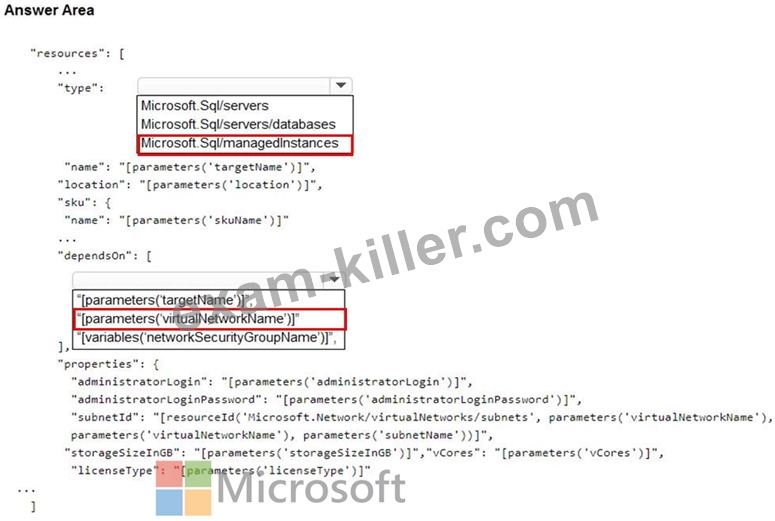
Reference:
https://docs.microsoft.com/en-us/azure/azure-sql/managed-instance/create-template-quickstart?tabs=azure-powershell
NEW QUESTION # 170
You have an Azure subscription that contains a logical SQL server. The server hosts two databases named db1 and db2 and an Azure AD service principal named app1.
You need to ensure that app1 can access db1. The solution must use the principle of least privilege.
How should you complete the Transact-SQL statement? To answer, select the appropriate options in the answer area.
NOTE: Each correct selection is worth one point.
Answer:
Explanation:
NEW QUESTION # 171
You need to recommend an availability strategy for an Azure SQL database. The strategy must meet the following requirements:
* Support failovers that do not require client applications to change their connection strings.
* Replicate the database to a secondary Azure region.
* Support failover to the secondary region.
What should you include in the recommendation?
- A. transactional replication
- B. geo-replication
- C. failover groups
- D. Availability Zones
Answer: C
Explanation:
Active geo-replication is an Azure SQL Database feature that allows you to create readable secondary databases of individual databases on a server in the same or different data center (region).
Reference:
https://docs.microsoft.com/en-us/azure/azure-sql/database/active-geo-replication-overview
NEW QUESTION # 172
You are designing an enterprise data warehouse in Azure Synapse Analytics that will contain a table named Customers. Customers will contain credit card information.
You need to recommend a solution to provide salespeople with the ability to view all the entries in Customers.
The solution must prevent all the salespeople from viewing or inferring the credit card information.
What should you include in the recommendation?
- A. data masking
- B. column-level security
- C. row-level security
- D. Always Encrypted
Answer: A
Explanation:
Section: [none]
Explanation:
Azure SQL Database, Azure SQL Managed Instance, and Azure Synapse Analytics support dynamic data masking. Dynamic data masking limits sensitive data exposure by masking it to non-privileged users.
The Credit card masking method exposes the last four digits of the designated fields and adds a constant string as a prefix in the form of a credit card.
Example:
XXXX-XXXX-XXXX-1234
NEW QUESTION # 173
You plan to build a structured streaming solution in Azure Databricks. The solution will count new events in fiveminute intervals and report only events that arrive during the interval.
The output will be sent to a Delta Lake table.
Which output mode should you use?
- A. update
- B. append
- C. complete
Answer: C
Explanation:
Explanation
Complete mode: You can use Structured Streaming to replace the entire table with every batch.
Reference:
https://docs.databricks.com/delta/delta-streaming.html
NEW QUESTION # 174
You have an Azure subscription.
You need to deploy an Azure SQL resource that will support cross database queries by using an Azure Resource Manager (ARM) template.
How should you complete the ARM template? To answer, select the appropriate options in the answer area.
NOTE: Each correct selection is worth one point.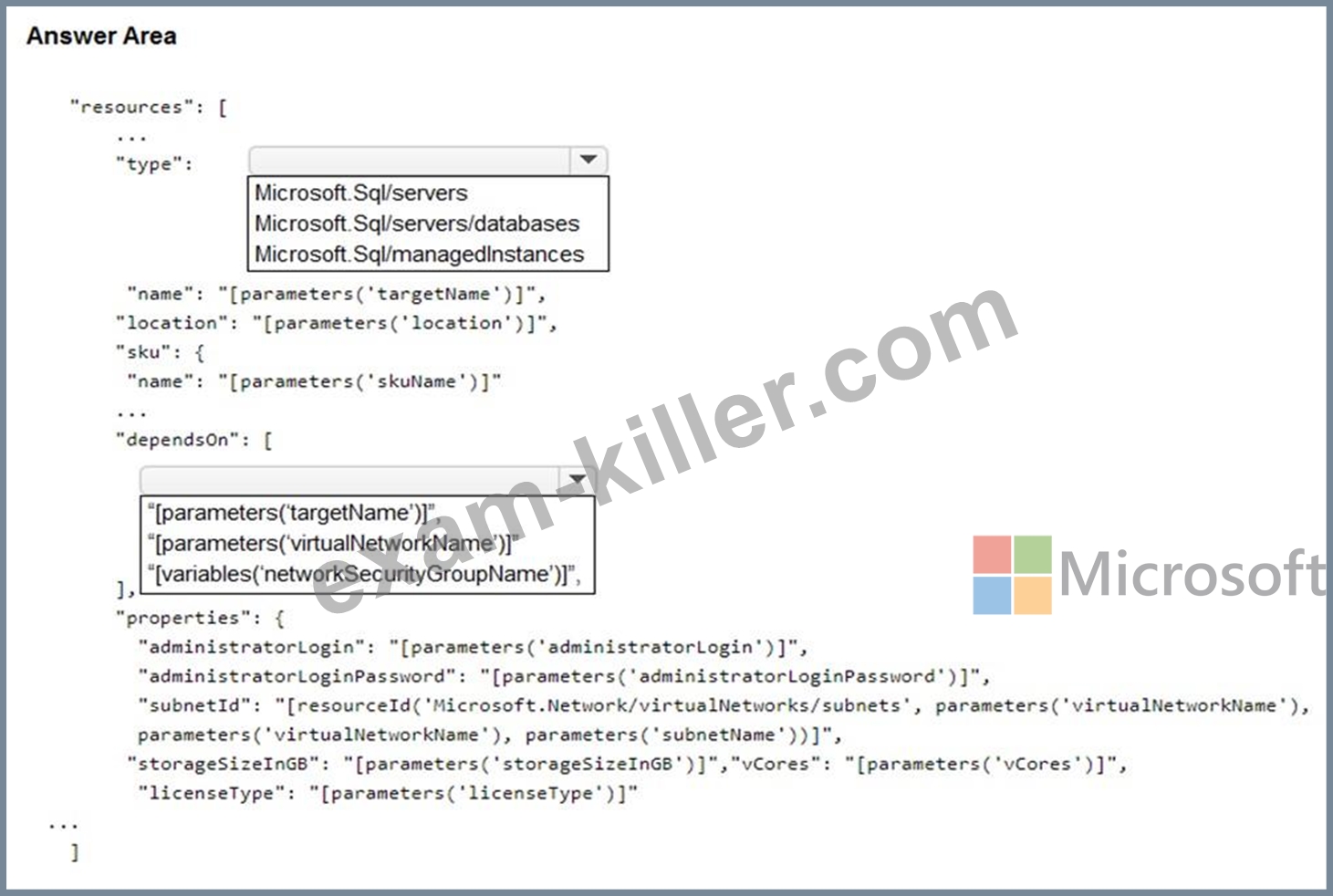
Answer:
Explanation: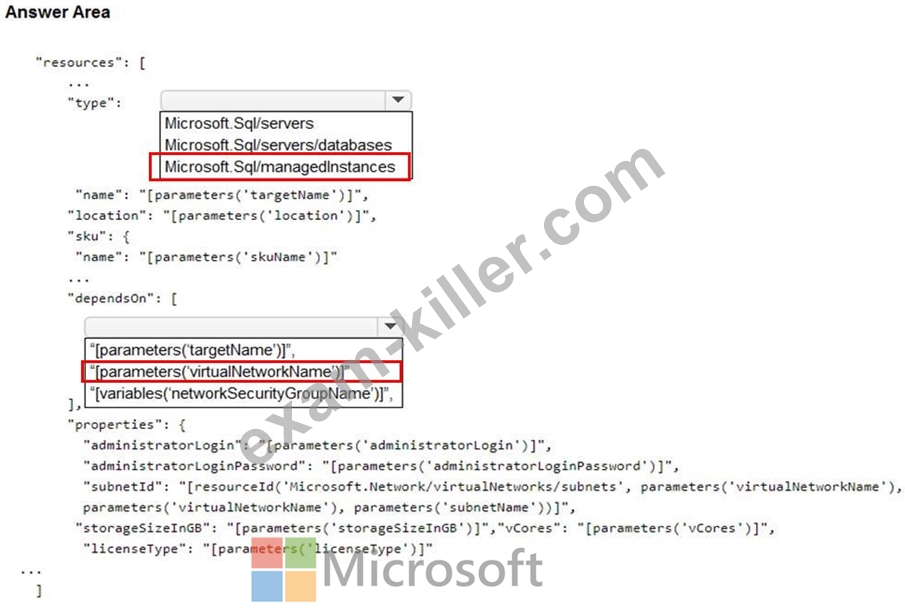
Reference:
https://docs.microsoft.com/en-us/azure/azure-sql/managed-instance/create-template-quickstart?tabs=azure-powershell
NEW QUESTION # 175
You have a database named db1.
The log for db1 contains the following entry.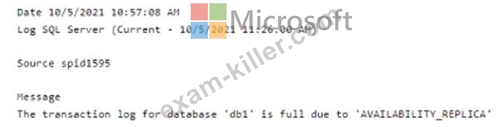
You need to ensure That db1 can process transactions.
Answer:
Explanation:
NEW QUESTION # 176
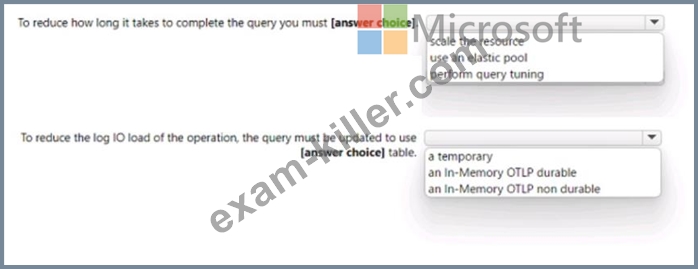
You have an Azure SQL database named that contains a table named Table1.
You run a query to bad data into Table1.
The performance Of Table1 during the load operation are shown in exhibit.
Answer:
Explanation: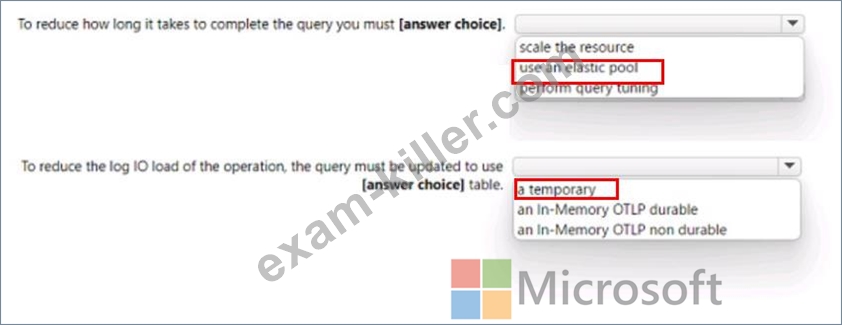
NEW QUESTION # 177
You plan to migrate on-premises Microsoft SQL Server databases to Azure.
You need to identify which deployment and resiliency options meet the following requirements:
Support user-initiated backups.
Support multiple automatically replicated instances across Azure regions.
Minimize administrative effort to implement and maintain business continuity.
What should you identify? To answer, select the appropriate options in the answer area.
NOTE: Each correct selection is worth one point.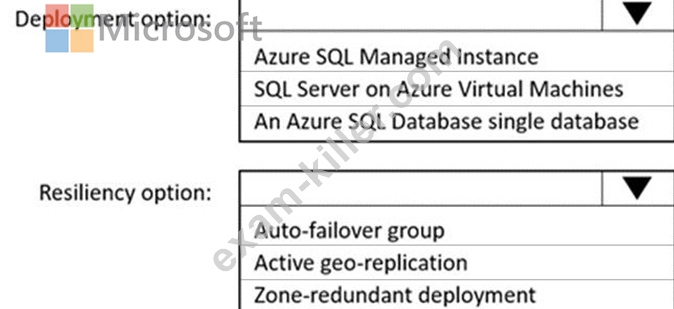
Answer:
Explanation: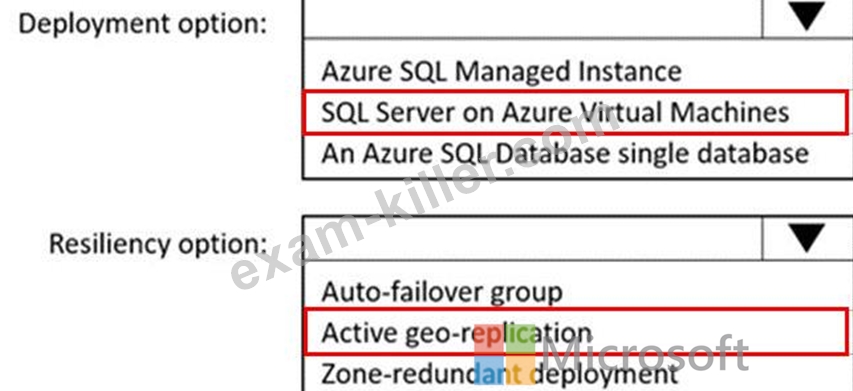
Reference:
https://docs.microsoft.com/en-us/azure/azure-sql/virtual-machines/windows/sql-server-on-azure-vm-iaas-what-is-overview
https://docs.microsoft.com/en-us/dotnet/architecture/cloud-native/infrastructure-resiliency-azure
NEW QUESTION # 178
Your on-premises network contains a Microsoft SQL Server 2016 server that hosts a database named db1.
You have an Azure subscription.
You plan to migrate db1 to an Azure SQL managed instance.
You need to create the SQL managed instance. The solution must minimize the disk latency of the instance.
Which service tier should you use?
- A. General Purpose
- B. Business Critical
- C. Hyperscale
- D. Premium
Answer: C
NEW QUESTION # 179
You have an Azure Active Directory (Azure AD) tenant named contoso.com that contains a user named [email protected] and an Azure SQL managed instance named SQLMI1.
You need to ensure that [email protected] can create logins in SQLMI1 that map to Azure AD service principals.
Which three actions should you perform in sequence? To answer, move the appropriate actions from the list of actions to the answer area and arrange them in the correct order.
Answer:
Explanation: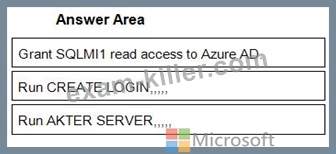
1 - Grant SQLMI1 read access to Azure AD.
2 - Run CREATE LOGIN,,,,,
3 - Run AKTER SERVER,,,,,
Reference:
https://docs.microsoft.com/en-us/azure/azure-sql/managed-instance/aad-security-configure-tutorial
NEW QUESTION # 180
Which audit log destination should you use to meet the monitoring requirements?
- A. Azure Storage
- B. Azure Log Analytics
- C. Azure Event Hubs
Answer: B
Explanation:
Explanation
Scenario: Use a single dashboard to review security and audit data for all the PaaS databases.
With dashboards can bring together operational data that is most important to IT across all your Azure resources, including telemetry from Azure Log Analytics.
Note: Auditing for Azure SQL Database and Azure Synapse Analytics tracks database events and writes them to an audit log in your Azure storage account, Log Analytics workspace, or Event Hubs.
Reference:
https://docs.microsoft.com/en-us/azure/azure-monitor/visualize/tutorial-logs-dashboards
Topic 2, Litware
Existing Environment
Network Environment
The manufacturing and research datacenters connect to the primary datacenter by using a VPN.
The primary datacenter has an ExpressRoute connection that uses both Microsoft peering and private peering.
The private peering connects to an Azure virtual network named HubVNet.
Identity Environment
Litware has a hybrid Azure Active Directory (Azure AD) deployment that uses a domain named litwareinc.com. All Azure subscriptions are associated to the litwareinc.com Azure AD tenant.
Database Environment
The sales department has the following database workload:
An on-premises named SERVER1 hosts an instance of Microsoft SQL Server 2012 and two 1-TB databases.
A logical server named SalesSrv01A contains a geo-replicated Azure SQL database named SalesSQLDb1. SalesSQLDb1 is in an elastic pool named SalesSQLDb1Pool. SalesSQLDb1 uses database firewall rules and contained database users.
An application named SalesSQLDb1App1 uses SalesSQLDb1.
The manufacturing office contains two on-premises SQL Server 2016 servers named SERVER2 and SERVER3. The servers are nodes in the same Always On availability group. The availability group contains a database named ManufacturingSQLDb1 Database administrators have two Azure virtual machines in HubVnet named VM1 and VM2 that run Windows Server 2019 and are used to manage all the Azure databases.
Licensing Agreement
Litware is a Microsoft Volume Licensing customer that has License Mobility through Software Assurance.
Current Problems
SalesSQLDb1 experiences performance issues that are likely due to out-of-date statistics and frequent blocking queries.
Requirements
Planned Changes
Litware plans to implement the following changes:
Implement 30 new databases in Azure, which will be used by time-sensitive manufacturing apps that have varying usage patterns. Each database will be approximately 20 GB.
Create a new Azure SQL database named ResearchDB1 on a logical server named ResearchSrv01.
ResearchDB1 will contain Personally Identifiable Information (PII) data.
Develop an app named ResearchApp1 that will be used by the research department to populate and access ResearchDB1.
Migrate ManufacturingSQLDb1 to the Azure virtual machine platform.
Migrate the SERVER1 databases to the Azure SQL Database platform.
Technical Requirements
Litware identifies the following technical requirements:
Maintenance tasks must be automated.
The 30 new databases must scale automatically.
The use of an on-premises infrastructure must be minimized.
Azure Hybrid Use Benefits must be leveraged for Azure SQL Database deployments.
All SQL Server and Azure SQL Database metrics related to CPU and storage usage and limits must be analyzed by using Azure built-in functionality.
Security and Compliance Requirements
Litware identifies the following security and compliance requirements:
Store encryption keys in Azure Key Vault.
Retain backups of the PII data for two months.
Encrypt the PII data at rest, in transit, and in use.
Use the principle of least privilege whenever possible.
Authenticate database users by using Active Directory credentials.
Protect Azure SQL Database instances by using database-level firewall rules.
Ensure that all databases hosted in Azure are accessible from VM1 and VM2 without relying on public endpoints.
Business Requirements
Litware identifies the following business requirements:
Meet an SLA of 99.99% availability for all Azure deployments.
Minimize downtime during the migration of the SERVER1 databases.
Use the Azure Hybrid Use Benefits when migrating workloads to Azure.
Once all requirements are met, minimize costs whenever possible.
NEW QUESTION # 181
You have an Azure subscription that contains a group named Group1 and an Azure SQL managed instance that hosts a database named 081. You need to ensure that Group 1 has read access to new tables created m 06I The solution must use the principle of least privilege How should you complete the Transact-SQL statement' To answer, select the appropriate options in the answer area. NOTE: Each correct selection is worth one point.
Answer:
Explanation:
Explanation
NEW QUESTION # 182
You have SQL Server on an Azure virtual machine.
You need to use Policy-Based Management in Microsoft SQL Server to identify stored procedures that do not comply with your naming conventions.
Which three actions should you perform in sequence? To answer, move the appropriate actions from the list of actions to the answer area and arrange them in the correct order.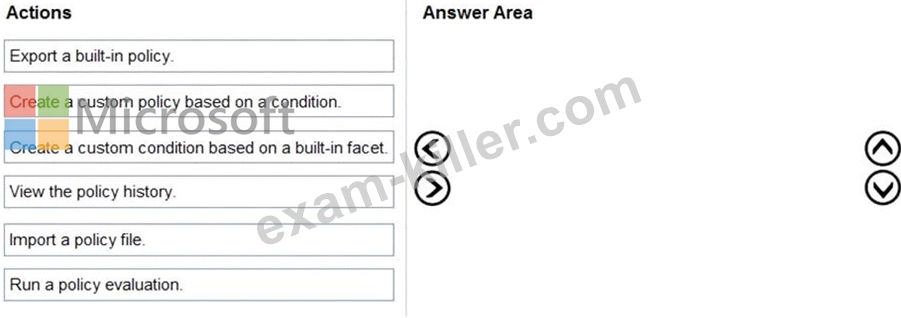
Answer:
Explanation: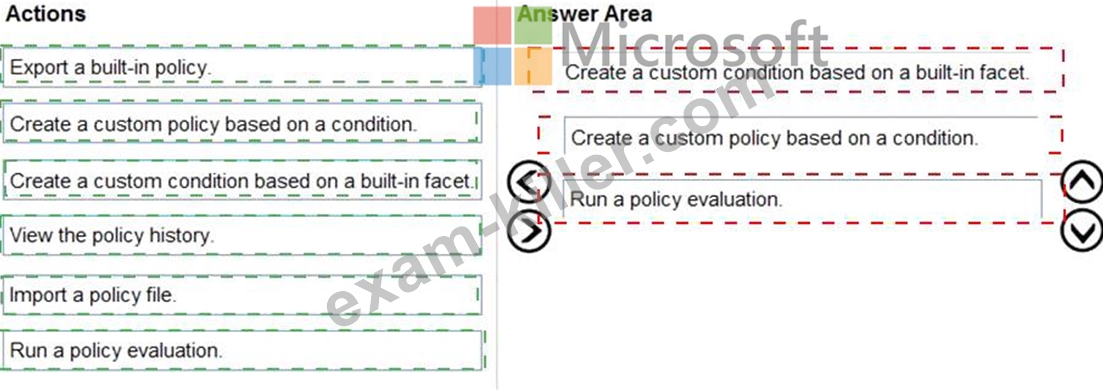
Explanation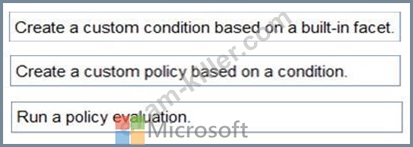
Text Description automatically generated
Reference:
https://www.mssqltips.com/sqlservertip/2298/enforce-sql-server-database-naming-conventions-using-policy-base
NEW QUESTION # 183
Your company analyzes images from security cameras and sends alerts to security teams that respond to unusual activity. The solution uses Azure Databricks.
You need to send Apache Spark level events, Spark Structured Streaming metrics, and application metrics to Azure Monitor.
Which three actions should you perform in sequence? To answer, move the appropriate actions from the list of actions in the answer area and arrange them in the correct order.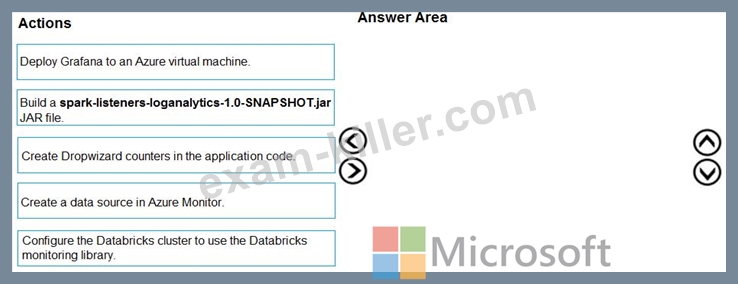
Answer:
Explanation: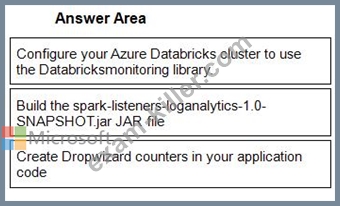
1 - Configure your Azure Databricks cluster to use the Databricksmonitoring library.
2 - Build the spark-listeners-loganalytics-1.0-SNAPSHOT.jar JAR file
3 - Create Dropwizard counters in your application code
NEW QUESTION # 184
You are building a database backup solution for a SQL Server database hosted on an Azure virtual machine.
In the event of an Azure regional outage, you need to be able to restore the database backups. The solution
must minimize costs.
Which type of storage accounts should you use for the backups?
- A. geo-redundant storage
- B. zone-redundant storage (ZRS)
- C. locally-redundant storage (LRS)
- D. read-access geo-redundant storage (RA-GRS)
Answer: D
Explanation:
Section: [none]
Explanation:
Geo-redundant storage (with GRS or GZRS) replicates your data to another physical location in the secondary
region to protect against regional outages. However, that data is available to be read only if the customer or
Microsoft initiates a failover from the primary to secondary region. When you enable read access to the
secondary region, your data is available to be read if the primary region becomes unavailable. For read access
to the secondary region, enable read-access geo-redundant storage (RA-GRS) or read-access geo-zone-
redundant storage (RA-GZRS).
Incorrect Answers:
A: Locally redundant storage (LRS) copies your data synchronously three times within a single physical location
in the primary region. LRS is the least expensive replication option, but is not recommended for applications
requiring high availability.
C: Zone-redundant storage (ZRS) copies your data synchronously across three Azure availability zones in the
primary region.
D: Geo-redundant storage (with GRS or GZRS) replicates your data to another physical location in the
secondary region to protect against regional outages. However, that data is available to be read only if the
customer or Microsoft initiates a failover from the primary to secondary region.
Reference:
https://docs.microsoft.com/en-us/azure/storage/common/storage-redundancy
NEW QUESTION # 185
......
Download Free Latest Exam DP-300 Certified Sample Questions: https://www.exam-killer.com/DP-300-valid-questions.html
Prepare for your exam certification with our DP-300 Certified Microsoft: https://drive.google.com/open?id=1DhtuvFhmGrPLkFyozqM9I8G9faaVGI5s
