

DP-300 Exam Dumps Pass with Updated 2025 Certified Exam Questions
DP-300 Exam Questions - Real & Updated Questions PDF
NEW QUESTION # 25
You are provisioning an Azure SQL database in the Azure portal as shown in the following exhibit.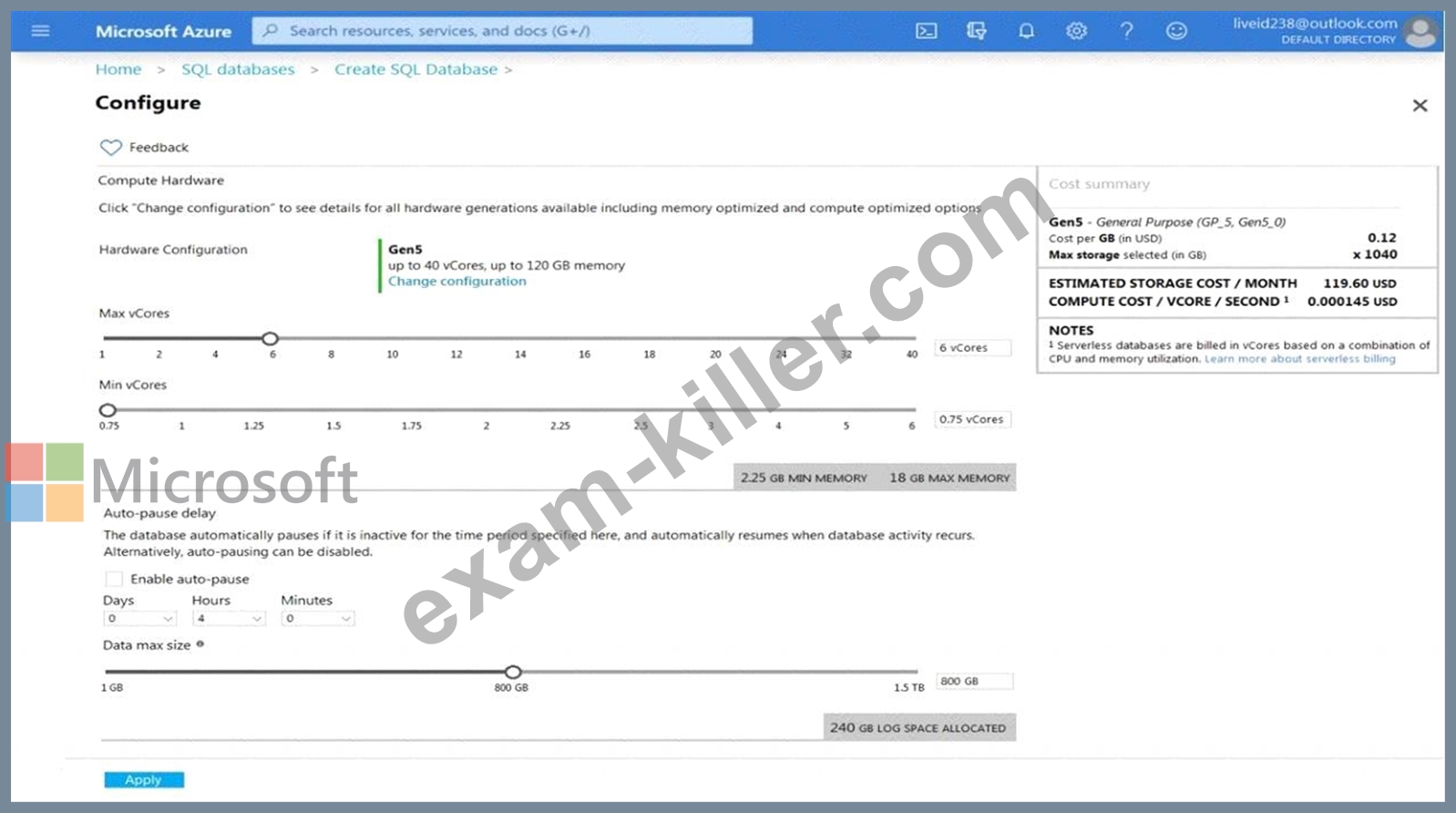
Use the drop-down menus to select the answer choice that completes each statement based on the information presented in the graphic.
NOTE:Each correct selection is worth one point.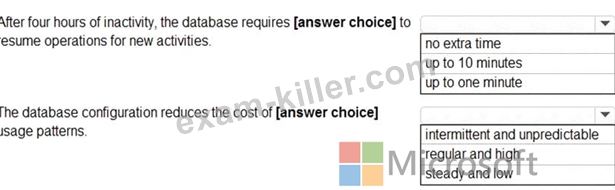
Answer:
Explanation: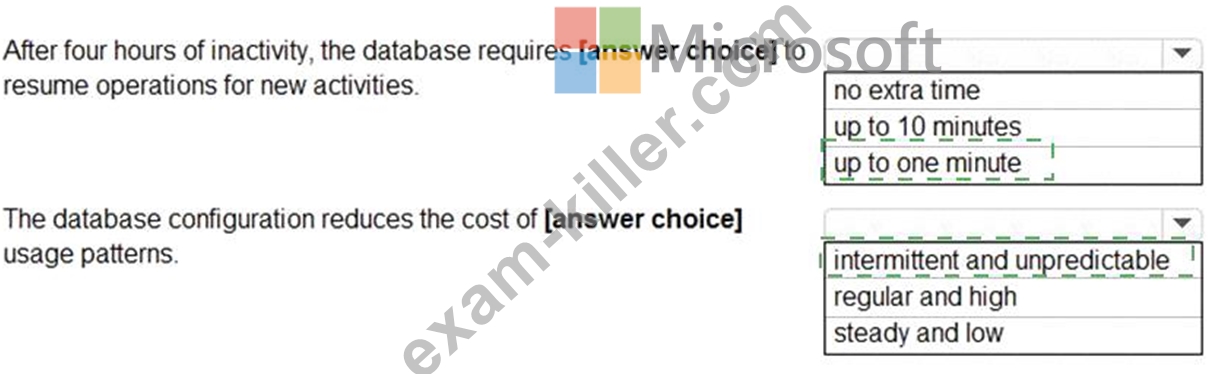
Explanation
Graphical user interface, text, application, email Description automatically generated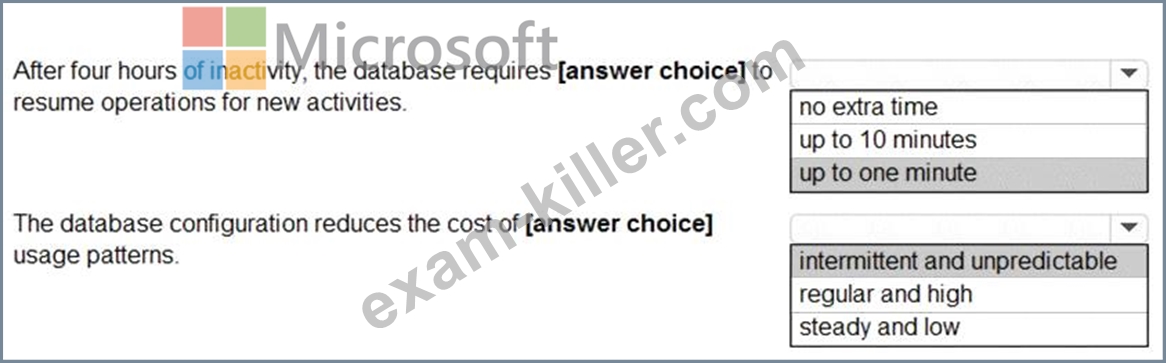
Reference:
https://docs.microsoft.com/en-us/azure/azure-sql/database/serverless-tier-overview
NEW QUESTION # 26
You deploy a database to an Azure SQL Database managed instance.
You need to prevent read queries from blocking queries that are trying to write to the database.
Which database option should set?
- A. READ_COMMITTED_SNAPSHOT to ON
- B. PARAMETERIZATION to SIMPLE
- C. Delayed Durability to Forced
- D. PARAMETERIZATION to FORCED
Answer: A
Explanation:
Explanation
In SQL Server, you can also minimize locking contention while protecting transactions from dirty reads of uncommitted data modifications using either:
* The READ COMMITTED isolation level with the READ_COMMITTED_SNAPSHOT database option set to ON.
* The SNAPSHOT isolation level.
If READ_COMMITTED_SNAPSHOT is set to ON (the default on SQL Azure Database), the Database Engine uses row versioning to present each statement with a transactionally consistent snapshot of the data as it existed at the start of the statement. Locks are not used to protect the data from updates by other transactions.
Reference:
https://docs.microsoft.com/en-us/sql/t-sql/statements/set-transaction-isolation-level-transact-sql
NEW QUESTION # 27
You have 10 Azure virtual machines that have SQL Server installed.
You need to implement a backup strategy to ensure that you can restore specific databases to other SQL
Server instances. The solution must provide centralized management of the backups.
What should you include in the backup strategy?
- A. SQL Server Agent jobs
- B. Azure Backup
- C. Azure Site Recovery
- D. Automated Backup in the SQL virtual machine settings
Answer: B
Explanation:
Section: [none]
Explanation:
Azure Backup provides an Enterprise class backup capability for SQL Server on Azure VMs. All backups are
stored and managed in a Recovery Services vault. There are several advantages that this solution provides,
especially for Enterprises.
Reference:
https://docs.microsoft.com/en-us/azure/azure-sql/virtual-machines/windows/backup-restore#azbackup
NEW QUESTION # 28
You have a SQL Server on Azure Virtual Machines instance that hosts a 10-TB SQL database named DB1.
You need to identify and repair any physical or logical corruption in DB1. The solution must meet the following requirements:
* Minimize how long it takes to complete the procedure.
* Minimize data loss.
How should you complete the command? To answer, select the appropriate options in the answer area NOTE:
Each correct selection is worth one point.
Answer:
Explanation:
Explanation:
NEW QUESTION # 29
You have a Microsoft SQL Server 2019 database named DB1 that uses the following database-level and instance-level features.
* Clustered columnstore indexes
* Automatic tuning
* Change tracking
* PolyBase
You plan to migrate DB1 to an Azure SQL database.
What feature should be removed or replaced before DB1 can be migrated?
- A. PolyBase
- B. Clustered columnstore indexes
- C. Automatic tuning
- D. Change tracking
Answer: A
Explanation:
This table lists the key features for PolyBase and the products in which they're available.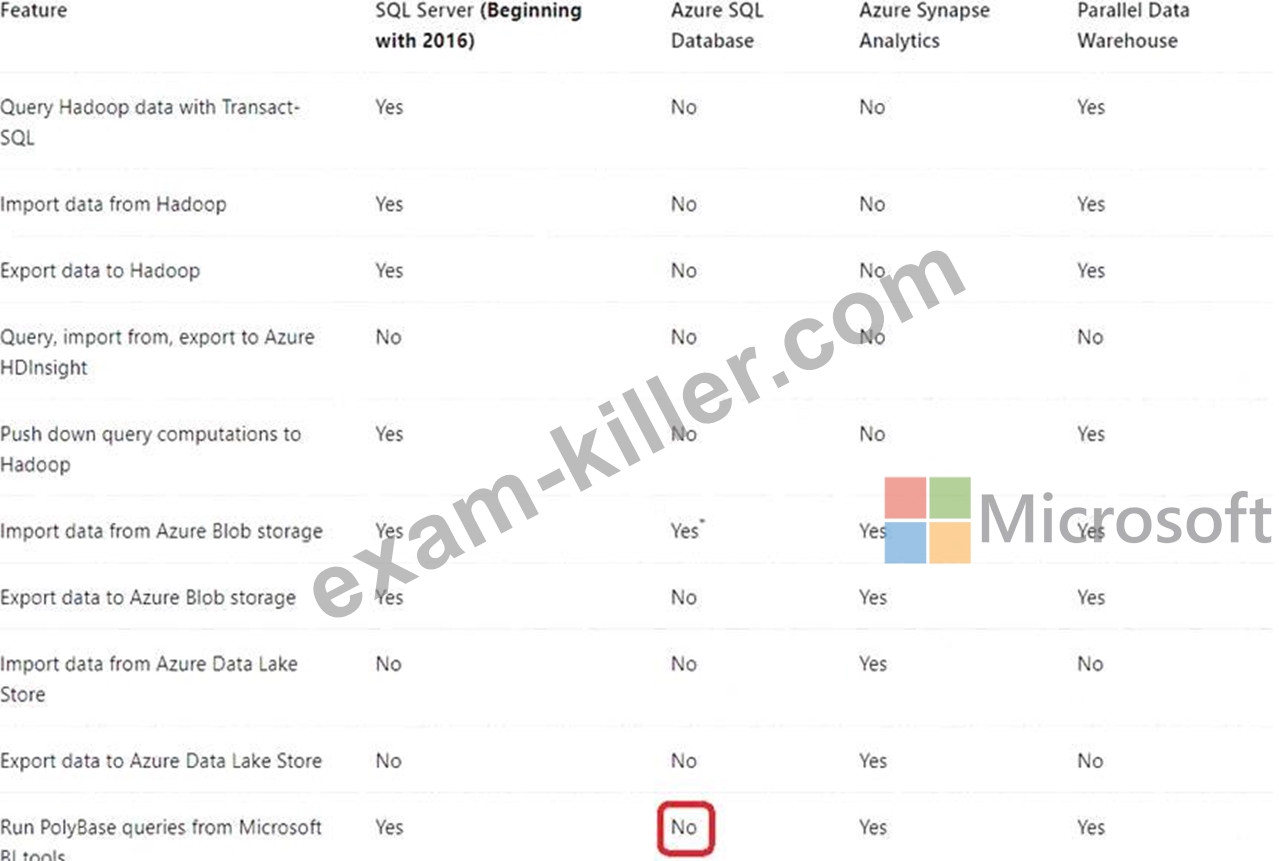
Reference:
https://docs.microsoft.com/en-us/sql/relational-databases/polybase/polybase-versioned-feature-summary
NEW QUESTION # 30
You have an Azure SQL database named DB1 in the General Purpose service tier.
You need to monitor D81 by using SQL insights.
What should you include in the solution? To answer, select the appropriate options in the answer area.
NOTE: Each correct selection is worth one point.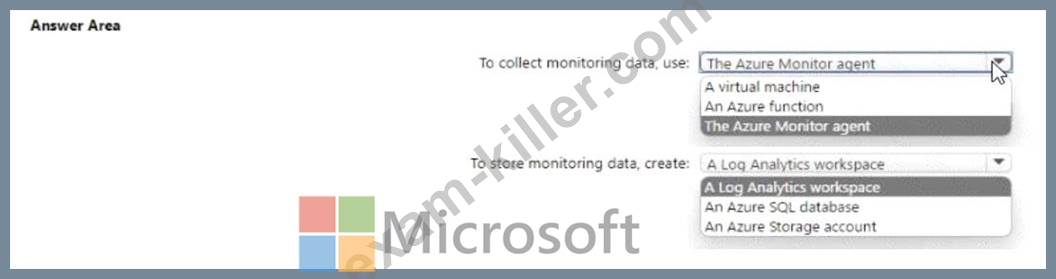
Answer:
Explanation: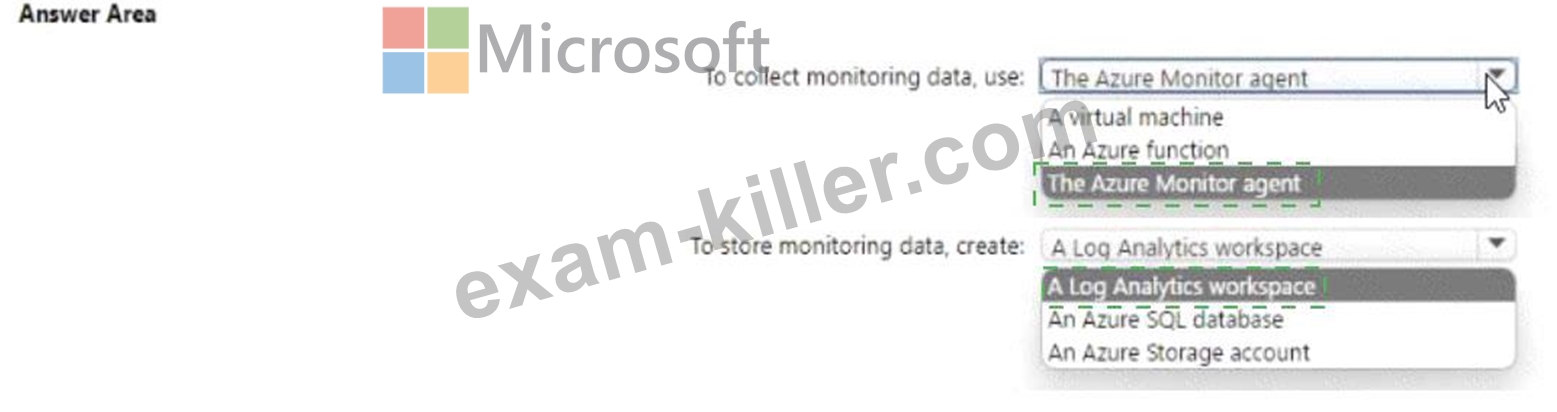
Explanation
NEW QUESTION # 31
You have an Azure SQL database named D61.
You need to identify how much unused space in megabytes was allocated to DB1.
How should you complete the Transact-SQL query? To answer select the appropriate options m the answer area.
NOTE: Each correct selection is worth one point.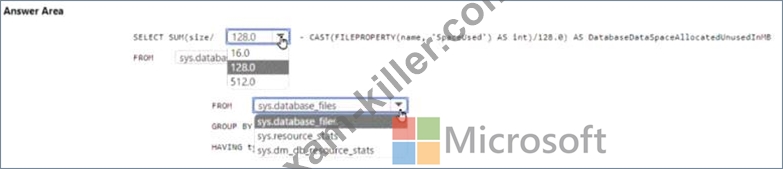
Answer:
Explanation: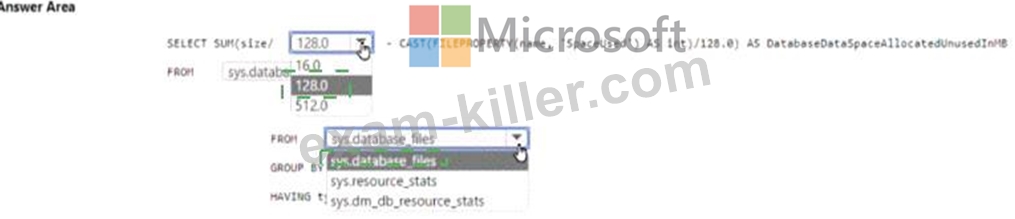
Explanation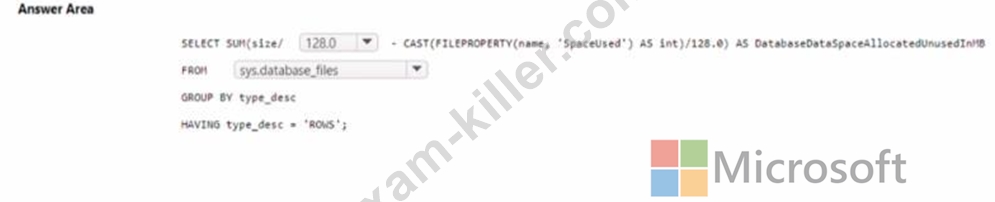
NEW QUESTION # 32
You have two on-premises servers that run Windows Server 2019 and host a Microsoft SQL Server 2017 Always On availability group named AG1. AG1 contains a single database named DB1.
You have an Azure subscription. The subscription contains a virtual machine named VM1 that runs Linux.
You need to migrate DB1 to a SQL Server 2019 instance on VM1. The solution must minimize the downtime of DB1 during the migration.
What should you do? To answer, select the appropriate options in the answer area.
NOTE: Each correct selection is worth one point.
Answer:
Explanation:
Answer as in image below.
NEW QUESTION # 33
You need to trigger an Azure Data Factory pipeline when a file arrives in an Azure Data Lake Storage Gen2 container.
Which resource provider should you enable?
- A. Microsoft.Automation
- B. Microsoft.Sql
- C. Microsoft.EventHub
- D. Microsoft.EventGrid
Answer: D
Explanation:
Section: [none]
Explanation:
Event-driven architecture (EDA) is a common data integration pattern that involves production, detection, consumption, and reaction to events. Data integration scenarios often require Data Factory customers to trigger pipelines based on events happening in storage account, such as the arrival or deletion of a file in Azure Blob Storage account. Data Factory natively integrates with Azure Event Grid, which lets you trigger pipelines on such events.
Reference:
https://docs.microsoft.com/en-us/azure/data-factory/how-to-create-event-trigger
NEW QUESTION # 34
You have an Azure subscription.
You plan to deploy an Azure SQL database by using an Azure Resource Manager template.
How should you complete the template? To answer, select the appropriate options in the answer area.
NOTE: Each correct selection is worth one point.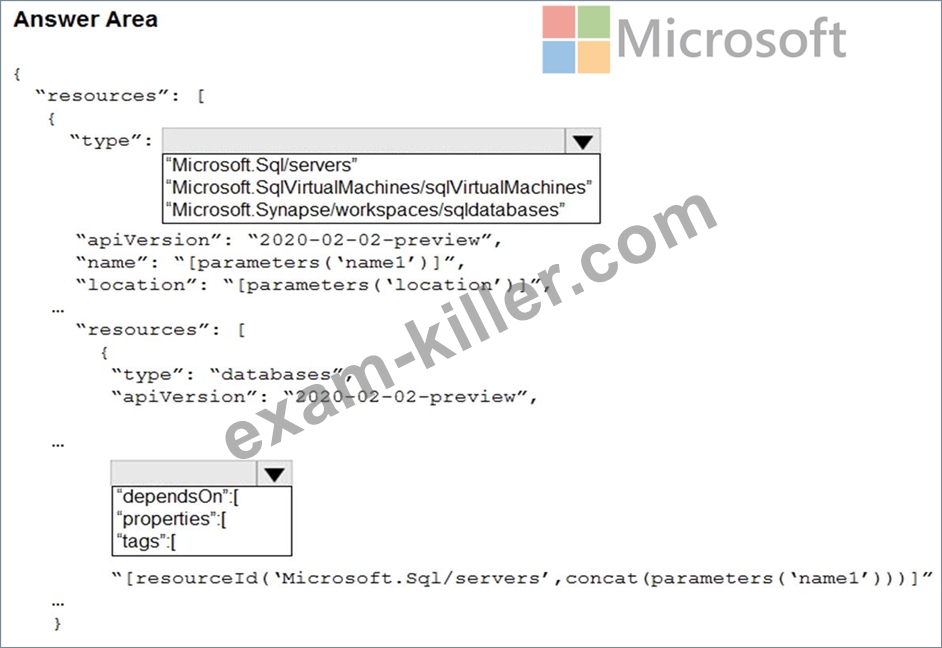
Answer:
Explanation: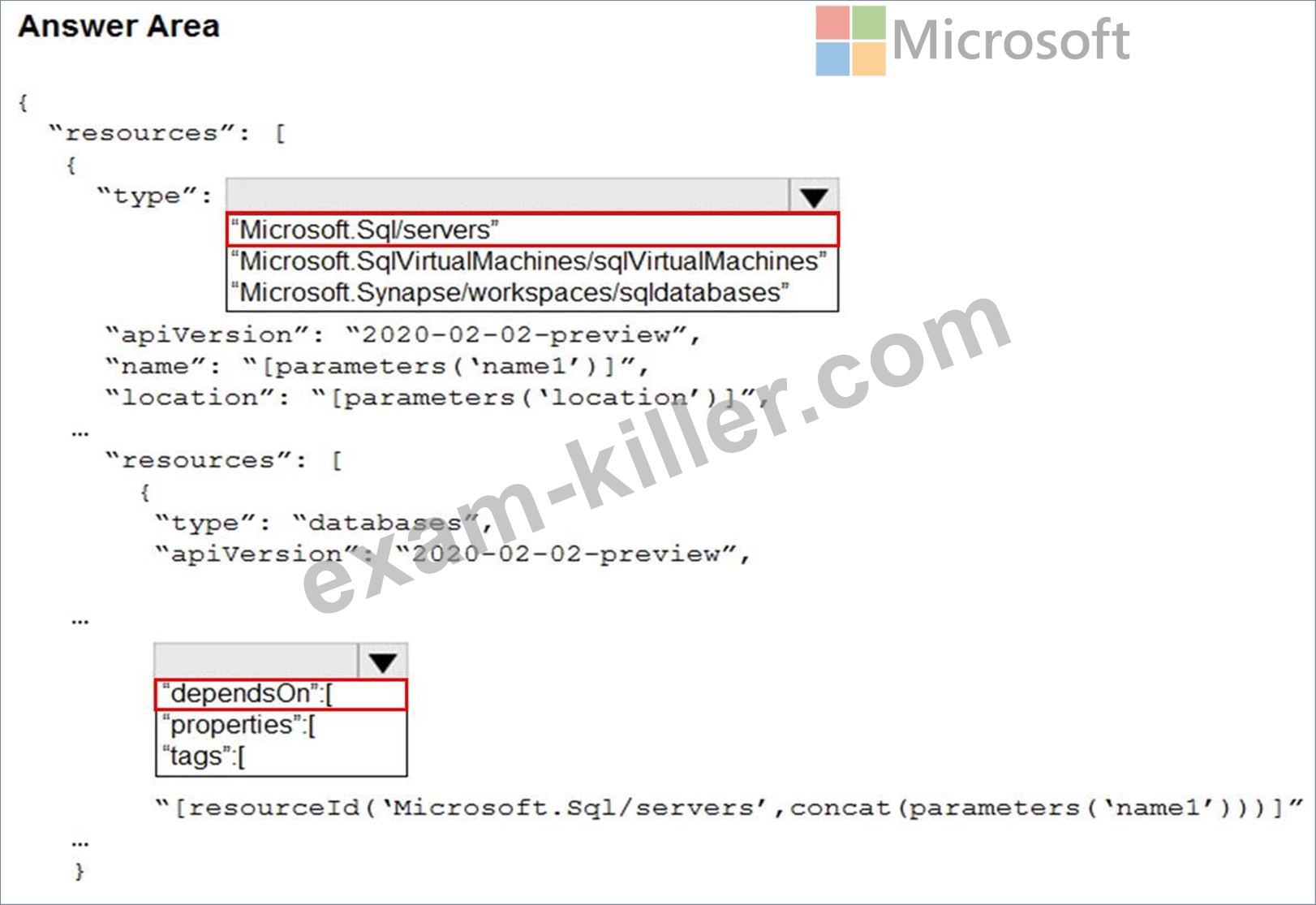
Reference:
https://docs.microsoft.com/en-us/azure/azure-sql/database/single-database-create-arm-template-quickstart
NEW QUESTION # 35
You are monitoring an Azure Stream Analytics job.
You discover that the Backlogged input Events metric is increasing slowly and is consistently non-zero.
You need to ensure that the job can handle all the events.
What should you do?
- A. Remove any named consumer groups from the connection and use $default.
- B. Create an additional output stream for the existing input stream.
- C. Change the compatibility level of the Stream Analytics job.
- D. Increase the number of streaming units (SUs).
Answer: D
Explanation:
Section: [none]
Explanation:
Backlogged Input Events: Number of input events that are backlogged. A non-zero value for this metric implies that your job isn't able to keep up with the number of incoming events. If this value is slowly increasing or consistently non-zero, you should scale out your job, by increasing the SUs.
Reference:
https://docs.microsoft.com/en-us/azure/stream-analytics/stream-analytics-monitoring
NEW QUESTION # 36
You have an Azure subscription that contains the resources shown in the following table.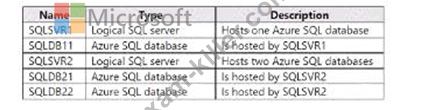
You plan louse SQLDB11 as an elastic job database to run jobs on SQlDb11 andSOtDB22. What is the minimum number of database scoped credentials required tor the elastic jobs?
- A. 0
- B. 1
- C. 2
- D. 3
Answer: D
NEW QUESTION # 37
You have SQL Server on an Azure virtual machine that contains a database named DB1.
The database reports a CHECKSUM error.
You need to recover the database.
How should you complete the statements? To answer, select the appropriate options in the answer area.
NOTE:Each correct selection is worth one point.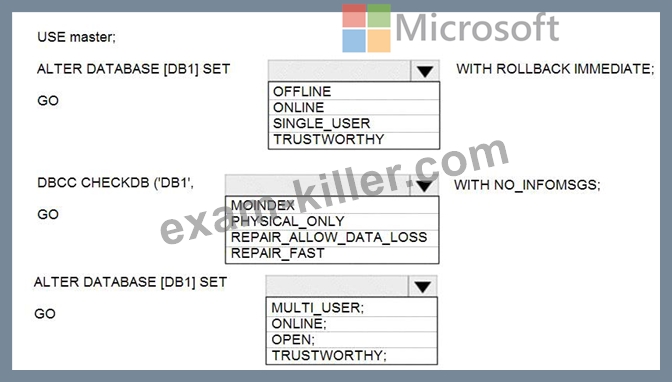
Answer:
Explanation: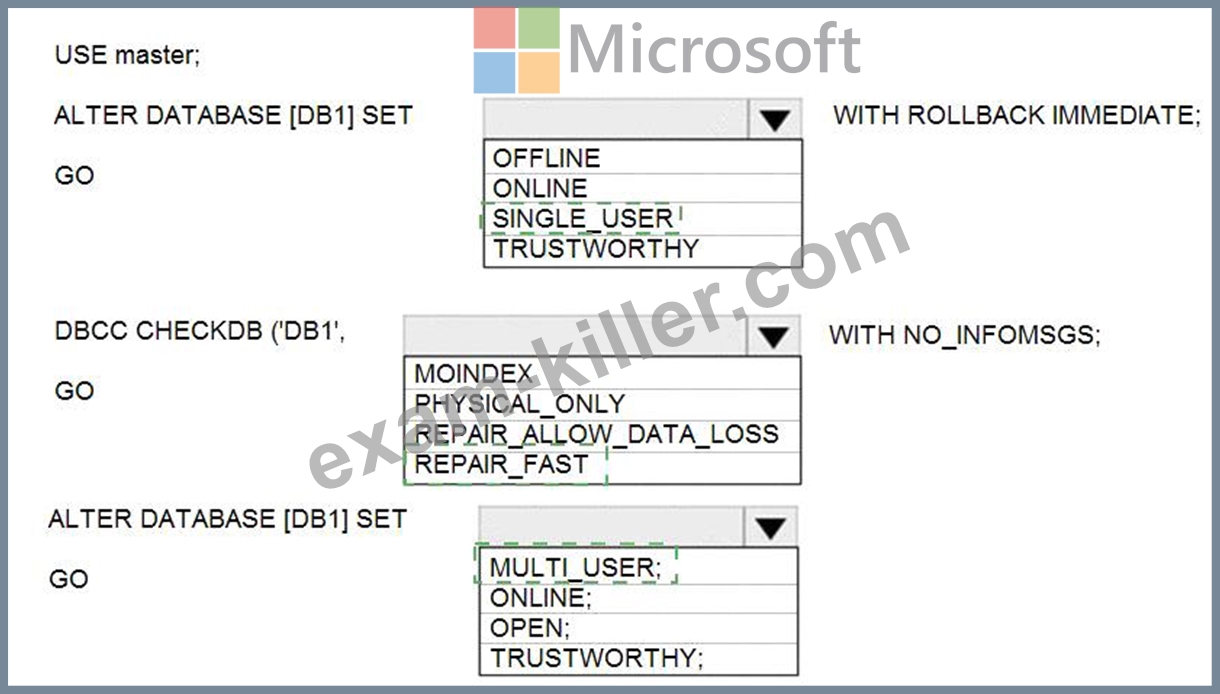
Explanation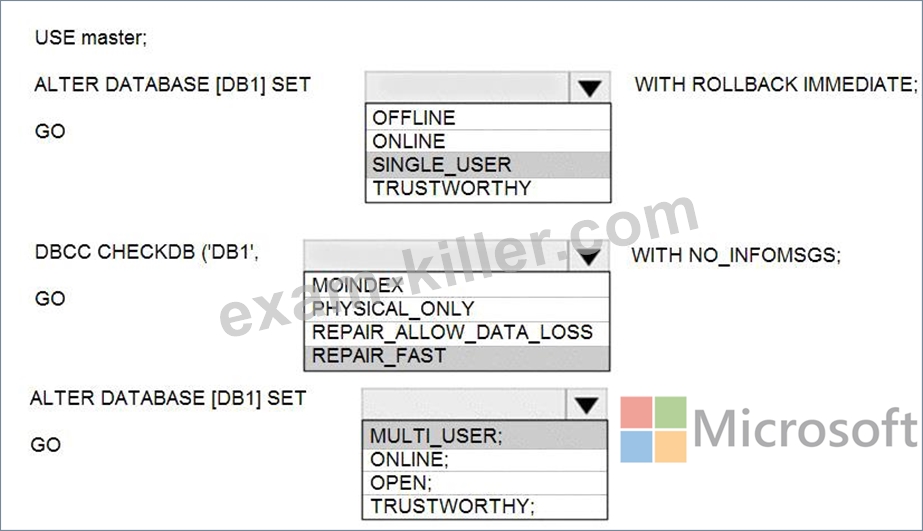
Box 1: SINGLE_USER
The specified database must be in single-user mode to use one of the following repair options.
Box 2: REPAIR_ALLOW_DATA_LOSS
REPAIR_ALLOW_DATA_LOSS tries to repair all reported errors. These repairs can cause some data loss.
Note: The REPAIR_ALLOW_DATA_LOSS option is a supported feature but it may not always be the best option for bringing a database to a physically consistent state. If successful, the REPAIR_ALLOW_DATA_LOSS option may result in some data loss. In fact, it may result in more data lost than if a user were to restore the database from the last known good backup.
Reference:
https://docs.microsoft.com/en-us/sql/t-sql/database-console-commands/dbcc-checkdb-transact-sql
NEW QUESTION # 38
Note: This question is part of a series of questions that present the same scenario. Each question in the series contains a unique solution that might meet the stated goals. Some question sets might have more than one correct solution, while others might not have a correct solution.
After you answer a question in this section, you will NOT be able to return to it. As a result, these questions will not appear in the review screen.
You have an Azure Data Lake Storage account that contains a staging zone.
You need to design a daily process to ingest incremental data from the staging zone, transform the data by executing an R script, and then insert the transformed data into a data warehouse in Azure Synapse Analytics.
Solution: You schedule an Azure Databricks job that executes an R notebook, and then inserts the data into the data warehouse.
Does this meet the goal?
- A. Yes
- B. No
Answer: B
Explanation:
Section: [none]
Explanation:
Must use an Azure Data Factory, not an Azure Databricks job.
Reference:
https://docs.microsoft.com/en-US/azure/data-factory/transform-data
NEW QUESTION # 39
You create a new Azure SQL managed instance named SQL1 and enable Database Mail extended stored You need to ensure that SQ Server Agent jobs running on SQL 1 can notify when a failure Occurs Which three actions should you perform in sequence 7 TO answer. move the appropriate actions from the list Of actions to answer area and arrange them in correct order.
Answer:
Explanation: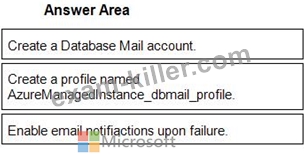
1 - Create a Database Mail account.
2 - Create a profile named AzureManagedInstance_dbmail_profile.
3 - Enable email notifiactions upon failure.
NEW QUESTION # 40
You plan to create a table in an Azure Synapse Analytics dedicated SQL pool.
Data in the table will be retained for five years. Once a year, data that is older than five years will be deleted.
You need to ensure that the data is distributed evenly across partitions. The solutions must minimize the amount of time required to delete old data.
How should you complete the Transact-SQL statement? To answer, drag the appropriate values to the correct targets. Each value may be used once, more than once, or not at all.
You may need to drag the split bar between panes or scroll to view content.
NOTE: Each correct selection is worth one point.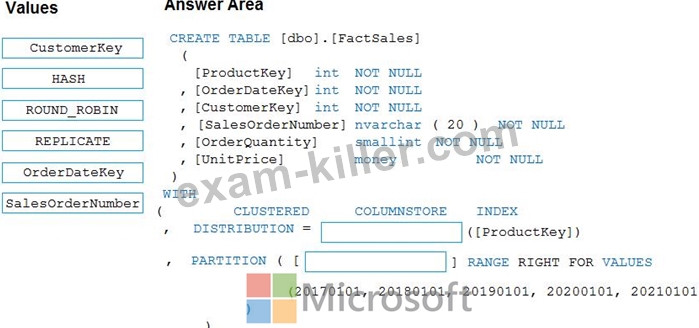
Answer:
Explanation: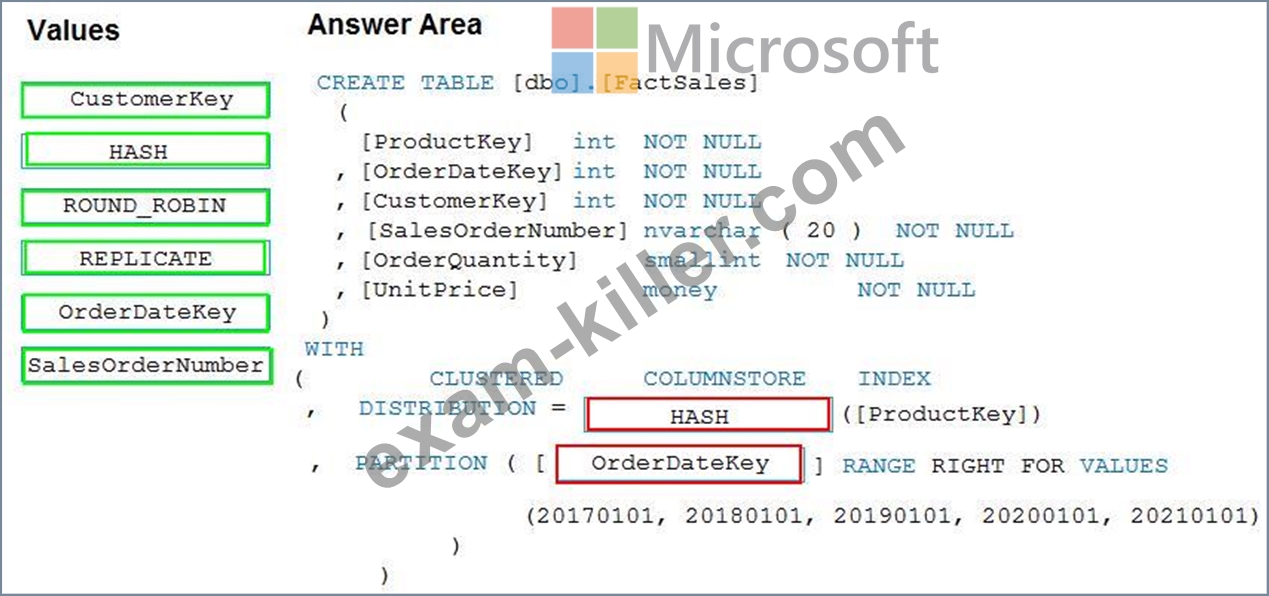
Reference:
https://docs.microsoft.com/en-us/sql/t-sql/statements/create-table-azure-sql-data-warehouse
https://docs.microsoft.com/en-us/azure/synapse-analytics/sql/best-practices-dedicated-sql-pool
NEW QUESTION # 41
You have an Azure Data Factory pipeline that is triggered hourly.
The pipeline has had 100% success for the past seven days.
The pipeline execution fails, and two retries that occur 15 minutes apart also fail. The third failure returns the following error.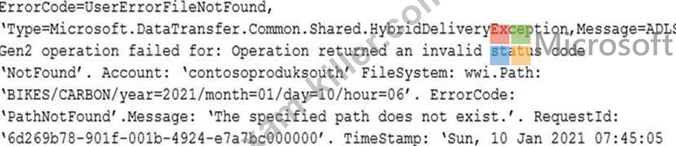
What is a possible cause of the error?
- A. The pipeline was triggered too early.
- B. From 06:00 to 07:00 on January 10, 2021, the file format of data in wwi/BIKES/CARBONwas incorrect.
- C. The parameter used to generate year=2021/month=01/day=10/hour=06was incorrect.
- D. From 06:00 to 07:00 on January 10, 2021, there was no data in wwi/BIKES/CARBON.
Answer: C
Explanation:
Section: [none]
Explanation:
A file is missing.
Testlet 1
Case study
This is a case study. Case studies are not timed separately. You can use as much exam time as you would like to complete each case. However, there may be additional case studies and sections on this exam.
You must manage your time to ensure that you are able to complete all questions included on this exam in the time provided.
To answer the questions included in a case study, you will need to reference information that is provided in the case study. Case studies might contain exhibits and other resources that provide more information about the scenario that is described in the case study. Each question is independent of the other questions in this case study.
At the end of this case study, a review screen will appear. This screen allows you to review your answers and to make changes before you move to the next section of the exam. After you begin a new section, you cannot return to this section.
To start the case study
To display the first question in this case study, click the Next button. Use the buttons in the left pane to explore the content of the case study before you answer the questions. Clicking these buttons displays information such as business requirements, existing environment, and problem statements. If the case study has an All Information tab, note that the information displayed is identical to the information displayed on the subsequent tabs. When you are ready to answer a question, click the Question button to return to the question.
Overview
Litware, Inc. is a renewable energy company that has a main office in Boston. The main office hosts a sales department and the primary datacenter for the company.
Physical Locations
Litware has a manufacturing office and a research office is separate locations near Boston. Each office has its own datacenter and internet connection.
Existing Environment
Network Environment
The manufacturing and research datacenters connect to the primary datacenter by using a VPN.
The primary datacenter has an ExpressRoute connection that uses both Microsoft peering and private peering.
The private peering connects to an Azure virtual network named HubVNet.
Identity Environment
Litware has a hybrid Azure Active Directory (Azure AD) deployment that uses a domain named litwareinc.com.
All Azure subscriptions are associated to the litwareinc.com Azure AD tenant.
Database Environment
The sales department has the following database workload:
* An on-premises named SERVER1 hosts an instance of Microsoft SQL Server 2012 and two 1-TB databases.
* A logical server named SalesSrv01A contains a geo-replicated Azure SQL database named SalesSQLDb1, SalesSQLDb1 is in an elastic pool named SalesSQLDb1Pool. SalesSQLDb1 uses database firewall rules and contained database users.
* An application named SalesSQLDb1App1 uses SalesSQLDb1.
The manufacturing office contains two on-premises SQL Server 2016 servers named SERVER2 and SERVER3. The servers are nodes in the same Always On availability group. The availability group contains a database named ManufacturingSQLDb1.
Database administrators have two Azure virtual machines in HubVnet named VM1 and VM2 that run Windows Server 2019 and are used to manage all the Azure databases.
Licensing Agreement
Litware is a Microsoft Volume Licensing customer that has License Mobility through Software Assurance.
Current Problems
Requirements
SalesSQLDb1 experiences performance issues that are likely due to out-of-date statistics and frequent blocking queries.
Planned Changes
Litware plans to implement the following changes:
* Implement 30 new databases in Azure, which will be used by time-sensitive manufacturing apps that have varying usage patterns. Each database will be approximately 20 GB.
* Create a new Azure SQL database named ResearchDB1 on a logical server named ResearchSrv01.
ResearchDB1 will contain Personally Identifiable Information (PII) data.
* Develop an app named ResearchApp1 that will be used by the research department to populate and access ResearchDB1.
* Migrate ManufacturingSQLDb1 to the Azure virtual machine platform.
* Migrate the SERVER1 databases to the Azure SQL Database platform.
Technical Requirements
Litware identifies the following technical requirements:
* Maintenance tasks must be automated.
* The 30 new databases must scale automatically.
* The use of an on-premises infrastructure must be minimized.
* Azure Hybrid Use Benefits must be leveraged for Azure SQL Database deployments.
* All SQL Server and Azure SQL Database metrics related to CPU and storage usage and limits must be analyzed by using Azure built-in functionality.
Security and Compliance Requirements
Litware identifies the following security and compliance requirements:
* Store encryption keys in Azure Key Vault.
* Retain backups of the PII data for two months.
* Encrypt the PII data at rest, in transit, and in use.
* Use the principle of least privilege whenever possible.
* Authenticate database users by using Active Directory credentials.
* Protect Azure SQL Database instances by using database-level firewall rules.
* Ensure that all databases hosted in Azure are accessible from VM1 and VM2 without relying on public endpoints.
Business Requirements
Litware identifies the following business requirements:
* Meet an SLA of 99.99% availability for all Azure deployments.
* Minimize downtime during the migration of the SERVER1 databases.
* Use the Azure Hybrid Use Benefits when migrating workloads to Azure.
* Once all requirements are met, minimize costs whenever possible.
NEW QUESTION # 42
......
Pass Guaranteed Quiz 2025 Realistic Verified Free Microsoft: https://www.exam-killer.com/DP-300-valid-questions.html
Free Microsoft Azure DP-300 Ultimate Study Guide: https://drive.google.com/open?id=1816tjQyO9b638p6zYmYxKCGMEQdsPUqG
