

Free OGEA-103 Exam Braindumps certification guide Q&A
OGEA-103 Certification Overview Latest OGEA-103 PDF Dumps
Preparing for the TOGAF Enterprise Architecture Combined Part 1 and Part 2 Certification Exam requires a solid understanding of the TOGAF framework, as well as practical experience in applying the framework. The Open Group offers a variety of resources to help candidates prepare for the exam, including study guides, training courses, and practice exams. Candidates should also have a good understanding of enterprise architecture principles, as well as experience in project management, business analysis, and IT architecture.
NEW QUESTION # 23
Complete the sentence. The key purpose of Gap Analysis is to _____
- A. validate nonfunctional requirements
- B. establish quality parameters for the architecture
- C. determine the required service levels for the architecture
- D. identify commercial building blocks to be purchased
- E. identify potential missing or overlapping functions
Answer: E
NEW QUESTION # 24
Complete the sentence Business Transformation Readiness Assessment is_________________.
- A. to ensure the active support of powerful stakeholders
- B. a joint effort between corporate staff lines of business and IT planners
- C. a way to put building blocks into context thereby supporting re-usable solutions
- D. widely used to validate an architecture that is being developed
Answer: B
Explanation:
Business Transformation Readiness Assessment is a joint effort between corporate staff lines of business and IT planners to evaluate the readiness of the organization to undergo change. It involves assessing factors such as vision, commitment, capacity, capability, culture, and motivation that may influence the success of a business transformation initiative. Reference: The TOGAF Standard | The Open Group Website, Section 3.3.2 Business Transformation Readiness Assessment.
NEW QUESTION # 25
What provides context for architecture work, by describing the needs and ways of working employed by the enterprise?
- A. Strategy and vision
- B. Architecture Contracts
- C. Stakeholder needs
- D. Business principles business goals, and business drivers
Answer: D
Explanation:
Business principles business goals, and business drivers provide context for architecture work, by describing the needs and ways of working employed by the enterprise. They define what the enterprise wants to achieve, how it wants to operate, and what factors influence its decisions and actions. Reference: The TOGAF Standard | The Open Group Website, Section 3.2 Preliminary Phase.
NEW QUESTION # 26
What are the four dimensions used to scope an architecture?
- A. Breadth Depth Time Period Architecture Domains
- B. Business Data Application Technology
- C. Strategy Portfolio Project Solution Delivery
- D. Strategy Segment Capability Budget
Answer: A
Explanation:
The four dimensions used to scope an architecture are Breadth, Depth, Time Period, and Architecture Domains. Breadth refers to the extent of the enterprise covered by the architecture. Depth refers to the level of detail and completeness of the architecture. Time Period refers to the planning horizon and the number of Transition Architectures required to achieve the Target Architecture. Architecture Domains refer to the four domains of Business, Data, Application, and Technology that constitute an enterprise's architecture. Reference: The TOGAF Standard | The Open Group Website, Section 3.2.1 Phase A: Architecture Vision.
NEW QUESTION # 27
Which statement best describes iteration and the ADM?
- A. The ADM is iterative, over the whole process between phases and within phases
- B. The ADM is sequential Iteration is applied within phases
- C. The ADM is iterative within the first cycle and then between phases
- D. The level of detail is defined once and applies to all iterations
Answer: A
Explanation:
This statement best describes iteration and the ADM. The ADM is iterative over the whole process between phases and within phases because it allows for feedback loops and refinements at any point in the architecture development and transition process. Iteration enables architects to address changing requirements, assumptions, constraints, and environments; to validate and improve architectures; to manage risks and issues; and to ensure stakeholder satisfaction and value realization. Reference: The TOGAF Standard | The Open Group Website, Section 3.1 Introduction to the ADM.
NEW QUESTION # 28
Complete the sentence The purpose of the Preliminary Phase is to_____________.
- A. architect an Enterprise Architecture Capability
- B. identify the stakeholders and their requirements
- C. define the enterprise strategy
- D. describe the target architecture
Answer: A
Explanation:
The purpose of the Preliminary Phase is to architect an Enterprise Architecture Capability that meets the needs and expectations of the enterprise's stakeholders and supports and enables subsequent phases of architecture development and transition. This phase involves defining the scope, principles, framework, and governance for the Enterprise Architecture Capability. Reference: The TOGAF Standard | The Open Group Website, Section 3.2 Preliminary Phase.
NEW QUESTION # 29
Which of the following are interests important to the stakeholders in a system?
- A. Principles
- B. Concerns
- C. Architecture views
- D. Requirements
Answer: B
Explanation:
Concerns are interests important to the stakeholders in a system. They are used to identify and classify the system's stakeholders and to guide the selection of viewpoints for the architecture description. Reference: The TOGAF Standard | The Open Group Website, Section 3.2.1 Architecture Viewpoints
NEW QUESTION # 30
Which of the following is included as part of Architecture Governance1?
- A. Managing Stakeholders and their requirements
- B. Interacting with the CxO level on Enterprise Architecture
- C. Creating and maintaining the Statement of Architecture Work though out the ADM cycle
- D. Ensuring compliance with internal and external standards and regulatory obligations
Answer: D
Explanation:
Ensuring compliance with internal and external standards and regulatory obligations is one of the activities included as part of Architecture Governance. Architecture Governance is the practice and orientation by which enterprise architectures and other architectures are managed and controlled at an enterprise-wide level. It involves establishing processes, roles, responsibilities, policies, and standards to ensure that architectures are aligned with the enterprise's strategy and objectives, and meet the quality and performance requirements. Reference: The TOGAF Standard | The Open Group Website, Section 3.3.6 Architecture Governance.
NEW QUESTION # 31
Refer to the table below: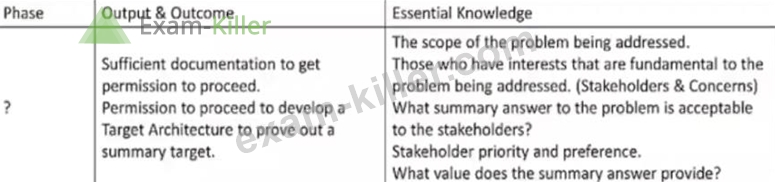
Which ADM Phase does this describe?
- A. Preliminary Phase
- B. Phase A
- C. Phase B
- D. Phase C
Answer: C
Explanation:
Phase B of the ADM cycle is the Business Architecture phase. It describes the development of a Business Architecture to support an agreed Architecture Vision. The objectives of this phase are to describe the baseline and target Business Architecture, identify candidate Architecture Roadmap components based on gaps between the baseline and target, and determine whether an incremental approach is required. Reference: The TOGAF Standard | The Open Group Website, Section 3.2.2 Phase B: Business Architecture.
NEW QUESTION # 32
Complete the following sentence. In the ADM documents which are under development and have not undergone any formal review and approval process are_______________.
- A. Known as ''Version 0.1''
- B. Invalid
- C. Called ''draft''
- D. In between phases
Answer: C
Explanation:
In the ADM documents which are under development and have not undergone any formal review and approval process are called "draft". This indicates that they are subject to change and refinement as the architecture development progresses. Reference: The TOGAF Standard | The Open Group Website, Section 4.2.5 Architecture Deliverables.
NEW QUESTION # 33
Consider the following statement:
According to the TOGAF Standard a governed approach of a particular deliverable will ensure a system of continuous monitoring to check integrity changes decision-making and audit of all architecture-related activities Which deliverable is being referred to?
- A. An Architecture Contract
- B. The Architecture Definition Document
- C. The Statement of Architecture Work
- D. The Architecture Vision
Answer: A
Explanation:
An Architecture Contract is a deliverable that specifies the responsibilities and obligations of the parties involved in the implementation and governance of an architecture. It ensures a system of continuous monitoring to check integrity changes decision-making and audit of all architecture-related activities. Reference: The TOGAF Standard | The Open Group Website, Section 3.3.4 Architecture Contracts.
NEW QUESTION # 34
Which of the following supports the need to govern Enterprise Architecture?
- A. The Architecture Project mandates the governance of the target architecture
- B. The TOGAF standard cannot be used without executive governance
- C. Best practice governance enables the organization to control value realization
- D. The Stakeholders preferences may go beyond the architecture project scope and needs control
Answer: C
Explanation:
This statement best supports the need to govern Enterprise Architecture. Best practice governance enables the organization to control value realization by ensuring that architectures are aligned with the enterprise's strategy and objectives, meet the quality and performance requirements, and deliver the expected benefits and outcomes. The Architecture Project does not mandate the governance of the target architecture, but rather follows the governance framework established by the enterprise. The TOGAF standard can be used without executive governance, but it is recommended that executive sponsorship and support are obtained for successful architecture development and transition. The Stakeholders preferences may go beyond the architecture project scope and need control, but this is not the primary reason for governing Enterprise Architecture. Reference: The TOGAF Standard | The Open Group Website, Section 3.3.6 Architecture Governance.
NEW QUESTION # 35
Complete the sentence The TOGAF standard covers the development of four architecture domains. Business. Data, Technology and__________________.
- A. Segment
- B. Transition
- C. Application
- D. Capability
Answer: C
Explanation:
The TOGAF standard covers the development of four architecture domains: Business, Data, Technology and Application. These domains represent different aspects of an enterprise's architecture and provide a consistent way of describing, analyzing, and designing them. Reference: The TOGAF Standard | The Open Group Website, Section 2.2 Architecture Development Method (ADM).
NEW QUESTION # 36
What is used lo structure architectural information in an orderly way so that it can be processed to meet stakeholder needs?
- A. Content Metamodel
- B. A Stakeholder Map
- C. An EA Library
- D. An Architecture Framework
Answer: D
Explanation:
An Architecture Framework is used to structure architectural information in an orderly way so that it can be processed to meet stakeholder needs. An Architecture Framework provides a common language and taxonomy for describing architectures; a set of tools and techniques for creating architectures; a method for defining views and viewpoints for different stakeholders; a metamodel for representing architecture artifacts; a repository for storing and managing architecture artifacts; and a governance framework for controlling architecture development and evolution. Reference: The TOGAF Standard | The Open Group Website, Section 2 Core Concepts.
NEW QUESTION # 37
What is presented as "striking a balance between positive and negative outcomes resulting from the realization of either opportunities or threats?
- A. Risk Management
- B. Agile development
- C. Architecture Security
- D. Transition Management
Answer: A
Explanation:
Risk Management is the process of identifying, assessing, and responding to risks that may affect the achievement of the enterprise's objectives. Risk Management involves balancing positive and negative outcomes resulting from the realization of either opportunities or threats. Reference: The TOGAF Standard | The Open Group Website, Section 3.3.3 Risk Management.
NEW QUESTION # 38
Complete the sentence The purpose of Enterprise Architecture is to_______________.
- A. guide effective change
- B. take major improvement decisions
- C. control the bigger changes
- D. govern the stakeholders
Answer: A
Explanation:
The purpose of Enterprise Architecture is to guide effective change by providing a coherent and consistent view of the enterprise's current and future state, as well as the roadmap and principles for achieving it. Enterprise Architecture helps to align business and IT strategies, optimize resources and investments, reduce complexity and risks, enhance agility and innovation, and deliver value to stakeholders. Reference: The TOGAF Standard | The Open Group Website, Section 1.3 Executive Overview.
NEW QUESTION # 39
Complete the following sentence:
Presenting different_________and_________to stakeholders helps architects to extract hidden agendas principles and requirements that could impact the final Target Architecture
- A. Solutions Applications
- B. Business Scenarios Business Models
- C. Alternatives Trade-offs
- D. Architecture Views Architecture Viewpoints
Answer: C
Explanation:
Presenting different alternatives and trade-offs to stakeholders helps architects to extract hidden agendas principles and requirements that could impact the final Target Architecture. Alternatives are different ways of achieving a desired outcome, while trade-offs are compromises or sacrifices that must be made to choose one alternative over another. Reference: The TOGAF Standard | The Open Group Website, Section 3.3.1 Business Scenarios.
NEW QUESTION # 40
......
The TOGAF Enterprise Architecture Combined Part 1 and Part 2 Certification Exam is a valuable certification for enterprise architects and other professionals involved in enterprise architecture initiatives. It demonstrates a candidate's knowledge and skills in applying the TOGAF framework to real-world scenarios, and is recognized globally as a standard for enterprise architecture. With the right preparation and experience, candidates can successfully pass the exam and earn this prestigious certification.
The Best The Open Group OGEA-103 Study Guides and Dumps of 2023: https://www.exam-killer.com/OGEA-103-valid-questions.html
Top The Open Group OGEA-103 Exam Audio Study Guide! Practice Questions Edition: https://drive.google.com/open?id=1bq1hm9nN5mF_THoqqhaFs9Iui2rw6mA9
