

[2026] Pass The Open Group OGEA-103 Exam Updated 136 Questions
Get 2026 Updated Free The Open Group OGEA-103 Exam Questions and Answer
The Open Group OGEA-103 certification exam is a valuable credential for professionals who want to demonstrate their expertise in enterprise architecture. OGEA-103 exam is designed to test learners' knowledge and understanding of the TOGAF framework, as well as their ability to apply it in real-world situations. TOGAF Enterprise Architecture Combined Part 1 and Part 2 Exam certification is recognized globally as a benchmark for excellence in enterprise architecture and can help professionals advance their careers in the field.
The Open Group OGEA-103 certification is ideal for professionals who are involved in enterprise architecture, such as architects, project managers, and IT leaders. It is also beneficial for individuals who want to enhance their career prospects and demonstrate their proficiency in enterprise architecture. TOGAF Enterprise Architecture Combined Part 1 and Part 2 Exam certification is recognized globally and is highly valued by employers in various industries. Passing the OGEA-103 exam requires a deep understanding of the TOGAF framework, and successful candidates are equipped with the skills and knowledge to develop and implement effective enterprise architecture strategies.
NEW QUESTION # 25
Exhibit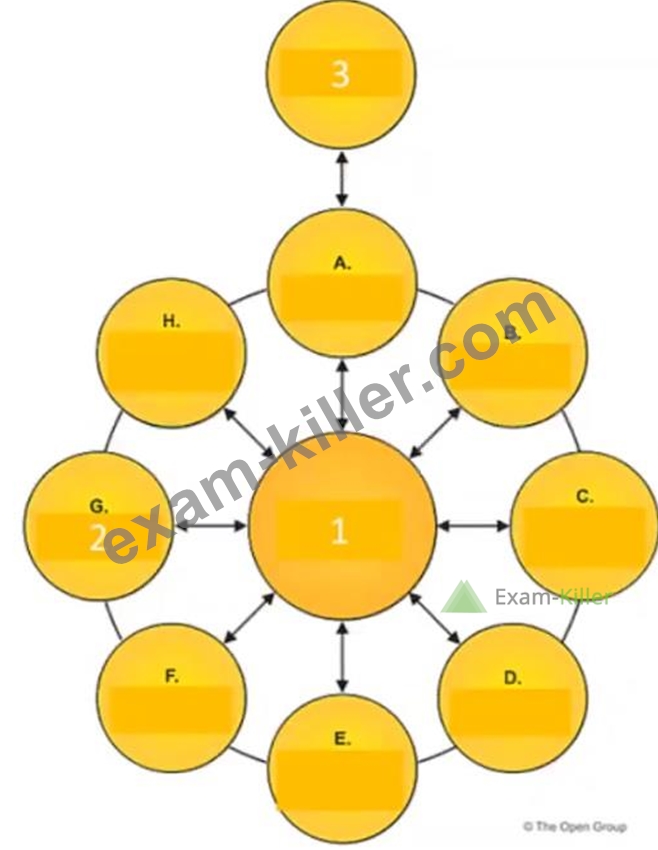
Consider the illustration showing an architecture development cycle Which description matches the phase of the ADM labeled as item 2?
- A. Provides architectural oversight for the implementation
- B. Establishes procedures for managing change to the new architecture
- C. Conducts implementation planning for the architecture defined in previous phases
- D. Operates the process of managing architecture requirements
Answer: A
Explanation:
Based on the illustration, the phase of the ADM labeled as item 2 is the Implementation Governance phase. This phase provides architectural oversight for the implementation. It ensures that the implementation project conforms to the architecture. It also provides a framework for monitoring and managing the implementation.
The Implementation Governance phase involves the following activities:
Finalizing the Architecture Roadmap and the supporting Implementation and Migration Plan Assigning an Architecture Board to oversee the implementation Establishing Architecture Contracts with the implementation partners Reviewing and approving the implementation project plans and deliverables Performing Architecture Compliance reviews to ensure alignment with the architecture Performing Architecture Audit reviews to ensure quality and performance of the architecture Resolving any architecture issues or change requests that arise during the implementation Maintaining the architecture lifecycle and ensuring its continuity The Implementation Governance phase is essential for ensuring that the architecture is realized as intended and that it delivers the expected business value and outcomes.
NEW QUESTION # 26
Which section of the TOGAF template for Architecture Principles should describe the relationship to other principles?
- A. Statement
- B. Name
- C. Implications
- D. Rationale
Answer: C
Explanation:
Explanation
The implications section of the TOGAF template for Architecture Principles should describe the relationship to other principles. Implications are statements that describe how a principle will impact other principles, as well as other aspects of the enterprise such as business processes, organizational structures, roles and responsibilities, standards, etc. Implications help to identify potential conflicts or synergies among principles and to assess their feasibility and applicability. Reference: The TOGAF Standard | The Open Group Website, Section 3.3.7 Architecture Principles.
NEW QUESTION # 27
What is an objective of the ADM Implementation Governance Phase?
- A. To finalize the Implementation and Migration Plan
- B. To provide continual monitoring of the governance framework
- C. To ensure conformance for the target architecture
- D. To establish the resources for architecture governance
Answer: C
Explanation:
The objective of the ADM Implementation Governance Phase is to provide an architectural oversight of the implementation and to ensure conformance for the target architecture. This phase involves establishing procedures and processes to monitor and control the implementation projects and to verify that they comply with the defined architecture. Reference: The TOGAF® Standard | The Open Group Website, Section 3.2.7 Phase G: Implementation Governance.
NEW QUESTION # 28
Please read this scenario prior to answering the question
You are working as an Enterprise Architect at a large supermarket. The company runs many retail stores, as well as an online grocery shop. Many of the stores used to remain open 24/7, but the number has decreased in recent years. Instead, they now focus on fulfilling online orders during the night.
The company has a mature Enterprise Architecture (EA) practice and uses the TOGAF standard for its architecture development method. The EA practice is involved in all aspects of the business, with oversight provided by an Architecture Board with representatives from different parts of the business. The EA program is sponsored by the Chief Information Officer (CIO).
Each store uses a standard method to track sales and inventory. This involves sending accurate timely sales data to a central Al-based inventory management system that can predict demand, adjust stock levels and automate reordering. The central inventory management system is housed at the company's central data center.
The company has bought a major rival. The Chief Executive Officer believes that a merger will enable growth through combined offerings and cost savings. The decision has been taken to fully integrate the two organizations, including merging retail operations and systems. This means that duplicated systems will be replaced with one standard retail management system. Also, the company will reduce the number of applications that are used. The CIO expects significant savings will be achieved by implementing these changes across the newly merged company.
One improvement that the rival has successfully implemented is the use of hand-held devices within stores, for both customers and staff. This has increased both customer and staff employee satisfaction due to the time savings this has brought. The CIO has given the go-ahead to roll out the devices in all stores but has stated that training on how to use the hand-held devices should be brief because there are a lot of employees, many of whom are part-time.
The Request for Architecture Work to oversee the merger has been approved. The project has been scoped and you have been assigned to work on it. Your role includes managing the architecture for the retail stores.
Refer to the scenario
You have been asked to confirm the most relevant architecture principles for the transformation.
Based on the TOGAF Standard, which of the following is the best answer?
[Note: The sequence of the principles listed in each answer does not matter. You should assume the company follows the set of principles that are provided in the TOGAF Standard, ADM Techniques, Architecture Principles chapter. You may need to refer to section 2.6 located in ADM Techniques within the reference text to answer this question.]
- A. Common Vocabulary and Data Definitions, Compliance with the Law, Requirements Based Change, Responsive Change Management, Data Security
- B. Common Use Applications, Data is an Asset, Data is Accessible, Ease of Use, Business Continuity
- C. Maximize Benefit to the Enterprise, Common Use Applications, Data is an Asset, Responsive Change Management, Technology Independence
- D. Control Technical Diversity, Interoperability, Data is an Asset, Data is Shared, Business Continuity
Answer: C
Explanation:
Key aspects of the scenario:
Business Objective:
A merger is happening to combine offerings, reduce costs, and achieve operational efficiency.
The goal includes fully integrating retail operations and systems, replacing duplicated systems, and reducing the number of applications used.
Technological Improvements:
A central AI-based inventory system is in place.
Hand-held devices for stores have improved customer and staff satisfaction and increased efficiency.
Scope of Architecture Work:
Integrating the merged systems.
Managing retail architecture to optimize operations.
TOGAF Alignment:
TOGAF principles aim to ensure the architecture supports business transformation effectively while aligning with governance and best practices.
Best answer analysis:
Option 1:
Maximize Benefit to the Enterprise: Aligns with the merger goals of cost reduction and efficiency.
Common Use Applications: Matches the goal to reduce duplicated systems.
Data is an Asset: Central AI system depends on accurate and reliable data.
Responsive Change Management: Necessary to support the transition and manage organizational impacts.
Technology Independence: Encourages selecting flexible, scalable solutions post-merger.
This option comprehensively aligns with the scenario.
Option 2:
Control Technical Diversity: Important but less emphasized than cost reduction and application unification.
Interoperability: Relevant, but less critical compared to principles addressing business value.
Data is an Asset: Relevant.
Data is Shared: Implied in centralized inventory but not directly stated.
Business Continuity: Important but not the main focus here.
This option partially fits but lacks emphasis on business outcomes.
Option 3:
Common Vocabulary and Data Definitions: Indirectly helpful but not central to the transformation.
Compliance with the Law: Always critical, but no explicit legal issues are mentioned.
Requirements-Based Change: General principle but not transformation-specific.
Responsive Change Management: Relevant.
Data Security: Important but not a central concern in the scenario.
This option focuses more on governance and less on merger goals.
Option 4:
Common Use Applications: Relevant to reducing duplicate systems.
Data is an Asset: Relevant.
Data is Accessible: Fits with AI system and handheld devices but is a subset of "Data is an Asset." Ease of Use: Relevant to handheld devices but not a core transformation principle.
Business Continuity: Important but secondary to cost and efficiency.
This option focuses more on usability and accessibility rather than transformation objectives.
NEW QUESTION # 29
Complete the sentence Business Transformation Readiness Assessment is_________________.
- A. to ensure the active support of powerful stakeholders
- B. widely used to validate an architecture that is being developed
- C. a way to put building blocks into context thereby supporting re-usable solutions
- D. a joint effort between corporate staff lines of business and IT planners
Answer: D
Explanation:
Explanation
Business Transformation Readiness Assessment is a joint effort between corporate staff lines of business and IT planners to evaluate the readiness of the organization to undergo change. It involves assessing factors such as vision, commitment, capacity, capability, culture, and motivation that may influence the success of a business transformation initiative. Reference: The TOGAF Standard | The Open Group Website, Section
3.3.2 Business Transformation Readiness Assessment.
NEW QUESTION # 30
Which section of the TOGAF template for Architecture Principles should highlight the business benefits of adhering to the principle?
- A. Statement
- B. Name
- C. Rationale
- D. Implications
Answer: C
Explanation:
According to the TOGAF Standard, 10th Edition, the rationale section of the architecture principles template should highlight the business benefits of adhering to the principle, as well as the business risks of not adhering to it 1. The rationale section should explain the reasoning behind the principle, and provide evidence or arguments to support it. The rationale section should also link the principle to the business drivers, goals, and objectives of the enterprise, and show how the principle contributes to the value and success of the enterprise.
The other options are not correct, as they have different purposes in the architecture principles template. The name section should provide a short and memorable name for the principle, such as "Information is an Asset" or "Business Continuity" 1. The statement section should provide a concise and formal statement of the principle, such as "The enterprise's information is recognized as a core asset, and is managed accordingly" or
"The enterprise's ability to provide critical services and products must be maintained in the event of a disaster" 1. The implications section should identify the impact of the principle on the enterprise, such as the changes, costs, benefits, and risks that may result from applying or violating the principle 1. References: 1:
TOGAF Standard, 10th Edition, Part III: ADM Guidelines and Techniques, Chapter 23: Architecture Principles, Section 23.3 Developing Architecture Principles.
NEW QUESTION # 31
Consider the following ADM phases objectives.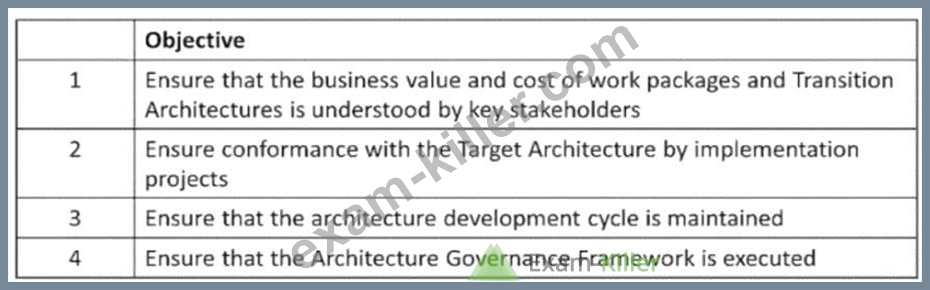
Which phase does each objective match?
- A. 1F-2G-3G-4H
- B. 1H-2F-3F-4G
- C. 1G-2H-3H-4F
- D. 1F-2G-3H-4H
Answer: B
Explanation:
* According to the TOGAF Standard, Version 9.2, the ADM phases and their objectives are as follows1:
* Preliminary Phase: To prepare and initiate the architecture development cycle, including defining the architecture framework, principles, and governance.
* Phase A: Architecture Vision: To define the scope, vision, and stakeholders of the architecture initiative, and to obtain approval to proceed.
* Phase B: Business Architecture: To describe the baseline and target business architecture, and to identify the gaps between them.
* Phase C: Information Systems Architectures: To describe the baseline and target data and application architectures, and to identify the gaps between them.
* Phase D: Technology Architecture: To describe the baseline and target technology architecture, and to identify the gaps between them.
* Phase E: Opportunities and Solutions: To identify and evaluate the opportunities and solutions for implementing the target architecture, and to define the work packages and transition architectures.
* Phase F: Migration Planning: To finalize the implementation and migration plan, and to ensure alignment with the enterprise portfolio and project management.
* Phase G: Implementation Governance: To provide architecture oversight and guidance for the implementation projects, and to manage any architecture change requests.
* Phase H: Architecture Change Management: To monitor the changes in the business and technology environment, and to assess the impact and performance of the architecture.
* Requirements Management: To manage the architecture requirements throughout the ADM cycle, and to ensure alignment with the business requirements.
* Based on the above definitions, we can match each objective with the corresponding phase as follows:
* Objective 1: Ensure that the business value and cost of work packages and transition architectures is understood by key stakeholders. This objective is achieved in Phase H: Architecture Change Management, where the value realization and cost-benefit analysis of the architecture are performed2.
* Objective 2: Ensure conformance with the Target Architecture by implementation projects. This objective is achieved in Phase F: Migration Planning, where the conformance requirements and criteria for the implementation projects are defined3.
* Objective 3: Ensure that the architecture development cycle is maintained. This objective is achieved in Phase F: Migration Planning, where the architecture roadmap and iteration cycle are maintained3.
* Objective 4: Ensure that the Architecture Governance Framework is executed. This objective is achieved in Phase G: Implementation Governance, where the architecture governance processes and procedures are applied to the implementation projects4.
References:
* 1: The TOGAF Standard, Version 9.2, Chapter 5: Architecture Development Method (ADM)
* 2: The TOGAF Standard, Version 9.2, Chapter 21: Architecture Change Management
* 3: The TOGAF Standard, Version 9.2, Chapter 20: Migration Planning
* 4: The TOGAF Standard, Version 9.2, Chapter 19: Implementation Governance
NEW QUESTION # 32
Which of the following best describes the purpose of the Architecture Requirements Specification?
- A. It defines the scope and approach to complete an architecture project
- B. It provides a set of statements that outline what a project must do to comply with the architecture
- C. It contains an assessment of the current architecture requirements
- D. It is sent from the sponsor and triggers the start of an architecture development cycle
Answer: B
Explanation:
The Architecture Requirements Specification is one of the TOGAF deliverables that provides a set of quantitative statements that outline what an implementation project must do in order to comply with the architecture12. It is a companion to the Architecture Definition Document, which provides a qualitative view of the solution and aims to communicate the intent of the architect. The Architecture Requirements Specification provides a quantitative view of the solution, stating measurable criteria that must be met during the implementation of the architecture3. It typically forms a major component of an implementation contract or contract for more detailed Architecture Definition4. Reference:
* Deliverable: Architecture Requirements Specification - The Open Group
* Architecture Requirements Specification - Visual Paradigm Community Circle
* The TOGAF Standard, Version 9.2 - Definitions - The Open Group
* The TOGAF Standard, Version 9.2 - Architecture Requirements Specification - The Open Group
NEW QUESTION # 33
Which of the following statements about architecture partitioning are correct*?
1 Partitions are used to simplify the management of the Enterprise Architecture
2 Partitions are equivalent to architecture levels
3 Partitions enable different teams to work on different element of the architecture at the same time.
4 Partitions reflect the organization's structure
- A. 1 & 4
- B. 2 & 4
- C. 2 & 3
- D. 1 & 3
Answer: D
Explanation:
Statements 1 and 3 about architecture partitioning are correct. Architecture partitioning is the technique of dividing an architecture into smaller and more manageable parts that can be developed, maintained, and governed independently. Partitions are used to simplify the management of the Enterprise Architecture and to enable different teams to work on different elements of the architecture at the same time. Partitions are not equivalent to architecture levels, which are different degrees of abstraction or detail in an architecture. Partitions do not necessarily reflect the organization's structure, which may change over time or differ from the architecture's scope and boundaries. Reference: The TOGAF Standard | The Open Group Website, Section 2.5 Architecture Partitioning.
NEW QUESTION # 34
What is used to structure architectural information in an orderly way so that it can be processed to meet stakeholder needs?
- A. An Architecture Framework
- B. Content Metamodel
- C. An EA Library
- D. A Stakeholder Map
Answer: A
Explanation:
An Architecture Framework is used to structure architectural information in an orderly way so that it can be processed to meet stakeholder needs. An Architecture Framework provides a common language and taxonomy for describing architectures; a set of tools and techniques for creating architectures; a method for defining views and viewpoints for different stakeholders; a metamodel for representing architecture artifacts; a repository for storing and managing architecture artifacts; and a governance framework for controlling architecture development and evolution. Reference: The TOGAF Standard | The Open Group Website, Section 2 Core Concepts.
NEW QUESTION # 35
You are working as an Enterprise Architect within an Enterprise Architecture (EA) team at a multinational energy company. The company is committed to becoming a net-zero emissions energy business by 2050. To achieve this, the company is focusing on shifting to renewable energy production and adopting eco-friendly practices.
The EA team, which reports to the Chief Technical Officer (CTO), has been tasked with overseeing the transformation to make the company more effective through acquisitions. The company plans to fully integrate these acquisitions, including merging operations and systems.
To address the integration challenges, the EA team leader wants to know how to manage risks and ensure that the company succeeds with the proposed changes. Based on the TOGAF Standard, which of the following is the best answer?
- A. The EA team should create a Business Scenario to fully describe the business problem that is being addressed by the transformation. Once requirements are identified, they should be evaluated in terms of risks. Any residual risks should be escalated to the Architecture Board.
- B. The EA team should develop Business Architecture views that demonstrate how stakeholder concerns are addressed and assess each factor for readiness, urgency, and degree of difficulty.
- C. The EA team should evaluate the company's readiness for change by identifying factors that will impact the transformation. These factors will be used to determine initial risks associated with the initiative.
- D. The EA team should document the risks associated with the transformation in an Implementation Factor Catalog to inform decisions during implementation and deployment.
Answer: A
Explanation:
In TOGAF, creating a Business Scenario is a foundational step in defining and understanding the business problem, especially for complex transformations involving multiple stakeholders and systems, such as in this scenario. This method aligns with Phase A (Architecture Vision) of the TOGAF Architecture Development Method (ADM). Here's why this approach is the most effective:
Understanding Business Requirements:
A Business Scenario provides a structured way to capture and analyze the business requirements, stakeholder concerns, and the contextual elements related to the problem. In this scenario, the company faces challenges in integrating newly acquired companies with existing operations, which includes complex stakeholder concerns across different functional areas. Developing a Business Scenario allows the EA team to break down these complexities into identifiable and manageable parts.
Risk Evaluation and Management:
By using the Business Scenario approach, the EA team can not only define the requirements but also assess associated risks systematically. TOGAF emphasizes the importance of risk management through identifying potential risks, evaluating their impact, and defining strategies for handling these risks. The process includes assessing how risks can be avoided, transferred, or reduced-a necessary step in large-scale transformations to ensure that risks are proactively managed.
Residual Risks and Governance:
Any risks that cannot be fully resolved should be identified as residual risks and escalated to the Architecture Board, which is aligned with TOGAF's governance approach. The Architecture Board's role in TOGAF is to provide oversight and make critical decisions on risks that exceed the control of the EA team. This ensures that unresolved risks are managed at the appropriate level of the organization.
Alignment with TOGAF ADM Phases:
The Business Scenario approach directly aligns with the Preliminary and Architecture Vision phases of the TOGAF ADM, which focuses on establishing a baseline understanding of the business context and the strategic transformation required. The detailed understanding of requirements, stakeholder concerns, and risks identified here will guide the subsequent phases of the ADM, including Business Architecture and Information Systems Architecture.
TOGAF Reference (Section 2.6, ADM Techniques):
TOGAF provides guidelines on the creation of Business Scenarios as part of ADM Techniques, highlighting the importance of defining a business problem comprehensively to ensure successful transformation. This method includes identification of stakeholders, business requirements, and associated risks, which aligns well with the company's need for strategic and systematic integration of new business units.
By utilizing a Business Scenario, the EA team ensures that all aspects of the transformation are well understood, risks are identified early, and residual risks are managed effectively, aligning with the company's strategic objectives and the TOGAF framework's guidance on risk management and stakeholder alignment.
NEW QUESTION # 36
Which of the following best describes the TOGAF Architecture Development Method?
- A. A process for managing and controlling change at an enterprise-wide level
- B. A process for managing architecture requirements
- C. A process for creating an Architecture Repository
- D. A method for developing and managing the lifecycle of an Enterprise Architecture
Answer: D
NEW QUESTION # 37
Exhibit: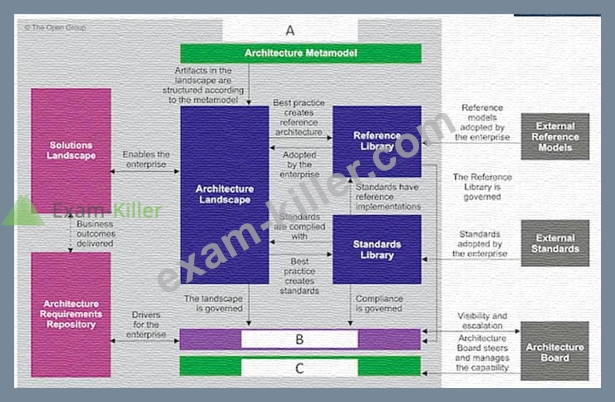
Consider the illustration. What are the items labelled A, B, and C?
- A. A-Architecture Repository, B-Governing Board, C-Enterprise Capability
- B. A-Enterprise Repository, B-Governance Repository, C-Board Repository
- C. A-Architecture Repository, B-Governance Repository, C-Architecture Capability
- D. A-Enterprise Repository, B-Board repository, C-Enterprise Capability
Answer: A
Explanation:
A-Architecture Repository: This is a part of the Architecture Metamodel that contains artifacts structured according to the metamodel. It includes the Architecture Landscape which is adopted by the enterprise and governed by certain standards and practices.
B-Governing Board: The Governing Board ensures visibility and escalation, meaning it oversees and manages the capability of the architecture landscape. It plays a crucial role in governance.
C-Enterprise Capability: This refers to how well an enterprise can execute its mission, meet business objectives or satisfy its stakeholders' needs and expectations. It's influenced by both internal factors (like resources, processes) and external ones (like market trends).
References: TOGAF Version 9.1, Chapter 34: 1
NEW QUESTION # 38
Complete the sentence. The key purpose of Gap Analysis is to _____
- A. identify commercial building blocks to be purchased
- B. identify potential missing or overlapping functions
- C. validate nonfunctional requirements
- D. determine the required service levels for the architecture
- E. establish quality parameters for the architecture
Answer: B
NEW QUESTION # 39
Consider the following ADM phases objectives.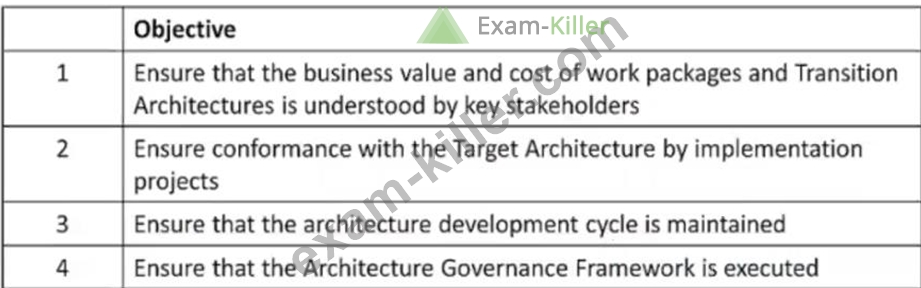
Which phase does each objective match?
- A. 1G-2H-3H-4F
- B. 1F-2G-3G-4H
- C. 1F-2G-3H-4H
- D. 1H-2F-3F-4G
Answer: B
Explanation:
1F: To define an Implementation and Migration Strategy that will achieve an orderly transition from the Baseline to Target Architectures 2G: To perform appropriate governance functions while the solution is being implemented 3G: To ensure conformance with the Target Architecture by implementation projects 4H: To establish procedures for continual monitoring and assessment of the performance of the solution in operation
NEW QUESTION # 40
What are the following activities part of?
. Risk classification
. Risk identification
. Initial risk assessment
- A. Risk Management
- B. Phase A
- C. Security Architecture
- D. Phase G
Answer: A
Explanation:
Risk management is a generic technique that can be applied across all phases of the Architecture Development Method (ADM), as well as in the Preliminary Phase and the Requirements Management Phase2.
Risk management involves the following steps1:
*Risk identification: This step involves identifying the potential risks that may affect the architecture project, such as technical, business, organizational, environmental, or legal risks. The risks can be identified through various sources, such as stakeholder interviews, workshops, surveys, checklists, historical data, or expert judgment.
*Risk classification: This step involves categorizing the risks based on their nature, source, impact, and priority. The risks can be classified according to different criteria, such as time, cost, scope, quality, security, or compliance. The classification helps in prioritizing the risks and allocating resources and efforts to address them effectively.
*Initial risk assessment: This step involves assessing the likelihood and impact of each risk, and determining the initial level of risk. The likelihood is the probability of the risk occurring, and the impact is the severity of the consequences if the risk occurs. The initial level of risk is the product of the likelihood and impact, and it indicates the urgency and importance of the risk. The initial risk assessment helps in identifying the most critical risks that need immediate attention and mitigation.
References: 1: The TOGAF Standard, Version 9.2 - Risk Management 2: TOGAF ADM: Top 10 techniques - Part 9: Risk Management
NEW QUESTION # 41
Which of the following is included as part of Architecture Governance1?
- A. Ensuring compliance with internal and external standards and regulatory obligations
- B. Creating and maintaining the Statement of Architecture Work though out the ADM cycle
- C. Interacting with the CxO level on Enterprise Architecture
- D. Managing Stakeholders and their requirements
Answer: A
Explanation:
Ensuring compliance with internal and external standards and regulatory obligations is one of the activities included as part of Architecture Governance. Architecture Governance is the practice and orientation by which enterprise architectures and other architectures are managed and controlled at an enterprise-wide level.
It involves establishing processes, roles, responsibilities, policies, and standards to ensure that architectures are aligned with the enterprise's strategy and objectives, and meet the quality and performance requirements.
Reference: The TOGAF Standard | The Open Group Website, Section 3.3.6 Architecture Governance.
NEW QUESTION # 42
Please read this scenario prior to answering the question
You have been appointed as Chief Enterprise Architect (CEA). reporting to the Chief Technical Officer (CTO), of a company established as a separate operating entity by a major automotive manufacturer. The mission of the company is to build a new industry leading unified technology and software platform for electric vehicles.
The company uses the TOGAF Standard as the basis for its Enterprise Architecture (EA) framework, and architecture development follows the purpose-based EA Capability model as described in the TOGAF Series Guide: A Practitioners'Approach to Developing Enterprise Architecture Following the TOGAF ADM.
An end-to-end Target Architecture has been completed with a roadmap for change over a five-year period. The new platform will be a cross-functional effort between hardware and software teams, with significant changes over the old platform. It is expected to be developed in several stages over three years. The EA team has inherited the architecture for the previous generation hardware and software automotive platform, some of which can be carried over to the new unified platform. The EA team has started to define the new platform, including defining which parts of the architecture to carry forward.
Enough of the Business Architecture has been defined, so that work can commence on the Information Systems and Technology Architectures. Those need to be defined to support the core business services that the company plans to provide. The core services will feature an innovative approach with swarm data generated by vehicles, paving the way for autonomous driving in the future.
The presentation and access to different variations of data that the company plans to offer through its platform pose an architecture challenge. The application portfolio and supporting infrastructure need to interact with various existing cloud services and data- Refer to the scenario You have been asked what approach should be taken to determine and organize the work to deliver the requested architectures?
Based on the TOGAF standard which of the following is the best answer?
- A. You will research leading data businesses, developing high-level Target Data, Application and Technology Architectures. You would review the Architecture Vision in order to estimate the level of detail, time, and breadth of the ADM cycle phases that will be needed to develop the architecture. You will identify and cost major work packages, and then develop an Architecture Roadmap. You would then seek approval by the Architecture Board and initiate the project.
- B. You would look outside the enterprise to research data models and application portfolios of leading big data businesses. You would develop just enough applications, data, and technology architecture to identify options. For each project this should include identification of candidate architecture and solution building blocks. You will identify solution providers, perform a readiness assessment, and assess the viability and fitness of the solution options. You will then document the draft Implementation and Migration plan.
- C. You will revisit ADM Phase A. identifying the stakeholders and creating a new Architecture Vision.
You will update the Stakeholder map produced for the strategic architecture so it reflects the stakeholders who are now the most relevant to the projects that are to be developed. You would then ask the CTO to make some decisions about the Architecture Roadmap, and update the Implementation and Migration Plan to reflect the decisions. - D. You would refer to the end-to-end Target Architecture for guidance and direction. The first objective should be to identify projects, dependencies and synergies, then prioritize before initiating the projects.
You will develop high-level architecture descriptions. For each project you would estimate effort size, identify reference architectures, and candidate building blocks. You will identify the resource needs considering cost and value. You will document options, risks, and controls to enable viability analysis and trade-off with the stakeholders.
Answer: D
Explanation:
Explanation
The Target Architecture is a description of the future state of the architecture that addresses the business goals and drivers, and satisfies the stakeholder requirements and concerns. The Target Architecture is developed through the Architecture Development Method (ADM), which is the core process of the TOGAF standard that guides the development and management of the enterprise architecture. The Target Architecture is typically divided into four domains: Business, Data, Application, and Technology. The Target Architecture also includes a roadmap for change, which defines the Transition Architectures, the Capability Increments, and the work packages that enable the transition from the Baseline Architecture to the Target Architecture12 The best answer is B, because it describes the approach that should be taken to determine and organize the work to deliver the requested architectures, which are the Information Systems and Technology Architectures.
The answer covers the following steps:
Refer to the end-to-end Target Architecture for guidance and direction. The end-to-end Target Architecture provides the overall vision, scope, and objectives of the architecture work, and the alignment with the business strategy and goals. The end-to-end Target Architecture also provides the high-level definitions and principles for the four architecture domains, and the roadmap for change that outlines the major milestones and deliverables.
Identify projects, dependencies and synergies, then prioritize before initiating the projects. Projects are the units of work that implement the architecture work packages, which are the sets of actions or tasks that are required to implement a specific part of the architecture. Dependencies are the relationships and constraints that affect the order or priority of the projects, such as logical, temporal, or resource dependencies. Synergies are the benefits or advantages that result from the combination or coordination of the projects, such as cost savings, efficiency gains, or innovation opportunities. Prioritization is the process of ranking the projects according to their importance, urgency, or value, and assigning resources and schedules accordingly.
Develop high-level architecture descriptions. High-level architecture descriptions are the outputs of the architecture development phases (B, C, and D) of the ADM cycle, which describe the Business, Data, Application, and Technology Architectures in terms of the Architecture Building Blocks (ABBs) and the Solution Building Blocks (SBBs), which are reusable components of business, IT, or architectural capability. High-level architecture descriptions also include the Architecture Views, which are representations of the system of interest from the perspective of one or more stakeholders and their concerns.
For each project, estimate effort size, identify reference architectures, and candidate building blocks.
Effort size is the measure of the amount of work, time, or resources required to complete a project.
Effort size can be estimated using various techniques, such as analogy, expert judgment, parametric, or bottom-up. Reference architectures are standardized architectures that provide a common framework and vocabulary for a specific domain or industry. Reference architectures can be used as a source of best practices, patterns, and models for the architecture development. Candidate building blocks are the potential ABBs or SBBs that can be used to implement the architecture. Candidate building blocks can be identified from the Architecture Repository, which is a collection of architecture assets, such as models, patterns, principles, standards, and guidelines.
Identify the resource needs considering cost and value. Resource needs are the specifications and criteria that define the acceptable level and quality of the resources required to complete the project, such as human, financial, physical, or technological resources. Resource needs can be identified by analyzing the scope, complexity, and dependencies of the project, and the availability, capability, and suitability of the resources. Cost and value are the factors that influence the allocation and utilization of the resources, such as the budget, the return on investment, the benefits, or the risks.
Document options, risks, and controls to enable viability analysis and trade-off with the stakeholders.
Options are the alternative ways of achieving the project objectives, such as different solutions, technologies, vendors, or approaches. Risks are the effects of uncertainty on the project objectives, such as threats or opportunities. Controls are the measures or actions that are taken to prevent, reduce, or mitigate the risks, such as policies, procedures, or standards. Viability analysis is the process of evaluating and comparing the options, risks, and controls, and determining the feasibility, suitability, and desirability of each option. Trade-off is the decision outcome that balances and reconciles the multiple, often conflicting, requirements and concerns of the stakeholders, and ensures alignment with the Architecture Vision and the Architecture Principles.
References: 1: The TOGAF Standard, Version 9.2, Part II: Architecture Development Method (ADM), Chapter 5: Introduction to the ADM 2: The TOGAF Standard, Version 9.2, Part IV: Architecture Content Framework, Chapter 36: Building Blocks : The TOGAF Standard, Version 9.2, Part II: Architecture Development Method (ADM), Chapter 18: Phase A: Architecture Vision : The TOGAF Standard, Version 9.2, Part II: Architecture Development Method (ADM), Chapter 19: Phase B: Business Architecture : The TOGAF Standard, Version 9.2, Part II: Architecture Development Method (ADM), Chapter 20: Phase C: Information Systems Architectures : The TOGAF Standard, Version 9.2, Part II: Architecture Development Method (ADM), Chapter 21: Phase F: Migration Planning : The TOGAF Standard, Version 9.2, Part III: ADM Guidelines and Techniques, Chapter 23: Architecture Principles : The TOGAF Standard, Version 9.2, Part III:
ADM Guidelines and Techniques, Chapter 30: Trade-Off Analysis : The TOGAF Standard, Version 9.2, Part VI: Architecture Capability Framework, Chapter 46: Tools for Architecture Development : The TOGAF Standard, Version 9.2, Part VI: Architecture Capability Framework, Chapter 47: Architecture Board : The TOGAF Standard, Version 9.2, Part VI: Architecture Capability Framework, Chapter 48: Architecture Compliance : The TOGAF Standard, Version 9.2, Part VI: Architecture Capability Framework, Chapter 49:
Architecture Contract : The TOGAF Standard, Version 9.2, Part VI: Architecture Capability Framework, Chapter 50: Architecture Governance : The TOGAF Standard, Version 9.2, Part VI: Architecture Capability Framework, Chapter 51: Architecture Maturity Models : The TOGAF Standard, Version 9.2, Part VI:
Architecture Capability Framework, Chapter 52: Architecture Skills Framework
NEW QUESTION # 43
Exhibit: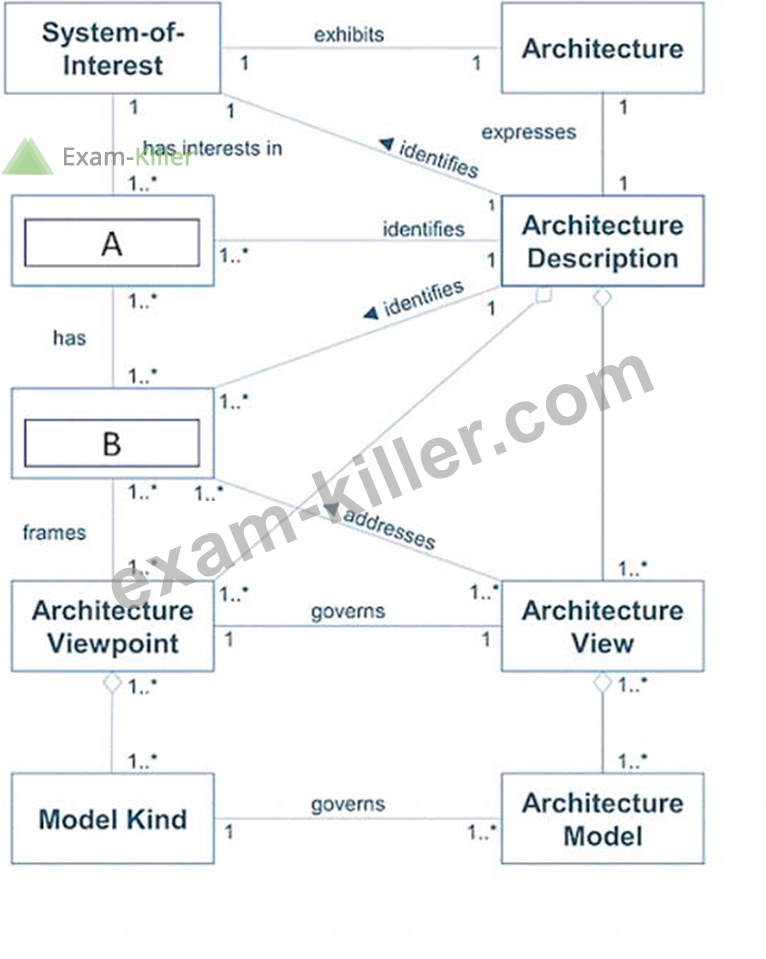
Consider the image showing basic architectural concepts.
What are items A and B?
- A. A-Stakeholder, B-Concern
- B. A-Candidate Architecture, B-Trade-off
- C. A-User, B-Requirement
- D. A-Base Architecture, B-Target Architecture
Answer: A
Explanation:
Explanation
In the context of TOGAF, a stakeholder is any individual, team, or organization who has interests in, or concerns relative to, the outcome of the architecture. Concerns are those interests which pertain to any aspect of the system's functioning, development or operation, including considerations such as performance, reliability, and security1. References:
*The TOGAF Standard, Version 9.2 - Definitions - The Open Group
NEW QUESTION # 44
What can architects present to stakeholders to extract hidden agendas, principles, and requirements that could impact the final Target Architecture?
- A. Business Scenarios and Business Models
- B. Solutions and Applications
- C. Alternatives and Trade-offs
- D. Architecture Views and Architecture Viewpoints
Answer: D
Explanation:
Explanation
According to the TOGAF Standard, Version 9.2, an architecture view is a representation of a system from the perspective of a related set of concerns1. It consists of one or more architecture models that demonstrate how the system addresses the stakeholder concerns1.
An architecture viewpoint is a specification of the conventions for constructing and using an architecture view to address specific stakeholder concerns1. It defines the perspective, scope, notation, and techniques for creating an architecture view of a system1.
Architects can present architecture views and viewpoints to stakeholders to extract hidden agendas, principles, and requirements that could impact the final Target Architecture, because23:
Architecture views and viewpoints help to communicate and visualize the architecture in a way that is meaningful and relevant to different stakeholders, addressing their specific interests and needs.
Architecture views and viewpoints help to elicit and validate the stakeholder concerns and requirements, ensuring that they are aligned with the business goals and objectives, and that they are consistent and feasible within the architecture context.
Architecture views and viewpoints help to identify and resolve any conflicts, gaps, or trade-offs among the stakeholder concerns and requirements, ensuring that they are balanced and prioritized in the architecture design and decision-making.
Architecture views and viewpoints help to demonstrate and verify the value and benefits of the architecture to the stakeholders, ensuring that they are satisfied and committed to the architecture outcome and governance.
References:
1: The TOGAF Standard, Version 9.2, Chapter 22: Architecture Views, Viewpoints, and Stakeholders
2: The TOGAF Standard, Version 9.2, Chapter 4: Introduction to Part II, Section 4.2: What is an Architecture Framework?
3: The TOGAF Standard, Version 9.2, Chapter 31: Architectural Artifacts, Section 31.1: Basic Concepts
NEW QUESTION # 45
......
The Open Group is a global consortium that brings together leading organizations to develop open technology standards and certifications. One of their most popular certifications is the TOGAF Enterprise Architecture (EA) Combined Part 1 and Part 2 exam, also known as OGEA-103. TOGAF Enterprise Architecture Combined Part 1 and Part 2 Exam certification is designed to validate an individual's knowledge and understanding of the TOGAF framework, which is widely used to develop and manage enterprise architecture.
Verified OGEA-103 exam dumps Q&As with Correct 136 Questions and Answers: https://www.exam-killer.com/OGEA-103-valid-questions.html
OGEA-103 Dumps PDF and Test Engine Exam Questions: https://drive.google.com/open?id=1Mxd9rQAJ8nFDU3MX4tEAnmALi2VRLFT1
