

Pass Your AZ-120 Dumps as PDF Updated on 2021 With 135 Questions
Microsoft AZ-120 Real Exam Questions and Answers FREE
NEW QUESTION 77
HOTSPOT
You deploy SAP HANA by using SAP HANA on Azure (Large Instances).
For each of the following statements, select Yes if the statement is true. Otherwise, select No.
NOTE: Each correct selection is worth one point.
Hot Area: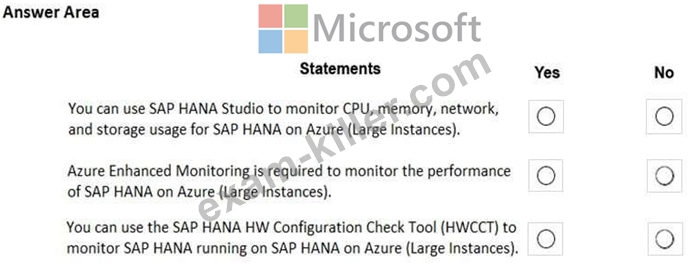
Answer:
Explanation: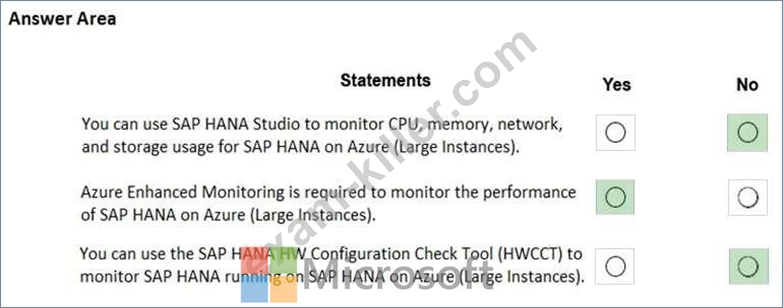
Explanation:
Box 1: No
Box 2: Yes
The SAP Azure Enhanced Monitoring Extension allows for collecting diagnostic data including OS and Application performance counters from Azure VMs running SAP workloads.
Box 3: No
Reference:
http://www.deployazure.com/compute/virtual-machines/sap-azure-enhanced-monitoring-extension/
NEW QUESTION 78
You have an on-premises SAP environment.
Backups are performed by using tape backups. There are SO TB of backups.
A Windows file server has BMP images of checks used by SAP Finance. There are 9 IB of images.
You need to recommend a method to migrate the images and the tape backups to Azure. The solution must maintain continuous replication of the images.
What should you include in the recommendation? To answer, select the appropriate options in the answer area.
NOTE: Each correct selection is worth one point.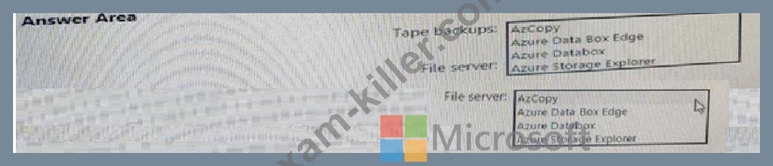
Answer:
Explanation: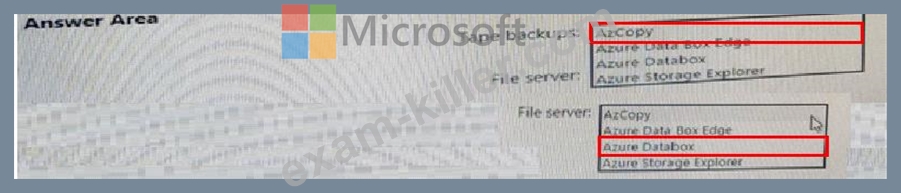
NEW QUESTION 79
You plan to deploy an SAP environment on Azure.
You plan to store all SAP connection strings securely in Azure Key Vault without storing credentials on the Azure virtual machines that host SAP.
What should you configure to allow the virtual machines to access the key vault?
- A. Azure Active Directory (Azure AD) Privilege Identity Manager (PIM)
- B. the Custom Script Extension
- C. a Managed Service Identity (MSI)
- D. role-based access control (RBAC)
Answer: C
Explanation:
To reference a credential stored in Azure Key Vault, you need to:
1. Retrieve data factory managed identity
2. Grant the managed identity access to your Azure Key Vault
3. Create a linked service pointing to your Azure Key Vault.
4. Create data store linked service, inside which reference the corresponding secret stored in key vault.
References:
https://docs.microsoft.com/bs-latn-ba/azure/data-factory/store-credentials-in-key-vault
NEW QUESTION 80
What should you use to perform load testing as part of the migration plan?
- A. Azure Monitor
- B. Azure Application Insights
- C. JMeter
- D. SAP LoadRunner by Micro Focus
Answer: D
Explanation:
Scenario: Upgrade and migrate SAP ECC to SAP Business Suite on HANA Enhancement Pack 8.
With the SAP LoadRunner application by Micro Focus, you can accelerate testing and development, reduce slowdowns and expenses, and gain a better understanding of performance issues. Validate software performance, virtualize your network, simulate workloads, benchmark production system performance, and optimize your deployment of SAP HANA software References:
https://www.sap.com/products/loadrunner.html
This is a case study. Case studies are not timed separately. You can use as much exam time as you would like to complete each case. However, there may be additional case studies and sections on this exam. You must manage your time to ensure that you are able to complete all questions included on this exam in the time provided.
To answer the questions included in a case study, you will need to reference information that is provided in the case study. Case studies might contain exhibits and other resources that provide more information about the scenario that is described in the case study. Each question is independent of the other questions in this case study.
At the end of this case study, a review screen will appear. This screen allows you to review your answers and to make changes before you move to the next section of the exam. After you begin a new section, you cannot return to this section.
To start the case study
To display the first question in this case study, click the Next button. Use the buttons in the left pane to explore the content of the case study before you answer the questions. Clicking these buttons displays information such as business requirements, existing environment, and problem statements. If the case study has an All Information tab, note that the information displayed is identical to the information displayed on the subsequent tabs. When you are ready to answer a question, click the Question button to return to the question.
Overview
Contoso, Ltd. is a manufacturing company that has 15,000 employees.
The company uses SAP for sales and manufacturing.
Contoso has sales offices in New York and London and manufacturing facilities in Boston and Seattle.
NEW QUESTION 81
For each of the following statements, select Yes if the statement is true. Otherwise, select No.
NOTE: Each correct selection is worth one point.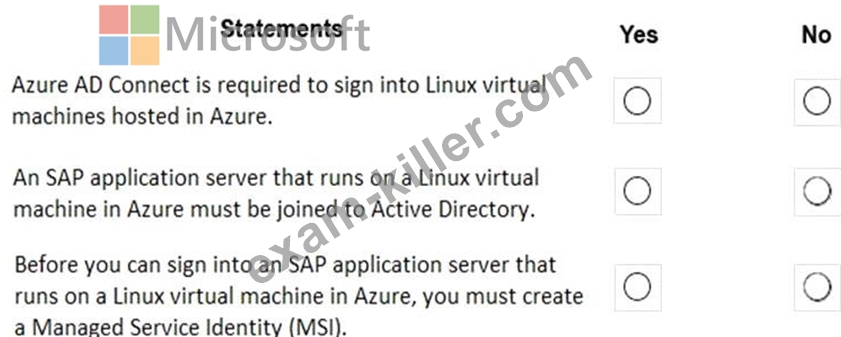
Answer:
Explanation: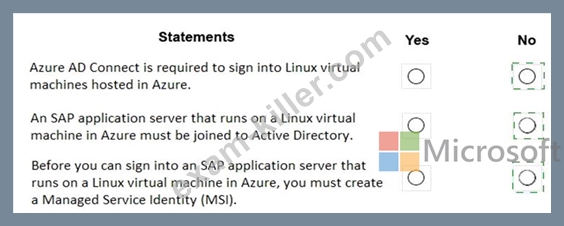
Explanation
Box 1: No
To log in to a Linux VM with Azure AD credentials, install the Azure Active Directory login VM extension.
Note: Azure AD Connect is the Microsoft tool designed to meet and accomplish your hybrid identity goals.
Box 2: NO
Box 3: No
References:
https://docs.microsoft.com/en-us/azure/virtual-machines/workloads/sap/deployment-guide
NEW QUESTION 82
You plan to migrate an SAP environment to Azure.
You need to design an Azure network infrastructure to meet the following requirements:
* Prevent end users from accessing the database servers.
* Isolate the application servers from the database servers.
* Ensure that end users can access the SAP systems over the Internet.
* Minimize the costs associated to the communications between the application servers and database servers.
Which two actions should you include in the solution? Each correct answer presents part of the solution.
NOTE: Each correct selection is worth one point.
- A. Configure an internal Azure Standard Load Balancer for incoming connections.
- B. Configure Azure Traffic Manager to route incoming connections.
- C. Create a site-to-site VPN between the on-premises network and Azure.
- D. In the same Azure virtual network, segregate the SAP application servers and database servers by using different subnets and network security groups.
- E. Segregate the SAP application servers and database servers by using Azure virtual networks.
Answer: C,D
NEW QUESTION 83
You plan to migrate an SAP HANA instance to Azure.
You need to gather CPU metrics from the last 24 hours from the instance.
Solution: You query views from SAP HANA Studio.
Does this meet the goal?
- A. No
- B. Yes
Answer: B
Explanation:
SAP HANA Studio -> Administration -> Overview -> CPU Usage.
SAP HANA Studio -> Administration -> Performance -> Load -> [System] CPU.
NEW QUESTION 84
You deploy an SAP environment on Azure.
You need to configure SAP NetWeaver to authenticate by using Azure Active Directory (Azure AD).
Which four actions should you perform in sequence? To answer, move the appropriate actions from the list of actions to the answer area and arrange them in the correct order.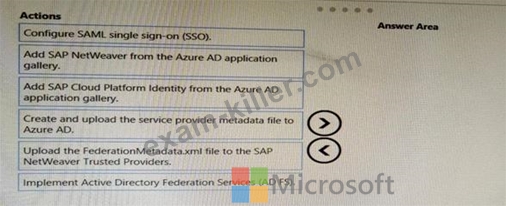
Answer:
Explanation: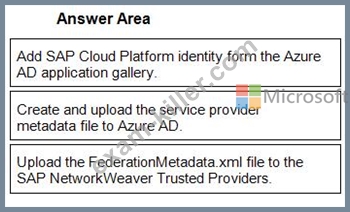
1 - Add SAP Cloud Platform identity form the Azure AD application gallery.
2 - Create and upload the service provider metadata file to Azure AD.
3 - Upload the FederationMetadata.xml file to the SAP NetworkWeaver Trusted Providers.
NEW QUESTION 85
You are deploying an SAP environment on Azure that will use an SAP HANA database server.
You provision an Azure virtual machine for SAP HANA by using the M64s virtual machine SKU.
You need to set the swap space by using the Microsoft Azure Linux Agent (waagent) configuration file.
Which two settings should you configure? Each correct answer presents part of the solution.
NOTE: Each correct selection is worth one point.
- A. ResourceDisk.EnableSwap=y
- B. ResourceDisk.SwapSizeMB=229376
- C. AutoUpdate.Enabled=n
- D. ResourceDisk.EnableSwapEncryption=n
Answer: A,B
Explanation:
Explanation
To create a swap file in the directory that's defined by the ResourceDisk.MountPoint parameter, you can update the /etc/waagent.conf file by setting the following three parameters:
ResourceDisk.Format=y
ResourceDisk.EnableSwap=y
ResourceDisk.SwapSizeMB=xx
References:
https://support.microsoft.com/en-us/help/4010058/how-to-add-a-swap-file-in-linux-azure-virtual-machines
NEW QUESTION 86
You are planning the Azure network infrastructure to support the disaster recovery requirements.
What is the minimum number of virtual networks required for the SAP deployment?
- A. 0
- B. 1
- C. 2
- D. 3
Answer: C
Explanation:
Scenario: Ensure that all the production databases can withstand the failure of an Azure region.
Note: Use Azure Site Recovery to replicate applications across regions. Azure Site Recovery replicates workloads running on physical and virtual machines from a primary site (either on-premises or in Azure) to a secondary location (in Azure). When an outage occurs at the customer's primary site, a failover can be triggered to quickly return the customer to an operational state. After the primary location is restored, customers can then fail back.
Reference:
https://docs.microsoft.com/en-us/azure/architecture/resiliency/recovery-loss-azure-region Operationalize Azure SAP Architecture Question Set 2
NEW QUESTION 87
For each of the following statements, select Yes if the statement is true. Otherwise, select No.
NOTE: Each correct selection is worth one point.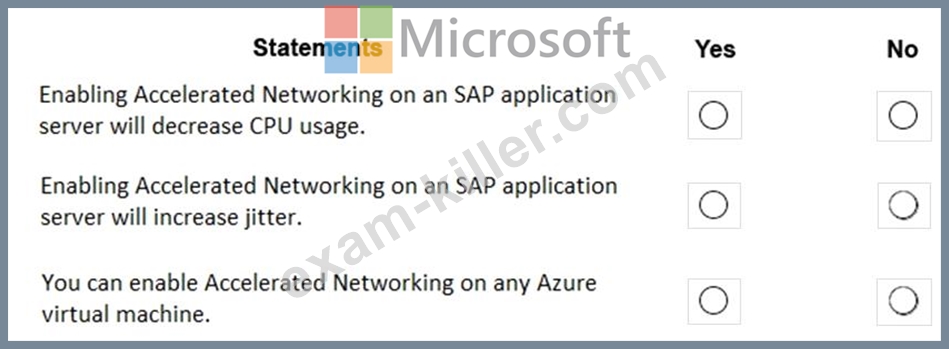
Answer:
Explanation: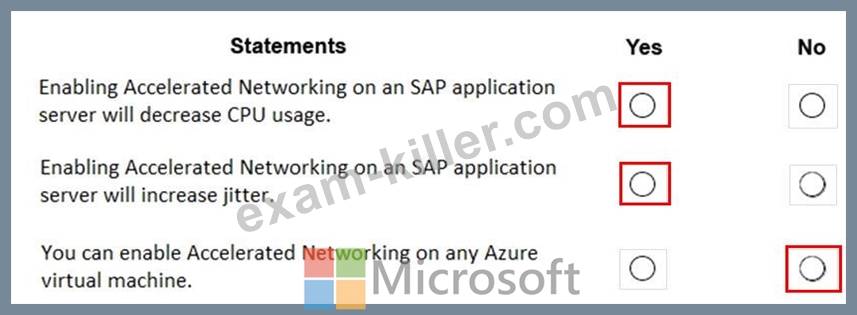
Explanation:
Box 1: Yes
By moving much of Azure's software-defined networking stack off the CPUs and into FPGA-based SmartNICs, compute cycles are reclaimed by end user applications, putting less load on the VM, decreasing jitter and inconsistency in latency.
Box 2: Yes
Box 3: No
Accelerated Networking (AN) is generally available (GA) and widely available for Windows and the latest distributions of Linux References:
https://azure.microsoft.com/en-us/blog/maximize-your-vm-s-performance-with-accelerated-networking-now-generally-available-for-both-windows-and-linux/
NEW QUESTION 88
You are integrating SAP HANA and Azure Active Directory (Azure AD).
For each of the following statements, select Yes if the statement is true. Otherwise, select No.
NOTE: Each correct selection is worth one point.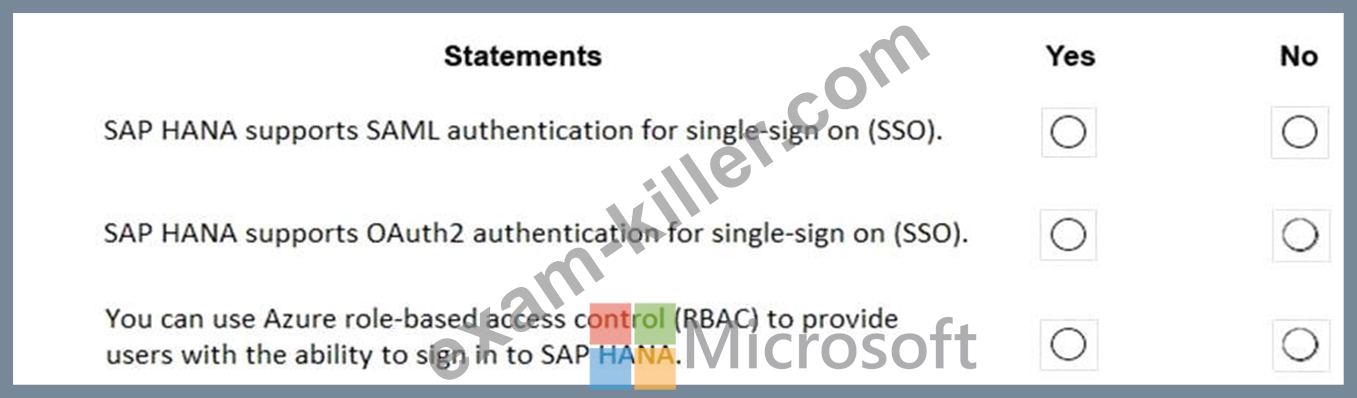
Answer:
Explanation: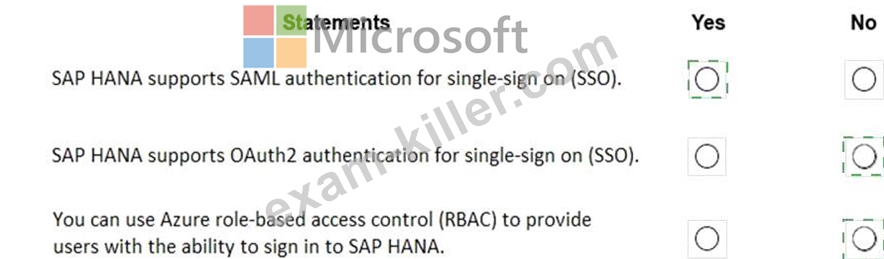
Explanation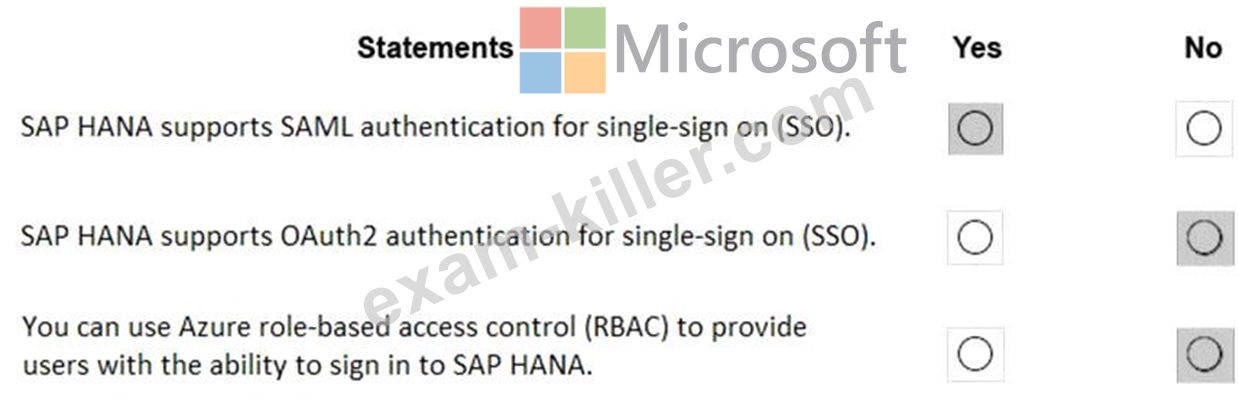
Box 1: Yes
To configure Azure AD single sign-on with SAP HANA, perform the following steps:
1. In the Azure portal, on the SAP HANA application integration page, select Single sign-on.
2. On the Select a Single sign-on method dialog, select SAML/WS-Fed mode to enable single sign-on.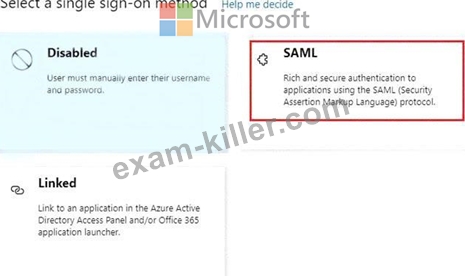
Box 2: No
Box 3: No
Key security considerations for deploying SAP on Azure
References:
https://docs.microsoft.com/en-us/azure/active-directory/saas-apps/saphana-tutorial
https://docs.microsoft.com/en-us/azure/active-directory/saas-apps/saphana-tutorial
NEW QUESTION 89
You have an Azure alert rule and action group as shown in the following exhibit.
Use the drop-down menus to select the answer choice that completes each statement based on the information presented in the graphic.
NOTE: Each correct selection is worth one point.
Answer:
Explanation: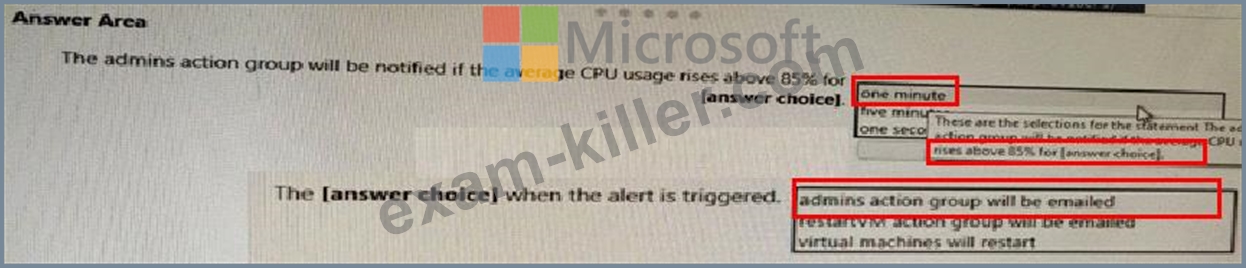
NEW QUESTION 90
Note: This question is part of a series of questions that present the same scenario. Each question in the series contains a unique solution that might meet the stated goals. Some question sets might have more than one correct solution, while others might not have a correct solution.
After you answer a question in this section, you will NOT be able to return to it. As a result, these questions will not appear in the review screen.
You deploy SAP HANA on Azure (Large Instances).
You need to back up the SAP HANA database to Azure.
Solution: You create a Recovery Services vault and a backup policy.
Does this meet the goal?
- A. No
- B. Yes
Answer: B
Explanation:
Backup architecture
* The backup process begins by creating a Recovery services vault in Azure. This vault will be used to store the backups and recovery points created over time.
* The Azure VM running SAP HANA server is registered with the vault, and the databases to be backed-up are discovered. To enable the Azure Backup service to discover databases, a preregistration script must be run on the HANA server as a root user.
* This script creates AZUREWLBACKUPHANAUSER DB user and a corresponding key with the same name in hdbuserstore. Refer to the setting up permissions section to understand more about what the script does.
* Azure Backup Service now installs the Azure Backup Plugin for HANA on the registered SAP HANA server.
* The AZUREWLBACKUPHANAUSER DB user created by the preregistration script is used by the Azure Backup Plugin for HANA to perform all backup and restore operations. If you attempt to configure backup for SAP HANA DBs without running this script, you might receive the following error:
UserErrorHanaScriptNotRun.
* To configure backup on the databases that are discovered, choose the required backup policy and enable backups.
* Once the backup is configured, Azure Backup service sets up the Backint parameters at the DATABASE level on the protected SAP HANA server.
* The Azure Backup Plugin for HANA maintains all the backup schedules and policy details. It triggers the scheduled backups and communicates with the HANA Backup Engine through the Backint APIs.
* The HANA Backup Engine returns a Backint stream with the data to be backed up.
* All the scheduled backups and on-demand backups (triggered from the Azure portal) that are either full or differential are initiated by the Azure Backup Plugin for HANA. However, log backups are managed and triggered by HANA Backup Engineitself.
Reference:
https://docs.microsoft.com/en-us/azure/backup/sap-hana-db-about
https://docs.microsoft.com/en-us/azure/backup/backup-azure-sap-hana-database#configure-backup
NEW QUESTION 91
You plan to deploy an SAP environment on Azure that will use Azure Availability Zones.
Which load balancing solution supports the deployment?
- A. Azure Standard Load Balancer
- B. Azure Application Gateway v1 SKU
- C. Azure Basic Load Balancer
Answer: A
Explanation:
When you deploy Azure VMs across Availability Zones and establish failover solutions within the same Azure region, some restrictions apply:
* You can't use an Azure Basic Load Balancer to create failover cluster solutions based on Windows Server Failover Clustering or Linux Pacemaker. Instead, you need to use the Azure Standard Load Balancer SKU.
References:
https://docs.microsoft.com/en-us/azure/virtual-machines/workloads/sap/sap-ha-availability-zones
NEW QUESTION 92
You plan to deploy multiple SAP HANA virtual machines to Azure by using an Azure Resource Manager template.
How should you configure Accelerated Networking and Write Accelerator in the template? To answer, drag the appropriate values to the correct targets. Each value may be used once, more than once, or not at all. You may need to drag the split bar between panes or scroll to view content.
NOTE: Each correct selection is worth one point.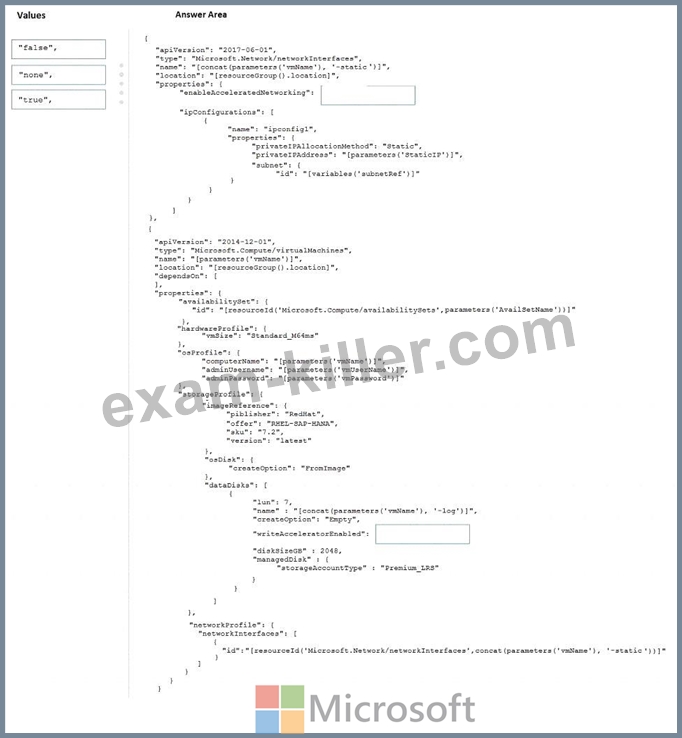
Answer:
Explanation:
Explanation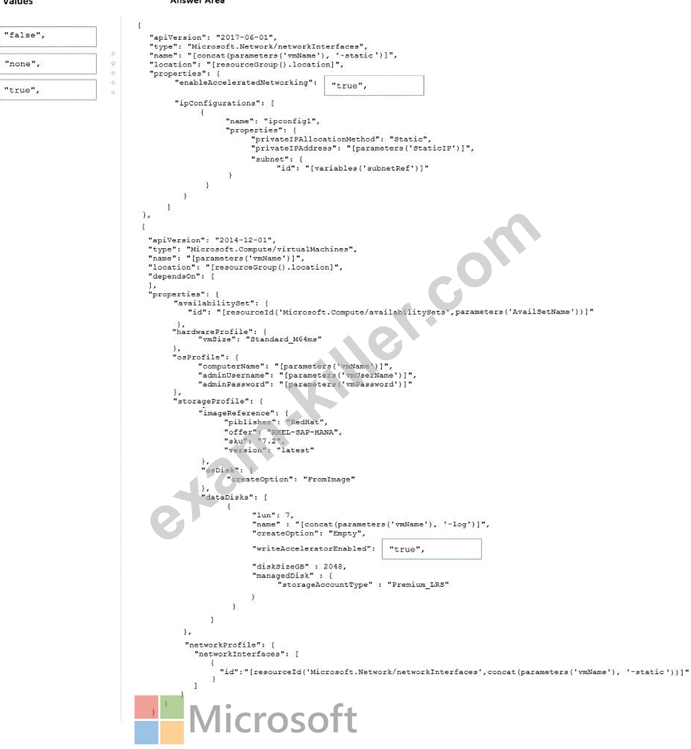
Box 1: true
enableAcceleratedNetworking: If the network interface is accelerated networking enabled.
To further reduce network latency between Azure VMs, we [Micorosoft] recommend that you choose Azure Accelerated Networking. Use it when you deploy Azure VMs for an SAP workload, especially for the SAP application layer and the SAP DBMS layer.
Box 2: true
Write Accelerator should be used for the volumes that contain the transaction log or redo logs of a DBMS. It is not recommended to use Write Accelerator for the data volumes of a DBMS as the feature has been optimized to be used against log disks.
References:
https://docs.microsoft.com/en-us/azure/virtual-machines/workloads/sap/dbms_guide_general
NEW QUESTION 93
For each of the following statements, select Yes if the statement is true. Otherwise, select No.
NOTE: Each correct selection is worth one point.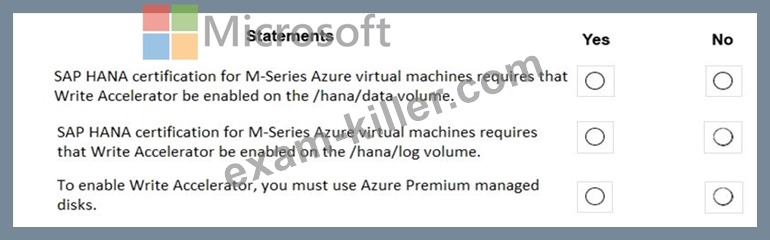
Answer:
Explanation: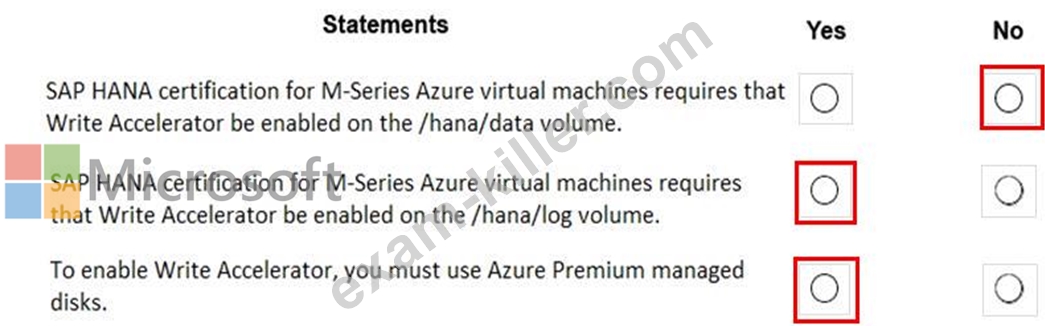
Explanation:
Box 1: No
Box 2: Yes
The minimum SAP HANA certified conditions for the different storage types are:
Azure Premium SSD - /hana/log is required to be cached with Azure Write Accelerator. The /hana/data volume could be placed on Premium SSD without Azure Write Accelerator or on Ultra disk Box 3: Yes References:
https://docs.microsoft.com/en-us/azure/virtual-machines/workloads/sap/hana-vm-operations-storage
NEW QUESTION 94
You are deploying SAP Fiori lo an SAP environment on Azure.
You are configuring SAML 2.0 for an SAP Fiori instance named FPP that uses client 100 to authenticate to an Azure Active Directory (Azure AD) tenant.
Which provider name should you use to ensure that the Azure AD tenant recognizes the SAP fiori instance?
- A. https://FPP
- B. ldap://FPP
- C. https://FPP100
- D. ldap://FPP-100
Answer: C
Explanation:
Explanation
By default, the provider name is in the format <sid><client>. Azure AD expects the name in the format
<protocol>://<name>. We recommend that you maintain the provider name as https://<sid><client> so you can configure multiple SAP Fiori ABAP engines in Azure AD.
Example: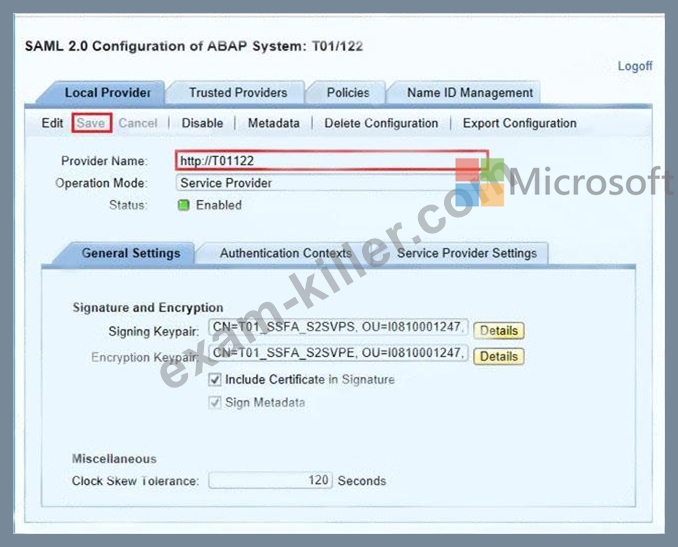
Reference:
https://docs.microsoft.com/en-us/azure/active-directory/saas-apps/sap-fiori-tutorial
NEW QUESTION 95
You migrate SAP ERP Central Component (SAP ECC) production and non-production landscapes to Azure.
You are licensed for SAP Landscape Management (LaMa).
You need to refresh from the production landscape to the non-production landscape.
Which four actions should you perform in sequence? To answer, move the appropriate actions from the list of actions to the answer area and arrange them in the correct order.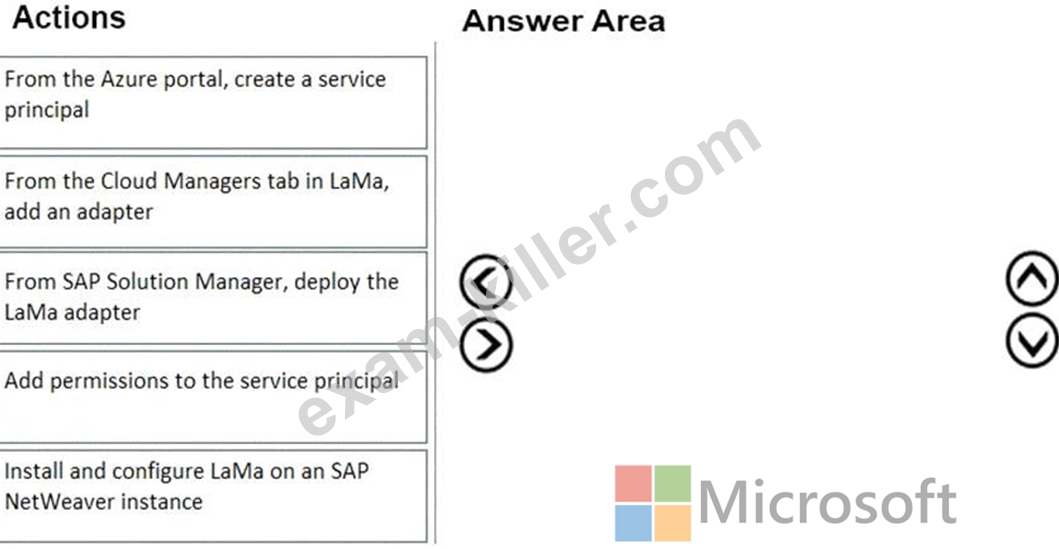
Answer:
Explanation:
Explanation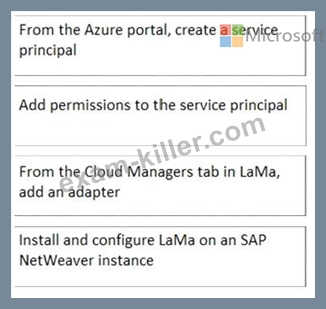
Step 1: From the Azure portal, create a service principal
The Azure connector can use a Service Principal to authorize against Microsoft Azure. Follow these steps to create a Service Principal for SAP Landscape Management (LaMa).
Step 2: Add permissions to the service principal
The Service Principal does not have permissions to access your Azure resources by default. You need to give the Service Principal permissions to access them.
Step 3: From the Cloud Managers tab in LaMa, add an adapter
Create a new connector in SAP LaMa
Open the SAP LaMa website and navigate to Infrastructure. Go to tab Cloud Managers and click on Add.
Select the Microsoft Azure Cloud Adapter
Step 4: Install and configure LaMA on an SAP NetWeater instance
Provision a new adaptive SAP system
You can manually deploy a new virtual machine or use one of the Azure templates in the quickstart repository.
It contains templates for SAP NetWeaver ASCS, SAP NetWeaver application servers, and the database. You can also use these templates to provision new hosts as part of a system copy/clone etc.
Note: To support customers on their journey into a cloud model (hybrid or entirely public cloud), SAP and Microsoft partnered to create an adapter that integrates the SAP management capabilities of LaMa with the IaaS advantages of Microsoft Azure.
References:
https://docs.microsoft.com/en-us/azure/virtual-machines/workloads/sap/lama-installation
https://docs.microsoft.com/en-us/learn/modules/maintain-azure-sap-workloads/2-set-up-remote-management
NEW QUESTION 96
......
Preparation Process
In addition to studying important exam details, the candidates should have a preparation plan that will help them ace the test with flying colors. Here is a step-by-step process to get prepared for the Microsoft AZ-120 exam:
Step 1: Visiting the Official Certification Webpage
The first thing to do is visit the official website. This will help you find out more about the exam. It also helps you keep up with any changes as soon as they are made.
Pass Microsoft AZ-120 Exam Info and Free Practice Test: https://www.exam-killer.com/AZ-120-valid-questions.html
New 2021 Latest Questions AZ-120 Dumps - Use Updated Microsoft Exam: https://drive.google.com/open?id=1I7whnNJ9R417IKiPk7fL9JGL6BeQCVOL
