

[Jul 10, 2024] Passing Key To Getting PCNSA Certified Exam Engine PDF
PCNSA Exam Dumps Pass with Updated Jul-2024 Tests Dumps
The PCNSA certification exam covers a range of topics related to Palo Alto Networks next-generation firewalls, including firewall configuration, network security management, and troubleshooting. PCNSA exam is designed to test the candidate's understanding of core concepts, best practices, and techniques used to secure a network with Palo Alto Networks firewalls. PCNSA exam consists of 60 multiple-choice questions and is timed at 90 minutes. Passing the PCNSA certification exam requires a score of 70% or higher. Achieving this certification demonstrates a high level of expertise in network security administration using Palo Alto Networks firewalls.
The Palo Alto Networks Certified Network Security Administrator (PCNSA) certificate can be important to your career as it confirms the specialists' competence in operating Palo Alto Networks' next-generation firewalls which are designed to keep networks away from high-level cyber threats. This certification validates the candidates' ability to create, install, maintain, and configure Palo Alto Networks firewalls as well as effectively deploy them to support networking traffic founded on ‘Who – User ID', ‘What – App ID', and ‘When – Policy'.
NEW QUESTION # 200
What is used to monitor Security policy applications and usage?
- A. Security profile
- B. Policy Optimizer
- C. Policy-based forwarding
- D. App-ID
Answer: B
NEW QUESTION # 201
In a security policy what I the quickest way to rest all policy rule hit counters to zero?
- A. use the Reset Rule Hit Counter > All Rules option.
- B. Highlight each rule and use the Reset Rule Hit Counter > Selected Rules.
- C. Use the CLI enter the command reset rules all
- D. Reboot the firewall.
Answer: C
NEW QUESTION # 202
Which three interface deployment methods can be used to block traffic flowing through the Palo Alto Networks firewall? (Choose three.)
- A. Virtual Wire
- B. Layer 2
- C. Tap
- D. Layer 3
- E. HA
Answer: A,B,D
NEW QUESTION # 203
What do you configure if you want to set up a group of objects based on their ports alone?
- A. Address groups
- B. Service groups
- C. Custom objects
- D. Application groups
Answer: B
NEW QUESTION # 204
An administrator notices that protection is needed for traffic within the network due to malicious lateral movement activity. Based on the image shown, which traffic would the administrator need to monitor and block to mitigate the malicious activity?
- A. north-south traffic
- B. east-west traffic
- C. perimeter traffic
- D. branch office traffic
Answer: B
NEW QUESTION # 205
Choose the option that correctly completes this statement. A Security Profile can block or allow traffic ____________.
- A. before it is matched to a Security policy rule.
- B. after it is matched by a security policy rule that allows traffic.
- C. after it is matched by a security policy rule that allows or blocks traffic.
- D. on either the data place or the management plane.
Answer: B
Explanation:
Explanation/Reference:
Reference:
https://docs.paloaltonetworks.com/pan-os/9-0/pan-os-admin/policy/security-policy.html
NEW QUESTION # 206
An administrator notices that protection is needed for traffic within the network due to malicious lateral movement activity. Based on the image shown, which traffic would the administrator need to monitor and block to mitigate the malicious activity?
- A. north-south traffic
- B. east-west traffic
- C. perimeter traffic
- D. branch office traffic
Answer: B
NEW QUESTION # 207
Which two statements are true for the DNS security service introduced in PAN-OS version 10.0?
- A. IT eliminates the need for dynamic DNS updates.
- B. It functions like PAN-DB and requires activation through the app portal.
- C. It removes the 100K limit for DNS entries for the downloaded DNS updates.
- D. IT is automatically enabled and configured.
Answer: B,C
NEW QUESTION # 208
Which list of actions properly defines the order of steps needed to add a local database user account and create a new group to which this user will be assigned?
- A. 1. Navigate to Device > Admins and click Add. 2. Enter a Name for the user. 3. Enter and Confirm a Password or Hash. 4. Enable the account and click OK. 5. Navigate to Device > User Groups and click Add. 6. Enter a Name for the group. 7. Add the user to the group and click OK.
- B. 1. Navigate to Device > Authentication Profile > Users and click Add. 2. Enter a Name for the user. 3. Enter and Confirm a Password or Hash. 4. Enable the account and click OK. 5. Navigate to Device > Local User Database > User Groups and click Add. 6. Enter a Name for the group. 7.
Add the user to the group and click OK. - C. 1. Navigate to Device > Local User Database > Users and click Add. 2. Enter a Name for the user. 3. Enter and Confirm a Password or Hash. 4. Enable the account and click OK. 5. Navigate to Device > Local User Database > User Groups and click Add. 6. Enter a Name for the group. 7.
Add the user to the group and click OK. - D. 1. Navigate to Device > Users and click Add. 2. Enter a Name for the user. 3. Enter and Confirm a Password or Hash. 4. Enable the account and click OK. 5. Navigate to Device > User Groups and click Add. 6. Enter a Name for the group. 7. Add the user to the group and click OK.
Answer: C
Explanation:
https://knowledgebase.paloaltonetworks.com/KCSArticleDetail?id=kA10g000000ClHcCAK
NEW QUESTION # 209
What must be considered with regards to content updates deployed from Panorama?
- A. Panorama can only install up to five content versions of the same type for potential rollback scenarios.
- B. Panorama can only download one content update at a time for content updates of the same type.
- C. A PAN-OS upgrade resets all scheduler configurations for content updates.
- D. Content update schedulers need to be configured separately per device group.
Answer: B
NEW QUESTION # 210
Given the Cyber-Attack Lifecycle diagram, identify the stage in which the attacker can initiate malicious code against a targeted machine.
- A. Act on Objective
- B. Installation
- C. Exploitation
- D. Reconnaissance
Answer: C
NEW QUESTION # 211
You have been tasked to configure access to a new web server located in the DMZ Based on the diagram what configuration changes are required in the NGFW virtual router to route traffic from the 10 1 1 0/24 network to 192 168 1 0/24?
- A. Add a route with the destination of 192 168 1 0/24 using interface Eth 1/3 with a next-hop of 192.168
1.10 - B. Add a route with the destination of 192 168 1 0/24 using interface Eth 1/3 with a next-hop of 172.16.1.2
- C. Add a route with the destination of 192 168 1 0/24 using interface Eth 1/3 with a next-hop of
192.168.1.254 - D. Add a route with the destination of 192 168 1 0/24 using interface Eth 1/2 with a next-hop of 172.16.1.2
Answer: B
NEW QUESTION # 212
You have been tasked to configure access to a new web server located in the DMZ Based on the diagram what configuration changes are required in the NGFW virtual router to route traffic from the 10 1 1 0/24 network to 192 168 1 0/24?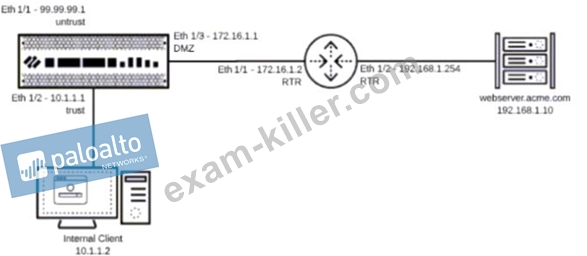
- A. Add a route with the destination of 192 168 1 0/24 using interface Eth 1/3 with a next-hop of 192.168.1.254
- B. Add a route with the destination of 192 168 1 0/24 using interface Eth 1/3 with a next-hop of 172.16.1.2
- C. Add a route with the destination of 192 168 1 0/24 using interface Eth 1/3 with a next-hop of 192.168 1.10
- D. Add a route with the destination of 192 168 1 0/24 using interface Eth 1/2 with a next-hop of 172.16.1.2
Answer: B
NEW QUESTION # 213
An administrator manages a network with 300 addresses that require translation. The administrator configured NAT with an address pool of 240 addresses and found that connections from addresses that needed new translations were being dropped.
Which type of NAT was configured?
- A. Static IP
- B. Dynamic IP
- C. Destination NAT
- D. Dynamic IP and Port
Answer: B
Explanation:
The size of the NAT pool should be equal to the number of internal hosts that require address translations. By default, if the source address pool is larger than the NAT address pool and eventually all of the NAT addresses are allocated, new connections that need address translation are dropped. To override this default behavior, use Advanced (Dynamic IP/Port Fallback) to enable the use of DIPP addresses when necessary
NEW QUESTION # 214
An administrator notices that protection is needed for traffic within the network due to malicious lateral movement activity. Based on the image shown, which traffic would the administrator need to monitor and block to mitigate the malicious activity?
- A. north-south traffic
- B. east-west traffic
- C. perimeter traffic
- D. branch office traffic
Answer: B
NEW QUESTION # 215
Which Security policy set should be used to ensure that a policy is applied first?
- A. Parent device-group pre-rulebase
- B. Child device-group pre-rulebase
- C. Local firewall policy
- D. Shared pre-rulebase
Answer: D
Explanation:
https://docs.paloaltonetworks.com/pan-os/9-1/pan-os-web-interface-help/panorama-web-interface/defining-policies-on-panorama
NEW QUESTION # 216
Which action can be performed when grouping rules by group tags?
- A. Apply Tag to the Selected Rule(s)
- B. Edit Selected Rule(s)
- C. Delete Tagged Rule(s)
- D. Tag Selected Rule(s)
Answer: D
Explanation:
When grouping rules by group tags, the action that can be performed is to tag selected rule(s). This action allows you to assign one or more tags to the selected rules, which will group them together and display them under the corresponding tag group. You can use tags to organize and visually distinguish your rules based on different criteria, such as function, location, or priority1. Reference: View Rules by Tag Group, Use Tags to Group and Visually Distinguish Objects, Certifications - Palo Alto Networks, Palo Alto Networks Certified Network Security Administrator (PAN-OS 10.0) or [Palo Alto Networks Certified Network Security Administrator (PAN-OS 10.0)].
NEW QUESTION # 217
Match the Palo Alto Networks Security Operating Platform architecture to its description.
Answer:
Explanation:
NEW QUESTION # 218
An administrator would like to protect against inbound threats such as buffer overflows and illegal code execution.
Which Security profile should be used?
- A. Anti-spyware
- B. Antivirus
- C. Vulnerability protection
- D. URL filtering
Answer: A
NEW QUESTION # 219
......
PCNSA exam questions for practice in 2024 Updated 361 Questions: https://www.exam-killer.com/PCNSA-valid-questions.html
Updated Premium PCNSA Exam Engine pdf: https://drive.google.com/open?id=19E-UYiXxfzFtdnd5tTYc_AeVXHTZCBSa
