

[Jan 15, 2026] CBAP Exam Dumps, CBAP Practice Test Questions
Free CBAP Study Guides Exam Questions and Answer
The CBAP certification is intended for experienced business analysts who have at least 7,500 hours of business analysis work experience in the last ten years. Candidates must also have completed a minimum of 35 hours of professional development in the last four years. Cetified business analysis professional (CBAP) appliaction certification exam is a challenging exam that tests the candidate's knowledge and skills in business analysis. Passing the exam is a significant achievement and is a testament to the candidate's expertise in the field.
IIBA CBAP certification exam is a computer-based test that consists of 120 multiple-choice questions. CBAP exam is divided into six knowledge areas, which include business analysis planning and monitoring, requirements elicitation and collaboration, requirements life cycle management, strategy analysis, requirements analysis and design definition, and solution evaluation. CBAP exam is designed to test the candidate's knowledge and application of these knowledge areas.
NEW QUESTION # 235
Which of the following is a table of all stakeholders showing the mapping of which stakeholders will contribute information to other stakeholders?
- A. RACI Chart
- B. Project scope statement
- C. Organizational Breakdown Structure
- D. Communications Requirements Matrix
Answer: D
NEW QUESTION # 236
You are the business analyst for your organization and you are completing the verify requirements process.
There are eight characteristics each requirement should have: cohesive, complete, consistent, correct, and feasible.
Which one of the following four is not a characteristic of a requirement?
- A. Modifiable
- B. Testable
- C. Unambiguous
- D. Functional
Answer: D
NEW QUESTION # 237
Gary is the business analyst for his organization and he is preparing a presentation about the requirements for a large software development project.
Before Gary makes the presentation what should he do as part of his preparation for the presentation?
- A. Confirm that the stakeholders have signed off on the requirements.
- B. Confirm that he has the authority to host the presentation.
- C. Determine an appropriate format for the presentation.
- D. Hire a scribe to keep the minutes of the meeting.
Answer: C
NEW QUESTION # 238
Your organization needs to adapt to the change economy, new technologies, and an increase in competition in order to survive. They've asked you to complete a business analysis approach that will help them change their organizational policies in order to achieve their goals and objectives.
What business analysis technique has this organization asked you to complete?
- A. Root cause analysis
- B. Brainstorming
- C. Business rules analysis
- D. Focus groups
Answer: C
NEW QUESTION # 239
Which of the following is the formal acceptance of the project?
- A. A project review
- B. Inspection trend analysis
- C. A sign-off
- D. Risk assessment
Answer: C
Explanation:
A sign-off is the formal acceptance of the project by the stakeholders, indicating that they agree that the project has met the requirements and delivered the expected value. A project review is an evaluation of the project performance and outcomes, but it does not necessarily imply acceptance. Risk assessment is a process of identifying and analyzing potential threats and opportunities that may affect the project. Inspection trend analysis is a technique of monitoring the quality of the project deliverables by comparing the results of inspections over time. References:
* CBAP / CCBA Certified Business Analysis Study Guide, 2nd Edition, Chapter 10, page 367
* BABOKGuide, Section 7.6, page 294
NEW QUESTION # 240
Which conduct stakeholder analysis technique identifies stakeholder roles that may serve as a useful starting point for identifying actors and roles?
- A. Scenario and uses cases and user stories
- B. Scope modeling
- C. Interviews
- D. Requirements workshops
Answer: A
Explanation:
Explanation
Scenario and uses cases and user stories are conduct stakeholder analysis techniques that identify stakeholder roles that may serve as a useful starting point for identifying actors and roles. These techniques describe how stakeholders interact with the solution or the business process, and what their goals, needs, and expectations are. By creating scenarios and use cases and user stories, the business analyst can identify the primary and secondary stakeholders, as well as their roles and responsibilities. These techniques can also help to elicit, validate, and prioritize the requirements, as well as to communicateand collaborate with the stakeholders1234. References: 1: Scenarios, Use Cases, and User Stories1 2: Business Analysis Techniques:
Eliciting Information and Collaborating with Stakeholders2 3: Use Cases and Scenarios3 4: User Stories4
NEW QUESTION # 241
Your organization needs to adapt to the change economy, new technologies, and an increase in competition in order to survive. They've asked you to complete a business analysis approach that will help them change their organizational policies in order to achieve their goals and objectives.
What business analysis technique has this organization asked you to complete?
- A. Root cause analysis
- B. Brainstorming
- C. Business rules analysis
- D. Focus groups
Answer: C
Explanation:
Explanation
Business rules analysis is a business analysis technique that involves identifying, analyzing, and documenting the rules that govern how an organization operates and makes decisions. Business rules analysis can help an organization to adapt to the change economy, new technologies, and an increase in competition by ensuring that the rules are aligned with the organizational goals and objectives, and that they are consistent, transparent, and flexible. Business rules analysis can also help to identify any gaps, conflicts, or redundancies in the existing rules, and to propose new or revised rules that can improve the organizational performance and efficiency. References: BABOK Guide v3, page 142; CBAP / CCBA Certified Business Analysis Study Guide, page 191.
NEW QUESTION # 242
Paul has been asked to complete SWOT analysis for his solution scope. What does SWOT analysis mean?
- A. Strengths, Weaknesses, Opportunities, Time
- B. Stakeholders Weaknesses, Organization, Threats
- C. Stakeholder Weaknesses, Organizational Threats
- D. Strengths, Weaknesses, Opportunities, Threats
Answer: D
NEW QUESTION # 243
You are the business analyst for a large, complex solution and you are working with the stakeholders to determine the prioritization of the requirements. You would like to use the decision analysis to determine the best decision for the requirements outcome. You must know four things as part of decision analysis. Which one of the following will not help you with this approach to the requirements prioritization process?
- A. The future value of the requirements
- B. The nature of the decision that must be made
- C. The values, goals, and objectives that are relevant to the requirements
- D. The consequences of each possible decision
Answer: A
NEW QUESTION # 244
Mark is the business analyst for his organization. He is working with the solution development team and he believes that the team does not want to implement a certain portion of the requirements. The team is expressing the difficulty of the requirements and how it will be extremely challenging to complete. When Mark asks about a similar project that the team completed, they insist that this is a different type of requirements though Mark believes that it is not. What is the solution development team appearing to do to the requirements?
- A. Get the requirements removed from the project scope.
- B. Change the prioritization of the requirements based on overstated complexity of the project work.
- C. Change the prioritization of the requirements based on the past project.
- D. Have the business analyst report the difficulty of the project work to the project customer.
Answer: B
NEW QUESTION # 245
All of the following are techniques that can be used to specify or model requirements except for which one?
- A. State diagrams
- B. Data modeling
- C. Organization modeling
- D. Work breakdown structure creation
Answer: D
Explanation:
Work breakdown structure creation is a technique that can be used to plan and manage the business analysis work, but it is not a technique to specify or model requirements. Organization modeling, data modeling, and state diagrams are all techniques that can be used to describe different aspects of the requirements, such as the stakeholders, the data, and the behavior of the solution. References:
* CBAP Handbook, page 6, Exam Blueprint, Knowledge Area 4: Requirements Analysis and Design Definition
* BABOK Guide, Chapter 10: Techniques, Section 10.1: Acceptance and Evaluation Criteria Definition, Section 10.8: Data Modeling, Section 10.34: State Modeling, Section 10.37: Work Breakdown Structure
NEW QUESTION # 246
Which of the following represents the duration of activities against a calendar?
- A. Scatter chart
- B. Pie chart
- C. Gantt chart
- D. Pareto chart
Answer: C
NEW QUESTION # 247
You are the business analyst for the TGH Organization and are determining if you should buy or build a solution for your company. You have determined that you can create the in-house solution for $78,000 with a monthly support cost of $8,765. A vendor can create the solution for $61,000 with a monthly support costs of
$7,990.
How long will it take your company to break even if you choose the internal solution versus the vendor's solution?
- A. 36 months
- B. 12 months
- C. 6 months
- D. 22 months
Answer: D
NEW QUESTION # 248
A major manufacturer of popular beverages has appointed a local distributor to serve a specific territory. The demand for the beverages has a pronounced seasonal pattern. The distributor performs well overall, but is repeatedly unable to keep up with fulfilling many customer orders during peak demand periods. The distributor's current delivery capability is stretched to deliver 60 tons of merchandise per day whereas the season's peak demand periods need a daily delivery capability of up to 100 tons.
The distributor is under pressure to fully meet the year-round market demand in order to stay in business. The distributor's management wants to identify and consider more cost-effective options as resorting to adding more trucks and drivers would not be economically feasible.
A business analyst (BA) has spent several days observing and measuring the warehouse activities to understand the situation and to gain insights into possible solutions. The delivery workflow is a four-step process: (1) picking the orders and assembling them on trays, (2) bringing the trays to the loading bay, (3) loading the orders into trucks, and (4) delivering the orders to customers. As the following table illustrates, overall performance depends is dependent on five major resources: (1) the workers who pick the orders and load them into trucks, (2) the tallyers who check the orders, (3) the drivers, (4) the trucks, and (5) eight loading bays (LBs).
Preparing a customer order for loading takes about one hour. Upon the BA's observation, only 30% of trips have their orders available for loading when a truck arrives. This causes a waste of both the truck's and the driver's time.
What should the BA recommend to eliminate such waste?
- A. Begin assembling orders for the next trip immediately following the truck's departure
- B. Ask the drivers to call the operations team member if they are going to be late
- C. Elicit requirements for a system to coordinate in advance order processing activities with all trips
- D. Hire more warehouse staff (workers) so that order assembly is done faster and less waiting occurs
Answer: A
NEW QUESTION # 249
Which of the following describes the actual users who interact with one another, a system, or data moved between two users?
- A. Communication port
- B. Device interface
- C. User interface
- D. Data interface
Answer: C
Explanation:
Explanation
The user interface is the part of a system that allows the actual users to interact with one another, the system, or data moved between two users. The user interface is the means by which the users can input, view, manipulate, or output information through the system. The user interface can be graphical, textual, auditory, tactile, or a combination of these. The user interface is an important aspect of the user experience and usability of the system. The user interface should be designed to meet the user needs, preferences, and expectations, as well as the system requirements and constraints. References: IIBA BABOK Guide v3, section 9.1.2, page
326; CBAP / CCBA Certified Business Analysis Study Guide, chapter 7, page 251; CBAP Exam Questions - Institute i4, question 241.
NEW QUESTION # 250
Your organization completes software development for other companies as its core business.
Management would like to streamline the requirements gathering processes as many of the projects your company do are similar in nature. What approach could you as a business analyst do to help streamline the requirements gathering process for your organization?
- A. Implement project template
- B. Implement a requirements gathering form
- C. Implement a requirements re-use repository
- D. Implement scope solution models
Answer: C
NEW QUESTION # 251
Company A is a nation-wide leader in commercial demolition. Having just celebrated its 100th year of operations, the company decided to begin doing work internationally. The current system used for reporting company finances is unable to keep pace with the potential demands of doing work in geographically dispersed locations. Therefore, the company decided to replace its client-based Profit & Loss (P&L) reporting system with a more robust, web-based system. This will ensure transparency across the organization and enable better decision making.
The business analyst (BA) at Company A has recently completed several rounds of elicitation to determine the requirements for the new, web-based system. Over 1250 requirements were elicited. An initial Requirements Traceability Matrix (RTM) has been drafted, and a subset of the RTM can be seen below:
The BA is working on identifying additional improvement opportunities based on these requirements. Which of the following improvement opportunities is reflected in Requirement ID NFP0002?
- A. Increased efficiency
- B. Additional capability
- C. Improved access to information
- D. Defined relationship to information
Answer: C
NEW QUESTION # 252
What plan includes the description of the scope of work, the deliverable Work Breakdown Structure, the activity list, and estimates for the business analysis activities?
- A. Business analysis plan
- B. Implementation plan
- C. Requirements management plan
- D. Project management plan
Answer: A
Explanation:
A business analysis plan is a document that describes the scope of work, the deliverable Work Breakdown Structure (WBS), the activity list, and estimates for the business analysis activities. It also includes the business analysis approach, the roles and responsibilities of the business analyst and other stakeholders, the communication plan, the requirements management plan, the change management plan, and the risk management plan12. A business analysis plan is an important input for the business analysis execution and monitoring process, as it helps to guide and control the business analysis work, and to ensure that the business analysis deliverables meet the quality standards and stakeholder expectations3.
The other options are not correct. A project management plan is a document that describes how the project will be executed, monitored, and controlled. It covers the project scope, schedule, cost, quality, resources, communication, risk, procurement, and stakeholder management. An implementation plan is a document that describes how the solution will be deployed, transitioned, and integrated into the business operations. It covers the implementation strategy, schedule, resources, tasks, roles, responsibilities, risks, and issues. A requirements management plan is a document that describes how the requirements will be elicited, analyzed, documented, validated, verified, prioritized, traced, and maintained throughout the project lifecycle. It is a component of the business analysis plan, not a separate document. References:
* Business Analysis Plan - IIBA
* Business Analysis Planning and Monitoring - IIBA
* Business Analysis Execution and Monitoring - IIBA
* [Project Management Plan - PMI]
* [Implementation Plan - PMI]
* [Requirements Management Plan - IIBA]
NEW QUESTION # 253
In a software implementation project, the designated business analyst (BA) has conducted all the elicitation activities and now needs to confirm the elicitation results.
What is used by the BA Professional to guide which sources of information and which results are to be compared?
- A. Business analysis approach
- B. Elicitation activity plan
- C. Information management approach
- D. Business analysis plan
Answer: A
Explanation:
The business analysis approach is used by the BA Professional to guide which sources of information and which results are to be compared when confirming the elicitation results. The business analysis approach is a description of the methodology, techniques, tools, and deliverables that will be used to conduct the business analysis work. The business analysis approach can help the BA Professional to determine the best way to compare and validate the elicitation results, and to ensure that they are consistent, complete, and accurate. The business analysis approach can also help the BA Professional to identify and resolve any conflicts, gaps, or issues that may arise from the elicitation results. Information management approach, business analysis plan, or elicitation activity plan are not the best options for guiding which sources of information and which results are to be compared, because they are either too specific, too general, or not directly related to the confirmation of the elicitation results. References:
* CBAP / CCBA Certified Business Analysis Study Guide, 2nd Edition, Chapter 4: Elicitation and Collaboration, page 165
* Business Analysis Body of Knowledge (BABOK) Guide, Version 3, Chapter 4: Elicitation and Collaboration, section 4.3: Confirm Elicitation Results, page 81
* Business Analysis Professional Resources, IIBA Resource Collection, Business Analysis Body of Knowledge (BABOK) Guide
* CBAP / CCBA Certified Business Analysis Study Guide, 2nd Edition, Skillsoft Book, Chapter 4:
Elicitation and Collaboration, page 165
NEW QUESTION # 254
Rachel is writing the business case for her organization. As she's completing this process Rachel is concerned that she's including all the correct information for management. Which one of the following should Rachel not include in her business case?
- A. Follow-on opportunities
- B. Time to break even
- C. Opportunities to prioritize requirements
- D. Qualitative and quantitative benefits
Answer: C
NEW QUESTION # 255
A multi-domain project has stakeholders with different technical backgrounds. The presentation prepared by the business analyst (BA) for domain 1 was also used for domain 2 but the presentation was not clear and caused concerns for stakeholders in domain 2.
What can the BA do to alleviate the concerns of the stakeholders in domain 2?
- A. Present a model applicable for the stakeholders in domain 2.
- B. Produce an estimation applicable for the stakeholders in domain 2.
- C. Develop a backlog applicable for the stakeholders in domain 2.
- D. Create a survey applicable for the stakeholders in domain 2.
Answer: A
Explanation:
Explanation
The BA can alleviate the concerns of the stakeholders in domain 2 by presenting a model applicable for them.
A model is a representation of a concept or system that is used to communicate, analyze, or design. A model can help the BA to convey complex or abstract information in a clear and concise way, using the appropriate level of detail, notation, and terminology for the audience. A model can also help the BA to elicit feedback, validate understanding, and resolve issues or conflicts. A survey, an estimation, or a backlog are not the best options to alleviate the concerns of the stakeholders in domain 2, because they are either too general, too specific, or too technical, and they do not address the root cause of the problem, which is the lack of clarity and relevance of the presentation. References:
CBAP / CCBA Certified Business Analysis Study Guide, 2nd Edition, Chapter 7: Requirements Analysis and Design Definition, page 279 Business Analysis Body of Knowledge (BABOK) Guide, Version 3, Chapter 7: Requirements Analysis and Design Definition, section 7.5: Specify and Model Requirements, page 133 Business Analysis Professional Resources, IIBA Resource Collection, Business Analysis Body of Knowledge (BABOK) Guide CBAP / CCBA Certified Business Analysis Study Guide, 2nd Edition, Skillsoft Book, Chapter 7:
Requirements Analysis and Design Definition, page 279
NEW QUESTION # 256
Ben is the business analyst for his organization. Ben is currently working on a solution to improve a laser printer. He has taken the laser printer apart, identified each component, and documented each component's purpose.
What type of requirements organization is Ben doing in this scenario?
- A. Data modeling
- B. Scope modeling
- C. Functional decomposition
- D. Process modeling
Answer: C
Explanation:
Explanation
Functional decomposition is a technique that breaks down a complex system or process into smaller and simpler parts, each with a specific function or purpose. By doing so, it helps to understand the structure, behavior, and functionality of the system or process, and to identify the requirements for each part. In this scenario, Ben is doing functional decomposition by taking the laser printer apart and documenting the purpose of each component. This can help him to improve the performance, quality, or efficiency of the laser printer by analyzing and optimizing each component's function. References:
[A Guide to the Business Analysis Body of Knowledge (BABOK Guide)], version 3, page 402, section
10.31.2.11
[CBAP Certification Study Guide v3.0], Chapter 6: Requirements Analysis and Design Definition, Section 6.3: Organize Requirements, page 2502 Project Management: Different Types of Requirement - Visual Paradigm, paragraph 4
NEW QUESTION # 257
Company A is a nation-wide leader in commercial demolition. Having just celebrated its 100th year of operations, the company decided to begin doing work internationally. The current system used for reporting company finances is unable to keep pace with the potential demands of doing work in geographically dispersed locations. Therefore, the company decided to replace its client-based Profit & Loss (P&L) reporting system with a more robust, web-based system. This will ensure transparency across the organization and enable better decision making.
The business analyst (BA) at Company A has recently completed several rounds of elicitation to determine the requirements for the new, web-based system. Over 1250 requirements were elicited. An initial Requirements Traceability Matrix (RTM) has been drafted, and a subset of the RTM can be seen below: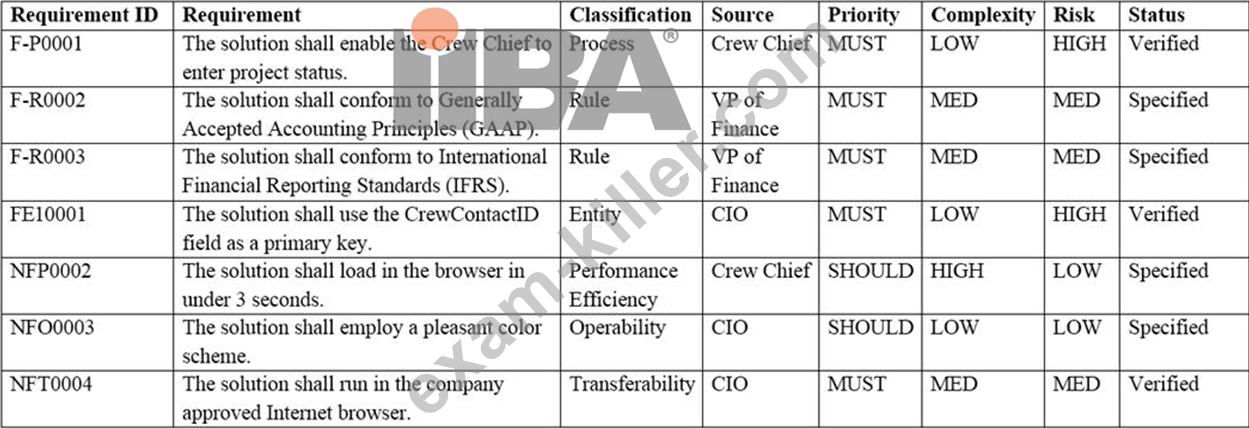
The risk associated with Requirement ID F-P0001 is HIGH. The BA has gone back to the Crew Chief to determine why this requirement's risk is HIGH. The Crew Chief stated that it was based on an assumption.
Which of the following assumptions would make this requirement's risk high?
- A. The cost of the solution outweighs its benefit.
- B. The web-based interface will be complex.
- C. The system will be inaccessible in remote locations.
- D. The users will require specialized training.
Answer: A
NEW QUESTION # 258
......
The Certified Business Analysis Professional (CBAP) certification exam is a globally recognized certification offered by the International Institute of Business Analysis (IIBA). CBAP exam is designed for business analysts who have extensive experience in the field and are looking to demonstrate their skills and knowledge in the industry.
CBAP Exam Dumps, CBAP Practice Test Questions: https://www.exam-killer.com/CBAP-valid-questions.html
Attested CBAP Dumps PDF Resource [2026]: https://drive.google.com/open?id=1LNrrMrcRf8F8U0DDDfNmNOmvaCz7Oc_u
