

[Dec-2023 Newly Released] CAMS-FCI Exam Questions For You To Pass
ACAMS CAMS-FCI Exam: Basic Questions With Answers
NEW QUESTION # 15
An investigator at a bank triggered a review in relation to potential misuse of legal persons and a complex network of corporate entities owned by customer A. For the investigator to provide a holistic view of the underlying risk, which action should be the initial focus of the investigation?
- A. Conduct a network link analysis on all customers of the bank.
- B. Review the customer due diligence documents of each entity and examine the year of incorporation and onboarding channel.
- C. Use data analytics to extract and analyze the linkages between the different entities.
- D. Find out whether customer A has relationships with other financial institutions.
Answer: B
Explanation:
Explanation
The initial focus of the investigation should be to review the customer due diligence documents of each entity and examine the year of incorporation and onboarding channel, as this would help identify the beneficial owners, the source of funds, and the purpose of the business relationship. This would also help determine if the entities are shell companies or have any red flags that indicate potential misuse of legal persons. Using data analytics to extract and analyze the linkages between the different entities would be a subsequent step, not the initial one. Conducting a network link analysis on all customers of the bank would be too broad and time-consuming. Finding out whether customer A has relationships with other financial institutions would be relevant, but not the initial focus. References: [Advanced CAMS-FCI Study Guide], page 44-45; [FATF Guidance on Transparency and Beneficial Ownership], page 12-13.
NEW QUESTION # 16
SAR/STR NARRATIVE
A SAR/STR has been submitted on five transactions conducted on the correspondent banking relationship with ABC Bank.
Client Information:
Remitter information: DEF Oil Resource Ltd. is the oldest member of the DEF Group. It was founded in 1977 as a general trading business with a primary focus on exports from Africa and North America. The group has business activities that span the entire energy value chain. Their core field of endeavor is centered within the oil and gas industry and its associated sub-sectors.
Beneficiary Information:
As per the response received from ABC Bank, it was determined that the beneficiaries are related to DEF Oil Resource Ltd. These were created by DEF Oil Resource Ltd. to purchase property in a foreign country on behalf of their senior management as part of a bonus scheme. The purpose behind this payment was for the purchase of property in another country.
Payment Reference:
ABCXXXXX31PZFG2H
ABCXXXXXX51PQGEH
ABCXXXXXX214QWVG
ABCXXXXXX41PSXA2
ABCXXXXXX815QWS3
Concerns:
* We are unsure about the country of incorporation of the beneficiaries.
* We are concerned about the transactional activity since the payment made towards entities (conducted on behalf of individuals) appears to be possible tax evasion.
* There appears to be an attempt to conceal the identity of individuals (senior management), which again raises concerns about the source of funds.
* Referring to the response received from ABC Bank, we are unclear about the ultimate beneficiary of funds.
* The remitter is involved in a high-risk business, (i.e., oil and crude products trading), and the beneficiary is involved in real estate business which again poses a higher risk.
When drafting the SAR/STR narrative, the investigator notes several payment references. What additional information should the investigator include in the narrative?
- A. All relevant tables, spreadsheets, and other supporting documentation
- B. The investigator's concerns based on their subjective opinion
- C. Personal tax records pertinent to the owners to indicate tax evasion
- D. The suspicious accounts and transactions identified
Answer: D
Explanation:
Explanation
The SAR/STR narrative should include the suspicious accounts and transactions identified, as well as the reasons why they are considered suspicious. The narrative should provide a clear and concise description of the activity, the parties involved, the dates, amounts, and frequencies of the transactions, and any other relevant information that would assist law enforcement in understanding the nature and purpose of the activity.
The narrative should not include the investigator's subjective opinion, personal tax records, or supporting documentation that is not essential to explain the suspicious activity. Supporting documentation can be attached separately to the SAR/STR form or provided upon request by law enforcement.
NEW QUESTION # 17
Why is a more robust supervisory approach needed by regulators when overseeing small- and medium-sized money service businesses (MSBs) compared to larger MSBs for combatting terrorist financing (TF)?
- A. Small- and medium-sized MSBs are more at risk of allowing transactions linked to TF due to the lack of skilled compliance resources.
- B. Small- and medium-sized MSBs need to be targeted to ensure that competition in the industry remains constant and uniform.
- C. Small- and medium-sized MSBs need to be robustly supervised so the regulator can maintain visibility in combatting TF.
- D. Small- and medium-sized MSBs are more likely to falsify records to appear less risky in order to keep the banking relationship.
Answer: A
Explanation:
Explanation
A more robust supervisory approach is needed by regulators when overseeing small- and medium-sized MSBs compared to larger MSBs for combatting TF because small- and medium-sized MSBs are more at risk of allowing transactions linked to TF due to the lack of skilled compliance resources. Small- and medium-sized MSBs may face challenges in implementing effective AML/CFT controls, such as conducting risk assessments, applying customer due diligence measures, monitoring transactions, detecting suspicious activities, and reporting to the authorities. They may also have limited access to training, guidance, and tools to enhance their compliance capabilities. Therefore, regulators need to provide more supervision and support to small- and medium-sized MSBs to ensure that they comply with the AML/CFT requirements and mitigate the TF risks.
References:
Sustainable Growth for Small and Medium-Sized Enterprises ... - MDPI
Lessons on Resilience for Small and Midsize Businesses - HBR
NEW QUESTION # 18
The investigative department of a financial institution (Fl) receives an internal escalation notice from the remittance department for a SWIFT message requesting a refund due to potential fraud. The notice indicates that a total of three international incoming remittances were transferred to a corporate customer from Country A, in the amount of approximately 5 million EUR for each. The first two incoming remittances had been exchanged into currency B and transferred out to Country B a few days ago. The third incoming remittance has been held by the remittance department.
As noted from the KYC profile, the corporate customer is working in the wood industry. with the last account review completed 3 months ago. Since the account's opening. there has been no history of a large amount of funds flowing through the account. The investigator conducts an Internet search and finds that the remitter is a food beverage company.
The same morning, the investigator receives a call from a financial intelligence unit (FIU) inquiring about the same incident. The FIU states that it will issue a warrant to freeze the account on the same day.
After further review, the decision is made that transactions appear suspicious. Which are the next steps the investigator should take? (Select Two.)
- A. Close the investigation as the FIU is already on this matter, and they will inform LE if needed.
- B. Contact local LE and advise them of the investigation details to help speed up the investigation and prosecution.
- C. Close the customer's accounts since the FIU is issuing a warrant to freeze the funds.
- D. Gather all the information that would be useful for law enforcement (LE) and recommend filing a SAR/STR
- E. Provide additional information to the LE upon receiving a formal request.
Answer: D,E
Explanation:
Explanation
The correct answer is C and E.
The investigator should provide additional information to the LE upon receiving a formal request, and gather all the information that would be useful for LE and recommend filing a SAR/STR. These steps are consistent with the best practices of conducting financial crime investigations and reporting suspicious activity. The investigator should not close the customer's accounts or the investigation, as this may interfere with the ongoing LE inquiry and violate the FI's policies and procedures. The investigator should also not contact local LE directly, as this may compromise the confidentiality of the investigation and the FIU's authority. References:
Advanced CAMS-FCI Study Guide, Chapter 4: Reporting Suspicious Activity, pages 40-411 Advanced CAMS-FCI Study Guide, Chapter 5: Governance of an AFC Investigations Unit, pages
48-491
Advanced CAMS-FCI Certification | ACAMS
NEW QUESTION # 19
Each month the automated transaction monitoring system generates alerts based on predetermined scenarios.
An alert was generated in relation to the account activity of ABC Foundation. Below is the transaction history for ABC Foundation (dates are in DD/MM/YYYY format).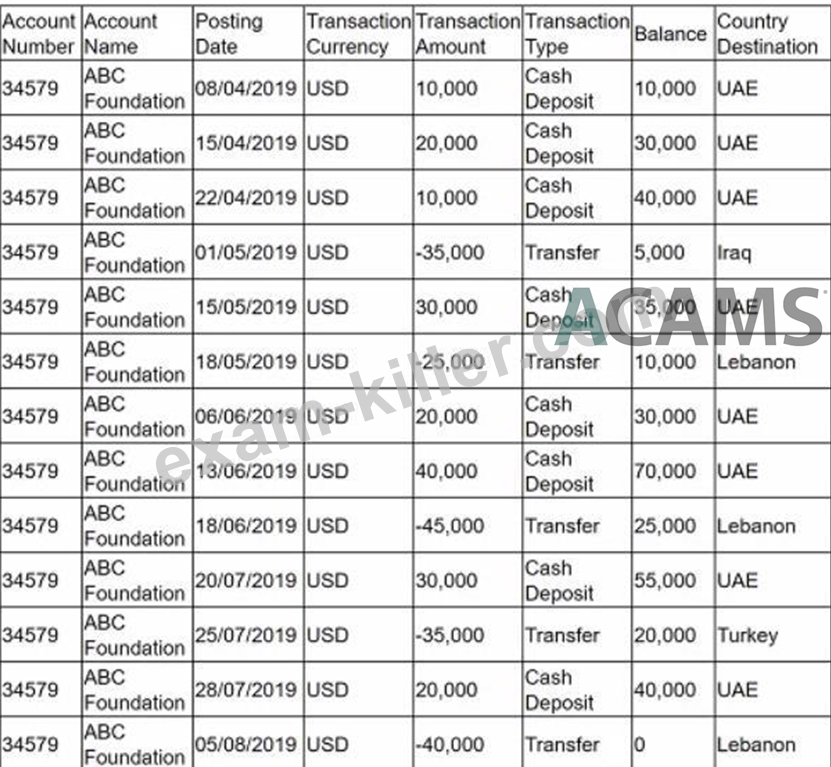
The relationship manager for ABC Foundation contacts the client to request more information on the beneficiary of the transfer in Turkey. ABC Foundation advises that this is a not-for-profit charity group called
'Forever Free." Which is the best next step in the investigation?
- A. File a SAR/STR with the new information learned about the beneficiary.
- B. Check the junsdiction's list of known chanties with connections to terrorist activity.
- C. Update the customer profile to include Forever Free as the recipient of the funds.
- D. Contact the financial institution in Turkey that has a relationship with Forever Free and advise them of the investigation.
Answer: B
Explanation:
Explanation
The best next step in the investigation is to check the jurisdiction's list of known charities with connections to terrorist activity . This is because the FI has a responsibility to verify the legitimacy and reputation of the beneficiary of the funds, especially if it is a charity or non-profit organization that operates in a high-risk jurisdiction or sector. According to the ACAMS Advanced Financial Crimes Investigations Certification Study Guide1, "the FI should conduct enhanced due diligence on all parties involved in the investigation, including checking various sources of information, such as watch lists, sanctions lists, negative news, and official registries" (p. 24). The FI should also check if the beneficiary is consistent with the customer's profile and expected activity.
The other options are not as appropriate or effective as option C.
Contacting the financial institution in Turkey that has a relationship with Forever Free and advising them of the investigation (A) could violate confidentiality or data protection laws, as well as compromise the investigation or alert the customer or beneficiary of the suspicion. Updating the customer profile to include Forever Free as the recipient of the funds (B) could be premature or inaccurate, as it does not verify the nature and purpose of the transfer or the identity and legitimacy of the beneficiary. Filing a SAR/STR with the new information learned about the beneficiary (D) could also be premature or incomplete, as it does not confirm if there is any suspicious or criminal activity involved in the transfer or if there are any other red flags or indicators.
NEW QUESTION # 20
During transaction monitoring. Bank A learns that one of their customers. Med Supplies 123, is attempting to make a payment via wire totaling 382,500 USD to PPE Business LLC located in Mexico to purchase a large order of personal protective equipment. specifically surgical masks and face shields. Upon further verification.
Bank A decides to escalate and refers the case to investigators.
Bank A notes that, days prior to the above transaction, the same customer went to a Bank A location to wire
1,215,280 USD to Breath Well LTD located in Singapore. Breath Well was acting as an intermediary to purchase both 3-ply surgical masks and face shields from China. Bank A decided not to complete the transaction due to concerns with the involved supplier in China. Moreover, the customer is attempting to send a third wire in the amount of 350,000 USD for the purchase of these items, this time using a different vendor in China. The investigator must determine next steps in the investigation and what actions, if any. should be taken against relevant parties.
Upon further investigation. Bank As investigator learns that both the Mexico- and Singapore-based companies are linked to the alleged suppliers in China. Which additional indicators would the investigator need to identify to determine if this fits a fentanyl (drug) trafficking typology? (Select Two.)
- A. Review of the account activity reveals that account is inconsistent with the expected business activity as it shows multiple charges at various hotels, transportation tickets for unrelated 3rd parties, etc.
- B. Review of the account activity reveals that wires were mainly funded by multiple cash deposits, conducted in amounts of 10.000 USD or below.
- C. Review of the invoices and transportation documents, provided by the customer, reveal significant discrepancies between the description of goods.
Internet research reveals that suppliers are newly established companies with no history of sales of medical equipment. - D. Review of the Food and Drug Administration (FDA) product certifications provided by the customer reveals that documents were falsified.
Answer: C,D
NEW QUESTION # 21
Which scenarios are common to money laundering through online marketplaces and trade-based money laundering? (Select Two.)
- A. No evidence of delivery of goods or shipping expenses
- B. Use of fraudulent letters of credit
- C. Frequent conversion of foreign currency
- D. Over-valuation of the stated price of goods
- E. Use of multiple freight forwarding or export companies
Answer: A,D
Explanation:
Explanation
Money laundering through online marketplaces and trade-based money laundering both involve the manipulation of the value or quantity of goods to disguise the illicit origin of funds. Over-valuation of the stated price of goods and no evidence of delivery of goods or shipping expenses are two common indicators of such schemes. The other options are not specific to these methods of money laundering.
References: Advanced CAMS-FCI Study Guide, page 29-30.
NEW QUESTION # 22
A KYC specialist from the first line of defense at a bank initiates an internal escalation based on a letter of credit received by the bank.
MEMO
To: Jane Doe. Compliance Manager, Bank B From: Jack Brown, KYC Specialist, Bank B RE: Concerning letter of credit A letter of credit (LC) was received from a correspondent bank. Bank A. in Country A. in Asia with strict capital controls, providing guarantee of payment to Bank B's client for the export of 10 luxury cars located in Country B. located in Europe. Bank A's customer is a general in the army where Bank A is headquartered.
The information contained in the LC is as follows:
* Advising amount per unit 30.000.00 EU *10 units of BMW
* Model IX3
* Year of registration: 2020
Upon checks on Bank B's client, the exporter mentioned that the transactions were particularly important, and a fast process would be much appreciated in order to avoid reputational damage to the firm and the banks involved in the trade finance process. The exporter has a longstanding relationship with Bank B and was clearly a good income generator. The exporter indicated that, as a general, the importer was trustworthy.
The relationship manager <RM) was contacted to conduct a full review of the exporter and to conduct a site visit.
Feedback from the RM:
The RM contacted the exporter for a client courtesy visit, but it was rearranged four times as the exporter kept cancelling the appointments. When the exporter was finally pinned down for an interview, employees were reluctant to provide clear answers about the basis of the transaction. The employees were evasive when asked about the wider business and trade activity in the country.
Findings from the investigation from various internal and external sources of information:
* There were no negative news or sanctions hits on the exporter company, directors, and shareholders.
* The registered address of the exporting business was a residential address.
* The price of the cats was checked and confirmed to be significantly below the market price of approximately
70,000 EU, based on manufacturer's new price guide.
* The key controllers behind the exporting company, that is the directors and During the investigation, the investigator determines that a nephew of the general.....
- A. should be flagged as a senior PEP.
- B. is a high-net-worth individual
- C. is a trustworthy source.
- D. should be treated well to avoid reputational damage to the bank
Answer: A
Explanation:
Explanation
The investigator should determine that a nephew of the general (Bank A's customer) should be flagged as a senior PEP . This is because the nephew is related to a senior military official who is a customer of Bank A, which is a high-risk jurisdiction with strict capital controls. According to the ACAMS Advanced Financial Crimes Investigations Certification Study Guide1, "the FI should identify and flag any customers who are PEPs or have close associations with PEPs, such as family members or business partners" (p. 24). The FI should also conduct enhanced due diligence on these customers and monitor their transactions for any suspicious or unusual activity.
The other options are not correct. The investigator should not determine that a nephew of the general should be treated well to avoid reputational damage to the bank (A), as this could compromise the integrity and objectivity of the investigation, as well as expose the bank to legal or regulatory risks. The investigator should not determine that a nephew of the general is a high-net-worth individual (B), as this is not relevant or material to the investigation, as the nephew's wealth does not affect his potential PEP status or risk level. The investigator should not determine that a nephew of the general is a trustworthy source (D), as this could be biased or inaccurate, as the nephew's trustworthiness does not depend on his relation to the general or his involvement in the transaction.
References: 1: ACAMS Advanced Financial Crimes Investigations Certification Study Guide, available at ACAMS
NEW QUESTION # 23
An unusual spike in activity has occurred for a customer who is a supplier of aviation parts to a military force.
The customer's current line of business is consistent with the banks records, and no adverse media hits have occurred. Which is the best reason for an investigator to continue an investigation?
- A. The end-user is a military force.
- B. The current line of business is consistent with the bank's records.
- C. The customer is a supplier of aviation parts.
- D. There are no adverse media hits.
Answer: A
Explanation:
Explanation
The best reason for an investigator to continue an investigation is that the end-user is a military force. This is because supplying aviation parts to a military force may involve sanctions risk, export control risk, or human rights risk, depending on the nature and destination of the military force. The investigator should conduct further due diligence to determine if the customer is complying with the relevant laws and regulations, and if the bank is exposed to any reputational or legal risk by providing services to the customer.
References:
Former Airline Employee and Aircraft Part Sellers Charged in Kickback ...
Former Airline Employee and Aircraft Part Sellers Charged in Kickback ...
Former airline employee and aircraft part sellers charged in kickback ...
NEW QUESTION # 24
Which pattern of activity most strongly indicates an individual is a foreign terrorist fighter?
- A. A series of small cash deposits made in rapid succession totaling just over 10,000 USD followed by a purchase at a jewelry store
- B. A series of small deposits followed by a large international wire to a well-known international charity
- C. A large purchase at a gas station immediately followed by several smaller purchases at an electronics store
- D. A large cash advance on a credit card and purchases at travel and sporting goods websites
Answer: D
Explanation:
Explanation
The pattern of activity that most strongly indicates an individual is a foreign terrorist fighter is a large cash advance on a credit card and purchases at travel and sporting goods websites. This is because this pattern may suggest that the individual is preparing to travel to a conflict zone and purchase equipment or supplies for terrorist activities. According to the United Nations Office on Drugs and Crime, some of the indicators of foreign terrorist fighters include1:
Sudden or increased financial activity, such as cash withdrawals, transfers, or deposits, especially in large amounts or involving foreign currency or locations.
Purchases of travel-related items, such as airline tickets, passports, visas, luggage, or clothing, especially to or from high-risk destinations or transit hubs.
Purchases of items that could be used for terrorist purposes, such as weapons, explosives, chemicals, communication devices, or survival gear.
Changes in behavior, such as expressing radical views, cutting ties with family or friends, joining extremist groups, or displaying signs of emotional distress.
References:
Foreign Terrorist Fighters - United Nations Office on Drugs and Crime
NEW QUESTION # 25
Potentially suspicious activity following an increase in the volume of transactions by an import company included outgoing wires to Indonesia and Uganda referencing invoice numbers. Incoming funds included large cash deposits and checks/wires from pet stores, breeders, and private individuals. What financial crime might the bank reference in the SAR/STR?
- A. Illegal wildlife trade
- B. International drug trafficking
- C. Black market peso exchange
- D. Tax evasion scheme
Answer: A
Explanation:
Explanation
The best reason the EU bank should file a SAR/STR is that the events raise concerns that the payment represents proceeds from illegal wildlife trade, which is a serious financial crime and a predicate offense for money laundering in many jurisdictions3. The fact that the incoming funds came from pet stores, breeders, and private individuals suggests that the import company may be involved in smuggling or trafficking endangered or protected animals or their parts4. The outgoing wires to Indonesia and Uganda, which are known source countries for wildlife trafficking, may indicate payments to suppliers or facilitators of this illicit activity.
References: 3: Financial Action Task Force Report on Money Laundering from the Illegal Wildlife Trade, page 9 4: Financial Crime Typologies - Intermediate, page 18 : [World Wildlife Crime Report], page 16
NEW QUESTION # 26
While each is potentially important, which allows an investigations analyst to better write a SAR/STR narrative that is useful to law enforcement? (Select Two.)
- A. Including an explanation of the internal process that brought the transaction to the attention of the analyst
- B. Including a detailed description of the known or suspected criminal violation or suspicious activity
- C. Including contact information for individuals at other institutions with whom correspondence has occurred
- D. Including information about the general activity trends in the area where the suspicious transactions were conducted
- E. Ensuring all information in the SAR/STR is complete and accurate based on what the institution knows
Answer: B,E
Explanation:
Explanation
A SAR/STR narrative that is useful to law enforcement should include a detailed description of the known or suspected criminal violation or suspicious activity, as well as ensure that all information in the SAR/STR is complete and accurate based on what the institution knows. These elements help law enforcement to understand the nature and scope of the suspicious activity, and to follow up with further investigation if needed. The other options are not essential for a useful SAR/STR narrative, as they either provide irrelevant or redundant information, or could compromise the confidentiality of the report.
NEW QUESTION # 27
Law enforcement (LE) suspects human trafficking to occur during a major sporting event. LE officers asked several financial institutions (FIs) to monitor financial transactions occurring before, during, and after the event.
An investigator identified a pattern linked to a business. The business' account received multiple even dollar deposits between midnight and 4:00 AM. They occurred each day for several days prior to the date of the sporting event. Also, large cash deposits, typically between 2,000 USD and 3,000 USD. made by a person to the business' account occurred in many branches in the days after the sports event.
There was little information about the company. The company did not have any history of employee payroll expenses or paying taxes. Expenses from the business account included air travel and hotel expenses. Searches about the person making cash deposits showed little. An online social media platform webpage with the individual's name showed ads for dates" and "companionship." The Fl receives a keep open' letter from LE for the identified account and agrees to keep the account open.
What is the Fl required to do?
- A. Stop filing SAR/STR reports on the account and/or customer.
- B. Contact the client for information relating to the account.
- C. Ensure that the request includes an end date.
- D. Notify LE immediately after new transactions.
Answer: C
Explanation:
Explanation
The FI is required to ensure that the request includes an end date when it receives a keep open letter from LE for the identified account. This is because the FI has to balance its legal obligations to cooperate with LE and to protect its customers' privacy and rights. According to the ACAMS Advanced Financial Crimes Investigations Certification Study Guide1, "the FI should request a written confirmation from LE that includes a specific end date for the request, as well as a point of contact for any questions or concerns" (p. 35). The FI should also document the request and its compliance with it, and continue to monitor the account for any suspicious activity.
The other options are not correct. The FI should not contact the client for information relating to the account (A), as this could compromise the LE investigation or alert the client of the suspicion. The FI should not stop filing SAR/STR reports on the account and/or customer (B), as this could violate its regulatory obligations and expose it to legal risks. The FI should not notify LE immediately after new transactions (D), as this could also interfere with the LE investigation or tip off the client. The FI should follow the instructions of LE regarding when and how to share information.
NEW QUESTION # 28
A country that does not have strong predicate offenses and is lax in prosecuting AML cases could suffer which social/economic consequence?
- A. Reputation risk for the port
- B. Increased organized crime and corruption
- C. US sanctions
- D. Loss of tax revenue
Answer: B
Explanation:
Explanation
A country that does not have strong predicate offenses and is lax in prosecuting AML cases could suffer increased organized crime and corruption as a social/economic consequence. "Weaknesses in the AML/CFT regime can lead to a range of economic and social consequences, including...increased crime and corruption." (CAMS Manual, 6th Edition, page 32)
NEW QUESTION # 29
A SAR/STR on cash activity is filed for a company registered in the Marshall Islands operating a Mediterranean beach bar and hotel. The company has three nominee directors, one nominee shareholder, and another individual declared as both the beneficial owner and authorized signatory. Which information is key for law enforcement's physical surveillance of cash activity? (Select Two.)
- A. The identification details o' the nominee shareholder
- B. The identification details the nominee directors
- C. The company's operating address
- D. The identification details of the beneficial owner and authorized signatory
- E. The company's registered address
Answer: C,D
Explanation:
Explanation
The identification details of the beneficial owner and authorized signatory are key for law enforcement's physical surveillance of cash activity, as they would help identify the person who controls and operates the company and who is responsible for its financial transactions. The company's operating address is also key, as it would help locate the premises where the cash activity takes place and observe any suspicious movements or behaviors. The identification details of the nominee shareholder and directors are not relevant, as they are not involved in the management or operation of the company. The company's registered address is also not relevant, as it is likely to be a shell or mailbox address that does not reflect the actual location of the business.
References: Advanced CAMS-FCI Study Guide, page 44-45; [FATF Guidance on Transparency and Beneficial Ownership], page 12-13.
NEW QUESTION # 30
Which is the first valid step in the Mutual Legal Assistance Treaties international cooperation process?
- A. The central authority of the requesting country sends a letter of request to the central authority of the other country.
- B. The investigator may remove the evidence collected without asking permission to do so.
- C. The central authority that receives the request sends it to a local judicial officer to find out if the information is available.
- D. An investigator from the requesting country visits the country where the information is sought and takes statements from the identified witnesses or suspects.
Answer: A
Explanation:
Explanation
The first valid step in the Mutual Legal Assistance Treaty (MLAT) international cooperation process is for the central authority of the requesting country to send a letter of request to the central authority of the other country. The letter of request should provide a summary of the facts and information required, the reasons for the request, and any specific legal or procedural requirements that need to be met. (CAMS Manual, 6th Edition, Page 233).
NEW QUESTION # 31
The training department is conducting awareness training for unusual customer identification scenarios. Which two indicators should be included? (Select Two.)
- A. The customer opens the account in the name of a family member who begins making large deposits.
- B. The customer's internet protocol address does not match the identifying information provided during online registration.
- C. The customer frequently exchanges small bills for large bills.
- D. The customer's name and home address cannot be verified
- E. The customer requests payment of proceeds to an unrelated third party.
Answer: A,D
Explanation:
Explanation
This information can be found in the Certified Anti-Money Laundering Specialist (CAMS) study guide, 6th edition, under the section on Unusual Customer Identification Scenarios. The guide explains that two indicators that should be included in awareness training for unusual customer identification scenarios are:
A: The customer opens the account in the name of a family member who begins making large deposits.
This is an indicator of potential structuring, where a customer may be attempting to avoid triggering reporting thresholds by depositing funds in smaller amounts over time. It is important for staff to be aware of this scenario and to monitor accounts for potential suspicious activity.
B: The customer's name and home address cannot be verified.
This is an indicator of potential identity theft or other fraudulent activity. If a customer's identifying information cannot be verified, it is important for staff to conduct additional due diligence to ensure that the customer is legitimate and that the account is not being used for illicit purposes.
NEW QUESTION # 32
The compliance learn is reviewing multiple data points to include in its data analytics program to detect shell or front company red flags. Which data points should the compliance team include? (Select Two.)
- A. Entities transacting with or having relation to tax haven or high-risk countries
- B. Entities with a large number and variety of beneficiaries not declared at the time of onboarding
- C. Entities with high paid-up capital relative to monthly value of transactions
- D. Entities whose principal place of business is a non-residential address
- E. Entities exhibiting transactions with declared counterparties
Answer: A,D
Explanation:
Explanation
The data points that the compliance team should include in its data analytics program to detect shell or front company red flags are entities whose principal place of business is a non-residential address and entities transacting with or having relation to tax haven or high-risk countries. These data points may indicate that the entities are not conducting legitimate business activities, but rather are used to conceal the identity or location of the true beneficiaries or owners, or to facilitate money laundering, tax evasion, or other illicit activities.
Some of the sources that support these data points as red flags are4567:
Entities whose principal place of business is a non-residential address may indicate that they have no physical presence, operations, assets, or employees. They may use addresses such as post office boxes, mail forwarding services, registered agents, or virtual offices to avoid detection or scrutiny.
Entities transacting with or having relation to tax haven or high-risk countries may indicate that they are involved in offshore financial activities that are designed to evade taxes, regulations, or sanctions. They may also be exposed to higher risks of money laundering, terrorist financing, corruption, or fraud.
References:
How to Identify a Shell Company and the Associated Red Flags
Difference between Shell, Shelf & Front Company | Sigma Ratings
Shell Companies and Money Laundering | ComplyAdvantage
General Comments Incorporation of shell companies - Singapore Police Force
NEW QUESTION # 33
According to the Financial Action Task Force, as part of their risk assessment, which are important data and information that a Trust and Company Service Provider must understand when establishing and administering a trust? (Select Two.)
- A. The source of funds in the structure
- B. The general purpose behind the structure
- C. The management structure of the trust
- D. The responsibility and authority in the structure
- E. The general nature of business of the trust
Answer: B,D
Explanation:
Explanation
Here is the exact information from the Financial Action Task Force (FATF) Guidance for a Risk-Based Approach for Trust and Company Service Providers:
"Understanding the management and ownership structure of a trust is crucial in assessing the ML/TF risk it poses. This includes the identity of all settlors, trustees and beneficiaries, and their respective roles and responsibilities, as well as the nature and purpose of the trust."
"TCSPs should obtain and maintain up-to-date information on the purpose and intended nature of the business relationship, the source of funds and wealth, and where relevant, the source of funds or wealth of the settlor and beneficiaries." Based on this information, the correct answers are A and D. Trust and Company Service Providers must understand the responsibility and authority in the structure, as well as the general purpose behind the structure in order to assess the overall risk of the trust and ensure that any transactions with the trust are legitimate.
NEW QUESTION # 34
Sanctions screening requirements include that a financial institution should:
- A. immediately freeze the bank account of an individual that appears on a sanctions list.
- B. immediately close the bank account of an entity who appears on a sanctions list.
- C. report an individual whose name appears on a sanctions list to the police.
- D. compare customer and transaction records against periodically updated sanctions lists provided by governmental bodies.
Answer: D
Explanation:
Explanation
Compare customer and transaction records against periodically updated sanctions lists provided by governmental bodies. This is stated in the Certified Anti-Money Laundering Specialist (the 6th edition) manual on page 595, which states: "Sanctions screening requirements include that a financial institution should compare customer and transaction records against periodically updated sanctions lists provided by governmental bodies."
NEW QUESTION # 35
An EU bank account received 1.8 million EUR from a Swiss bank. The EU bank determines the originator was indicted by U.S. law enforcement, arrested in Switzerland, and extradited for alleged insider trading.
Which is the best reason the EU bank should file a SAR/STR?
- A. Insider trading is a predicate offense in the U.S. and Switzerland.
- B. The Swiss bank filed a SAR/STR with the Money Laundering Reporting Office Switzerland.
- C. The events raise concerns that the payment represents proceeds from insider trading.
- D. The originator was indicted by U.S. law enforcement.
Answer: C
Explanation:
Explanation
The best reason the EU bank should file a SAR/STR is that the events raise concerns that the payment represents proceeds from insider trading, which is a form of market abuse and a predicate offense for money laundering in many jurisdictions. The fact that the originator was indicted by U.S. law enforcement, arrested in Switzerland, and extradited for alleged insider trading indicates that there is a strong suspicion that the funds are derived from criminal activity. The other options are not sufficient reasons to file a SAR/STR, as they do not directly relate to the nature or source of the funds.
References: [Financial Action Task Force Report on Money Laundering and Terrorist Financing Risks and Vulnerabilities Associated with Gold], page 17 : [Leading Complex Investigations Certificate], page 12
NEW QUESTION # 36
Which information is it best practice to share at the very beginning of a well-written SAR/STR narrative?
- A. The purpose of the SAR/STR narrative and a general description of the known or alleged violation
- B. Any and all relevant facts about the parties who facilitated the suspicious activity or transactions
- C. Information about any follow-up actions conducted by the financial institution on the account
- D. A specific description of the involved accounts and transactions, including the origination and application of funds
Answer: A
Explanation:
Explanation
The best information to share at the very beginning of a well-written SAR/STR narrative is the purpose of the SAR/STR narrative and a general description of the known or alleged violation. This is because this information provides an overview of why the SAR/STR is being filed and what type of suspicious activity or transaction is involved. It also helps to capture the attention of the reader and set the tone for the rest of the narrative.
References: Reporting Suspicious Activity Certificate, Module 4, page 7.
NEW QUESTION # 37
Law enforcement agents arrive at a broker-dealer's premises with a search warrant. In addition to cooperation with the warrant, which instructions should the person in charge of the broker-dealer provide to their employees?
- A. Provide agents with unlimited access to customers' personal data.
- B. Volunteer information not requested by the agents that the employees think may be useful.
- C. Take notes on the questions and comments made by the agents.
- D. Sign consent forms permitting the agents to search employees' offices.
Answer: C
Explanation:
Explanation
The instruction that the person in charge of the broker-dealer should provide to their employees is to take notes on the questions and comments made by the agents (A). This is because taking notes can help the employees to recall and document what happened during the search warrant execution, which can be useful for legal or regulatory purposes. According to ACAMS3, "the FI should instruct its staff to cooperate with LE agents during a search warrant execution, but also to take notes of what is being searched, seized, or asked by the agents" (p. 35). The FI should also "keep copies of any documents or records that are taken by LE agents" (p.
35).
The other instructions are not correct. The person in charge of the broker-dealer should not instruct their employees to sign consent forms permitting the agents to search employees' offices (B), as this is unnecessary and potentially risky, as the agents already have a valid search warrant that authorizes them to search the premises. The person in charge of the broker-dealer should not instruct their employees to provide agents with unlimited access to customers' personal data , as this could violate privacy or data protection laws, as well as compromise customer trust and confidentiality. The person in charge of the broker-dealer should not instruct their employees to volunteer information not requested by the agents that they think may be useful (D), as this could interfere with the LE investigation or expose them to legal or regulatory risks.
References:
Introduction to Transnational Organized Crime
ACAMS Law Enforcement and Financial Crimes Investigations eLearning Course Module Law Enforcement Requests and Actions
NEW QUESTION # 38
Which reputations risk consequence could a financial entity face for violating AML laws?
- A. Increased audit costs to monitor behavior
- B. Seizure of assets
- C. Monetary penalties
- D. Loss of high-profile customers
Answer: C
Explanation:
Explanation
According to the Certified Anti-Money Laundering Specialist (CAMS) Manual [1], 6th edition, financial entities that violate Anti-Money Laundering (AML) laws can face several reputational risks such as loss of high-profile customers, seizure of assets, increased audit costs to monitor behavior, and monetary penalties.
For example, the US Treasury's Financial Crimes Enforcement Network (FinCEN) imposes civil money penalties on "persons who willfully violate, attempt to violate, conspire to violate, or cause any violation of any provision of the Bank Secrecy Act or its implementing regulations." (CAMS Manual, 6th edition, page
26).
NEW QUESTION # 39
Which are some of the negative impacts from illegal wildlife trade and environmental crimes? (Select Two.)
- A. Public health consequences
- B. Loss of potential tax proceeds
- C. Barriers to banking by low income population
- D. Threats to biodiversity
- E. Threats to a country's political stability
Answer: B,D
Explanation:
Explanation
Some of the negative impacts of illegal wildlife trade and environmental crimes are loss of potential tax proceeds and threats to biodiversity. Loss of potential tax proceeds occurs when illegal wildlife trade and environmental crimes evade taxation and customs duties, depriving governments of revenues that could be used for public services and development. Threats to biodiversity occur when illegal wildlife trade and environmental crimes endanger species, habitats, and ecosystems, reducing their resilience and ability to provide essential services for human well-being. Public health consequences and threats to a country's political stability are not directly related to illegal wildlife trade and environmental crimes, but rather to other types of financial crimes such as money laundering, terrorism financing, or corruption.
References: [Advanced CAMS-FCI Study Guide], page 68-69; [FATF Report on Money Laundering from Environmental Crime], page 9-10.
NEW QUESTION # 40
......
New 2023 Realistic Free ACAMS CAMS-FCI Exam Dump Questions and Answer: https://www.exam-killer.com/CAMS-FCI-valid-questions.html
CAMS-FCI Practice Test Engine: Try These 102 Exam Questions: https://drive.google.com/open?id=1xEk6cnDv6Ws0frXWuqAVCwuRavkR8LTh
