

Ace Cisco 300-420 Certification with Actual Questions Jul 31, 2026 Updated
2026 The Most Effective 300-420 with 457 Questions Answers
To successfully pass the Cisco 300-420 Certification Exam, candidates must have a solid understanding of Cisco enterprise network design principles, including network topology, routing protocols, and network security. Additionally, candidates must have hands-on experience with Cisco technologies, including Cisco DNA Center, virtualization technologies, and network automation tools. 300-420 exam consists of multiple-choice questions, simulations, and drag-and-drop exercises, and candidates are required to demonstrate their expertise in designing enterprise networks using Cisco technologies. Upon passing the exam, candidates will earn the Cisco Certified Design Professional (CCDP) certification, which is recognized globally as a symbol of expertise in enterprise network design.
NEW QUESTION # 254
Drag and drop the characteristics from the left onto the telemetry mode they apply to on the right.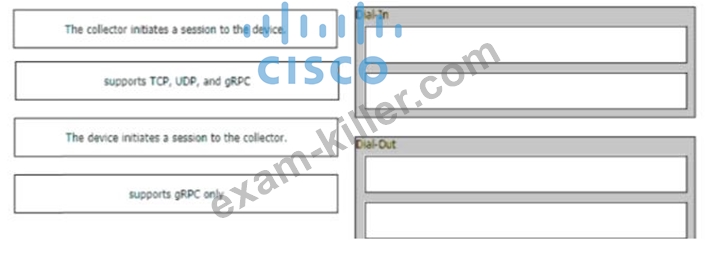
Answer:
Explanation:
NEW QUESTION # 255 
Refer to the exhibit. An architect must design a solution to connect the two ASs. To optimize bandwidth, the design will implement load sharing between router R6 and router R4. Which solution should the design include?
- A. Use maximum-paths to install multiple paths in the routing table.
- B. Use update-source to specify the Loopback interface.
- C. Use next-hop-serf attributes only for routes that are learned from eBGP peers.
- D. Configure the eBGP TTL to support eBGP multihop.
Answer: A
Explanation:
The BGP maximum-paths feature should be included when the design goal is to install multiple eligible BGP paths in the routing table and use them for load sharing. By default, BGP selects a single best path after comparing attributes such as weight, local preference, AS path, origin, MED, eBGP over iBGP, IGP metric to next hop, and other tie breakers. If two links between autonomous systems should both carry traffic, the router must be allowed to retain more than one equal or eligible path for forwarding. The maximum-paths command enables BGP multipath installation so the data plane can load share across the available links. Update-source is used to source a BGP session from a loopback or specific interface, not to perform load sharing. Next-hop- self influences recursive reachability and next-hop handling but does not install multiple paths by itself. eBGP multihop changes TTL behavior for non-directly connected eBGP neighbors and is unrelated to load sharing over the two links. Reference topics: BGP multipath, maximum-paths, eBGP load sharing, BGP path selection, route installation.
NEW QUESTION # 256
What is the purpose of Cisco Catalyst SD-WAN Cloud OnRamp?
- A. It simplifies and automates the process of connecting on-premises environments to the cloud.
- B. It brings secure and private connectivity agnostics to all types of links and providers.
- C. It delivers secure access to business-critical applications across a multicloud environment.
- D. It creates Cisco Catalyst SD-WAN application-aware policies and route-critical applications.
Answer: A
Explanation:
Cisco Catalyst SD-WAN Cloud OnRamp is built to simplify and automate cloud connectivity from enterprise sites. Cisco describes the feature as a way to simplify connecting on-premises environments to cloud-hosted applications and workloads while extending SD-WAN policy into the cloud. The key design value is automation: branches and data centers can connect to SaaS, IaaS, or multicloud resources without manually building every tunnel, route policy, and cloud attachment. That is why option D is the strongest answer.
Option A is too broad because generic transport independence is a core SD-WAN value, not the specific purpose of Cloud OnRamp. Option B confuses Cloud OnRamp with application-aware routing policy. Option C describes a business outcome, but the operational purpose tested here is automated on-premises-to-cloud integration and consistent policy extension. Reference topics: Cisco Catalyst SD-WAN Cloud OnRamp, multicloud connectivity, cloud workload access, SD-WAN fabric extension, automated cloud onboarding.
NEW QUESTION # 257
Which function are fabric intermediate nodes responsible for in an SD-Access Architecture?
- A. registering new endpoints in the HTDB
- B. encapsulating user traffic in a VXLAN header including the SGT
- C. mapping EIDs to RLOCs
- D. transporting IP packets between edge nodes and border nodes
Answer: D
NEW QUESTION # 258
Which OSPF area blocks LSA Type 3, 4 and 5, but allows a default summary route?
- A. stub
- B. NSSA
- C. totally stubby
- D. normal
Answer: C
NEW QUESTION # 259
Drag and drop the characteristics from the left onto the correct telemetry mode on the right.
Answer:
Explanation:
In a dial-in mode, the destination initiates a session to the router and subscribes to data to be streamed. Dialin mode is supported over gRPC in only 64-bit platforms In a dial-out mode, the router initiates a session to the destinations based on the subscription. All 64-bit IOS XR platforms (except for NCS 6000 series routers) support gRPC and TCP protocols. All 32-bit IOS XR platforms support only TCP.
Reference:
https://www.cisco.com/c/en/us/td/docs/iosxr/asr9000/telemetry/b-telemetry-cg-asr9000-61x/b-telemetry-cgasr9000-
61x_chapter_010.html#id_36445
NEW QUESTION # 260
An engineer is working for a large cable TV provider that requires multiple sources streaming video on different channels using multicast with no rendezvous point. Which multicast protocol meets these requirements?
- A. BIDIR-PIM
- B. PIM-SM
- C. any-source multicast
- D. PIM-SSM
Answer: A
Explanation:
Section: Network Services
NEW QUESTION # 261
What is the purpose of the fabric control plane in a Cisco SD-Access architecture?
- A. create and resolve endpoint-to-location mapping
- B. create, propagate, and enforce GBAC policies in the fabric
- C. extend multiple subnets to one RLOC
- D. create a transit node with BGP route reflector functionality
Answer: A
NEW QUESTION # 262
Which option will help build your customers platform during the discovery phase?
- A. POV report
- B. high-level design
- C. business case
- D. PO
- E. detailed design
Answer: C
NEW QUESTION # 263
An engineer is designing a multicast network for a company specializing in VoD content. Receivers are across the Internet, and for performance reasons, the multicast framework close to the receivers within each AS. For high availability, if the sources in one AS are no longer available, the receivers of that AS must be able to receive the VoD content from sources in another AS. Which feature must the design include?
- A. Bidirectional PIM
- B. Anycast RP
- C. MSDP
- D. SSM
Answer: B
Explanation:
Explanation
https://learningnetwork.cisco.com/s/question/0D53i00000KsrGrCAJ/rendezvous-point-high-availability-mechan
NEW QUESTION # 264
Drag and drop the characteristics from the left onto the configuration protocols they describe on the right.
Answer:
Explanation:
NEW QUESTION # 265
A customer reports that each time a networking component fails, OSPF recalculates the backup path, with causes a short outage. Which solution must the customer implement to improve this situation?
- A. Incremental SPF
- B. Aggressive OSPF timers
- C. BFD
- D. LFA FRR
Answer: A
Explanation:
https://www.cisco.com/c/en/us/td/docs/ios-xml/ios/iproute_ospf/configuration/15-sy/iro-15-sy-book/iro-incre-spf.pdf
NEW QUESTION # 266
Which two BGP features will result in successful route exchanges between eBGP neighbors sharing the same AS number? (Choose two.)
- A. as-override
- B. bestpath as-path ignore
- C. advertise-best-external
- D. client-to-client reflection
- E. allow-as-in
Answer: A,E
Explanation:
Section: Advanced Addressing and Routing Solutions
NEW QUESTION # 267
Which consideration must be made when designing a Cisco SD-Access fabric underlay?
- A. A unified policy must be used.
- B. Up to six control planes are supported.
- C. Subnets must be reduced to decrease latency.
- D. The default MTU should be increased.
Answer: D
Explanation:
The default MTU should be increased in the Cisco SD-Access fabric underlay. SD-Access data-plane traffic uses VXLAN encapsulation, and VXLAN adds overhead beyond the original endpoint frame. If the underlay remains at a standard 1500-byte MTU, encapsulated packets can fragment or be dropped, especially when applications set the DF bit. Cisco SD-Access design guidance therefore calls for an increased underlay MTU so the fabric can carry overlay-encapsulated traffic cleanly. Reducing subnets is an overlay simplification topic, not an underlay MTU consideration. The number of supported control-plane nodes is a scale and availability design consideration, not the key underlay requirement in this question. Unified policy is part of fabric policy and segmentation, not underlay transport readiness. A professional SD-Access underlay design validates routed reachability, loopback advertisements, IGP operation, redundant paths, and MTU end to end before enabling the overlay. The MTU setting is critical because a stable underlay must transport LISP control-plane traffic and VXLAN data-plane traffic without fragmentation. Reference topics: SD-Access underlay, VXLAN overhead, MTU design, fabric transport readiness.
NEW QUESTION # 268
Drag and drop the elements from the left onto the YANG models where they and used on the right.
Answer:
Explanation: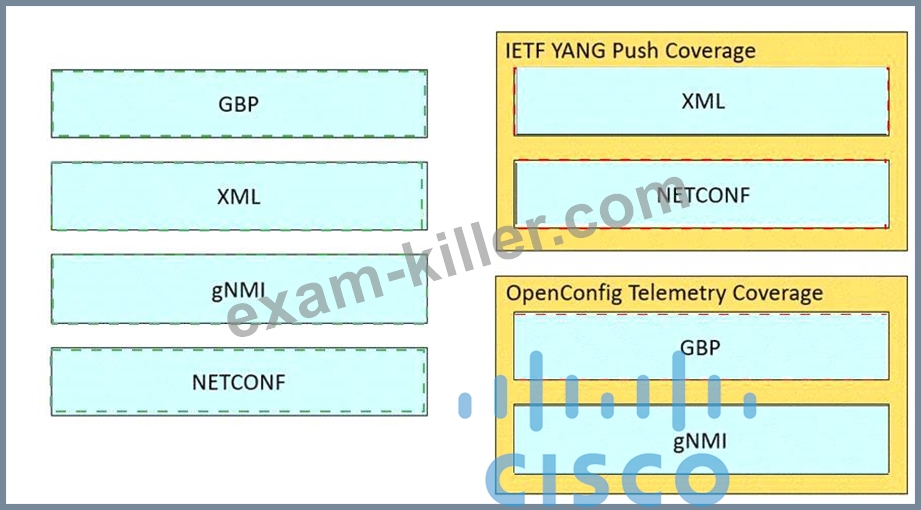
Explanation:
The drag-and-drop answer follows the practical distinction between the YANG model families. IETF models are standards-based models intended to provide a common structure for widely implemented protocol and interface functions. OpenConfig models are vendor-neutral operational and configuration models developed for cross-vendor automation, with a strong focus on consistent telemetry and network state representation.
Cisco native models expose Cisco platform-specific capabilities and usually provide the deepest coverage for IOS XE, IOS XR, or NX-OS features that are not fully represented in a common model. The selected mapping therefore assigns model elements according to origin, portability, and feature depth. In a production automation design, engineers should start with open models when interoperability and long-term portability matter, but they should choose Cisco native models when a required Cisco feature is not available or is incomplete in IETF or OpenConfig. The choice is not cosmetic; it affects payload structure, namespace, validation behavior, and operational consistency across device families. Reference topics: YANG model families, IETF YANG, OpenConfig, Cisco native YANG, model-driven configuration.
NEW QUESTION # 269 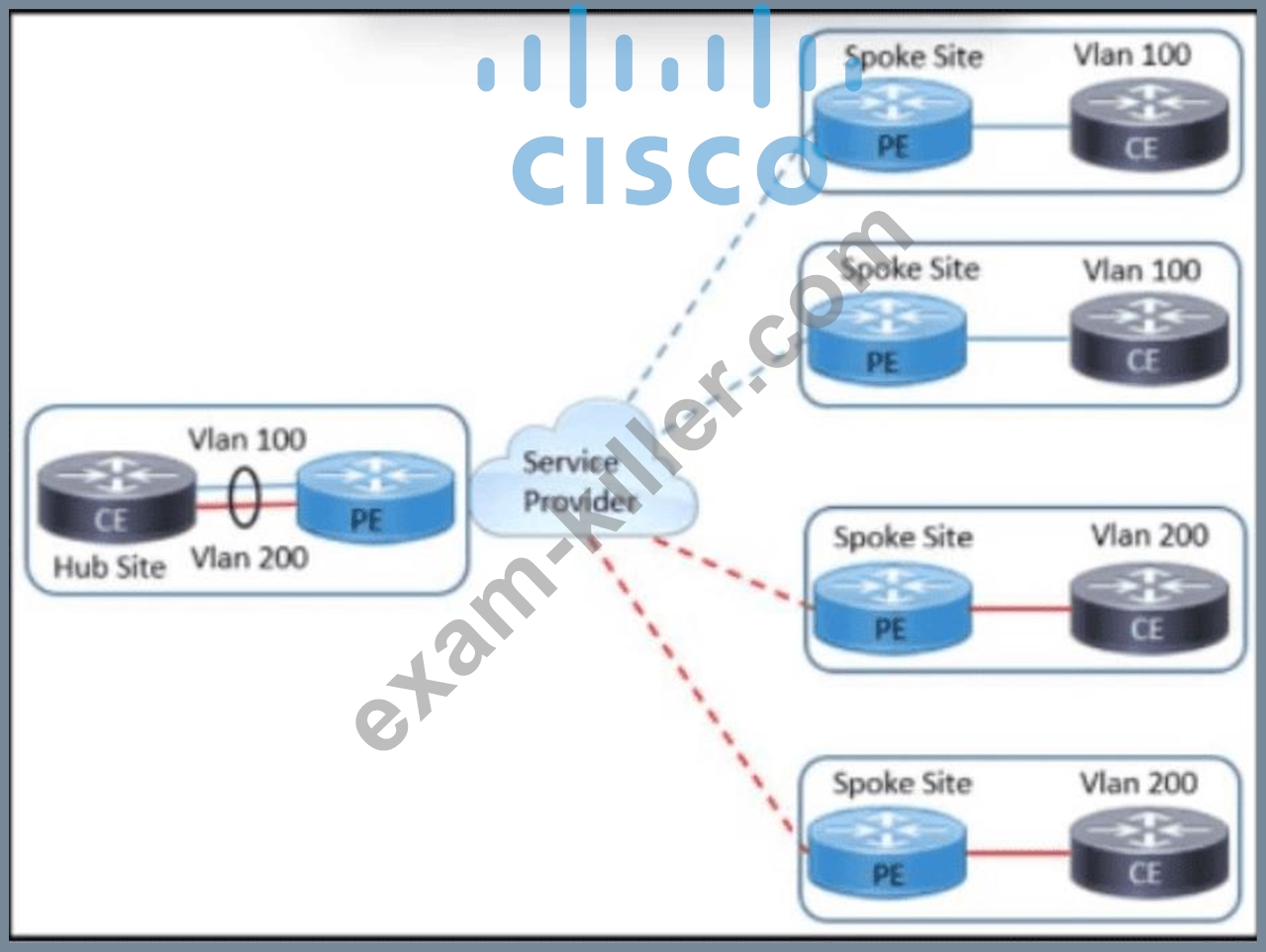
Refer to the exhibit. An architect working for a service provider with an employee ID: 4763:44:876 must design a Layer 2 VPN solution that supports:
* transparency of service provider devices
* direct communication between CE routers attached to the same VLAN
Which solution must the design include?
- A. single VPWS
- B. single VPLS
- C. multiple VPLS
- D. multiple VPWS
Answer: B
Explanation:
A single VPLS instance is the correct Layer 2 VPN design because the customer requires service-provider transparency and direct communication between CE routers attached to the same VLAN. Virtual Private LAN Service provides a multipoint Ethernet LAN service across a provider MPLS or IP backbone. To the customer, the provider network behaves like a transparent Layer 2 switching domain, allowing CE devices in the same VLAN to communicate directly at Layer 2. VPWS is point-to-point, so multiple VPWS circuits would be required to approximate multipoint connectivity, and the design would not provide the same transparent shared LAN behavior. Multiple VPLS instances are unnecessary when the requirement is a single VLAN or single broadcast domain. VPLS also hides provider devices from the customer Layer 2 service view while allowing MAC learning and forwarding across the provider edge. Reference topics: VPLS, Layer 2 VPN, multipoint Ethernet service, CE transparency, VLAN extension, service provider WAN design.
NEW QUESTION # 270
Which nonproprietary mechanism can be used to automate rendezvous point distribution in a large PIM domain?
- A. Static RP
- B. BSR
- C. Embedded RP
- D. Auto-RP
Answer: B
NEW QUESTION # 271
Refer to the exhibit.
A customer is running HSRP on the core routers. Over time the company has grown and requires more network capacity. In the current environment, some of the downstream interfaces are almost fully utilized, but others are not. Which solution improves the situation?
- A. Enable RSTP on the downstream switches.
- B. Make router R2 active for half of the VLANs.
- C. Add more interfaces to R1 and R2.
- D. Configure port channel toward downstream switches.
Answer: B
NEW QUESTION # 272
An architect must develop a campus network solution that includes:
logically segmented and isolated networks
ability to communicate between network segments when required
support for overlapping IP addresses
widely available technologies to avoid purchasing specialized equipment Which solution must the architect select?
- A. vPC with HSRP
- B. VRF-Lite with OSPF
- C. VSS with IGP
- D. 802.1Q with HSRP
Answer: B
NEW QUESTION # 273
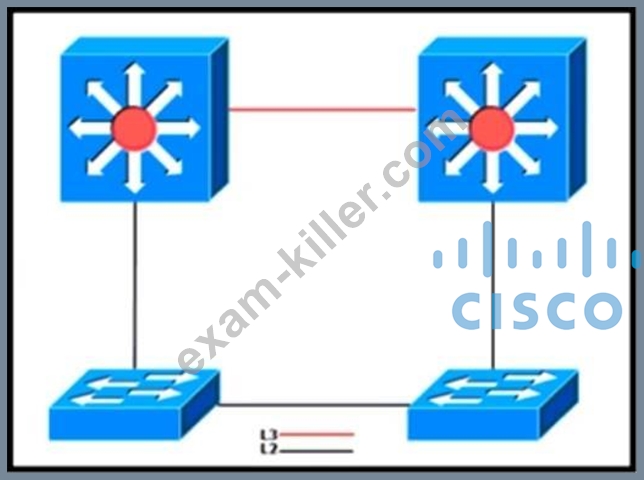
An engineer working for a service provider with an employee ID: 4604:68:004 prepared several designs for a traditional campus network. The design must allow the deployment of the same VLAN to any switch at the access layer and must support:
- fast convergence
- high availability
- resilience
Which design must be selected?
- A.

- B.
- C.

- D.

Answer: B
NEW QUESTION # 274
......
Try Free and Start Using Realistic Verified 300-420 Dumps Instantly.: https://www.exam-killer.com/300-420-valid-questions.html
300-420 Actual Questions - Instant Download 457 Questions: https://drive.google.com/open?id=1tDLs3jnpKrFreZzQMqJKnVN3TSZtRk25
