

2024 AZ-305 exam torrent AZ-305 Study Guide
Easily pass AZ-305 Exam with our Dumps & PDF Test Engine
NEW QUESTION # 12
Your on-premises network contains a file server named Server1 that stores 500 GB of data.
You need to use Azure Data Factory to copy the data from Server1 to Azure Storage.
You add a new data factory.
What should you do next? To answer, select the appropriate options in the answer area.
NOTE: Each correct selection is worth one point.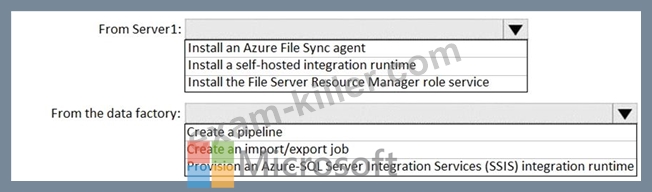
Answer:
Explanation: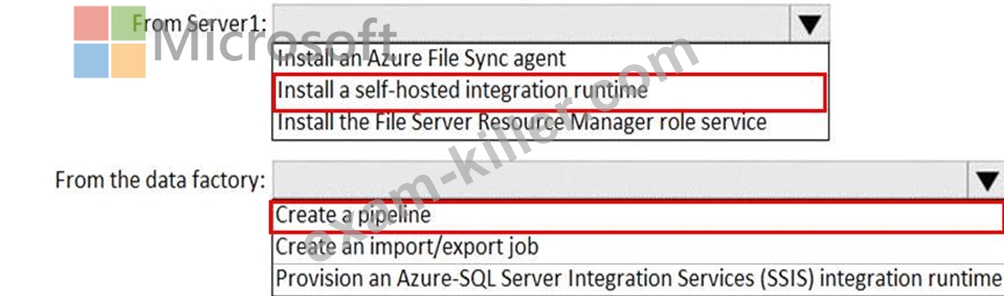
Reference:
https://docs.microsoft.com/en-us/azure/machine-learning/team-data-science-process/move-sql-azure-adf
https://docs.microsoft.com/pl-pl/azure/data-factory/tutorial-hybrid-copy-data-tool syu31svc 3 months, 4 weeks ago
https://docs.microsoft.com/en-us/azure/data-factory/create-self-hosted-integration-runtime?tabs=data-factory
"A self-hosted integration runtime can run copy activities between a cloud data store and a data store in a private network"
https://docs.microsoft.com/en-us/azure/data-factory/introduction
"With Data Factory, you can use the Copy Activity in a data pipeline to move data from both on-premises and cloud source data stores to a centralization data store in the cloud for further analysis"
NEW QUESTION # 13
You plan to automate the deployment of resources to Azure subscriptions.
What is a difference between using Azure Blueprints and Azure Resource Manager templates?
- A. Azure Blueprints remain connected to the deployed resources.
- B. Only Azure Blueprints can contain policy definitions.
- C. Azure Resource Manager templates remain connected to the deployed resources.
- D. Only Azure Resource Manager templates can contain policy definitions.
Answer: A
Explanation:
With Azure Blueprints, the relationship between the blueprint definition (what should be deployed) and the blueprint assignment (what was deployed) is preserved. This connection supports improved tracking and auditing of deployments. Azure Blueprints can also upgrade several subscriptions at once that are governed by the same blueprint.
Reference:
https://docs.microsoft.com/en-us/answers/questions/26851/how-is-azure-blue-prints-different-from-resource-m.html
NEW QUESTION # 14
Note: This question is part of a series of questions that present the same scenario. Each question in the series contains a unique solution that might meet the stated goals. Some question sets might have more than one correct solution, while others might not have a correct solution.
After you answer a question in this section, you will NOT be able to return to it. As a result, these questions will not appear in the review screen.
Your company plans to deploy various Azure App Service instances that will use Azure SQL databases. The App Service instances will be deployed at the same time as the Azure SQL databases.
The company has a regulatory requirement to deploy the App Service instances only to specific Azure regions. The resources for the App Service instances must reside in the same region.
You need to recommend a solution to meet the regulatory requirement.
Solution: You recommend using the Regulatory compliance dashboard in Azure Security Center.
Does this meet the goal?
- A. Yes
- B. No
Answer: B
Explanation:
The Regulatory compliance dashboard in Azure Security Center is not used for regional compliance.
Note: Instead Azure Resource Policy Definitions can be used which can be applied to a specific Resource Group with the App Service instances.
Note 2: In the Azure Security Center regulatory compliance blade, you can get an overview of key portions of your compliance posture with respect to a set of supported standards. Currently supported standards are Azure CIS, PCI DSS 3.2, ISO 27001, and SOC TSP.
Reference:
https://docs.microsoft.com/en-us/azure/governance/policy/overview
https://azure.microsoft.com/en-us/blog/regulatory-compliance-dashboard-in-azure-security-center-now-available/
NEW QUESTION # 15
You have an Azure subscription named Sub1 that is linked to an Azure AD tenant named contoso.com.
You plan to implement two ASP.NET Core apps named App1 and App2 that will be deployed to 100 virtual machines in Sub1. Users will sign in to App1 and App2 by using their contoso.com credentials.
App1 requires read permissions to access the calendar of the signed-m user. App2 requires write permissions to access the calendar of the signed-in user.
You need to recommend an authentication and authorization solution for the apps. The solution must meet the following requirements:
* Use the principle of least privilege.
* Minimize administrative effort
What should you include in the recommendation? To answer, select the appropriate options in the answer area.
NOTE: Each correct selection is worth one pent.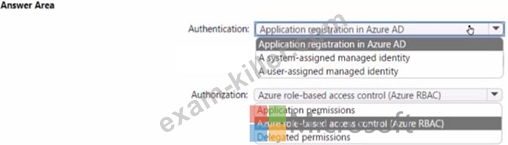
Answer:
Explanation: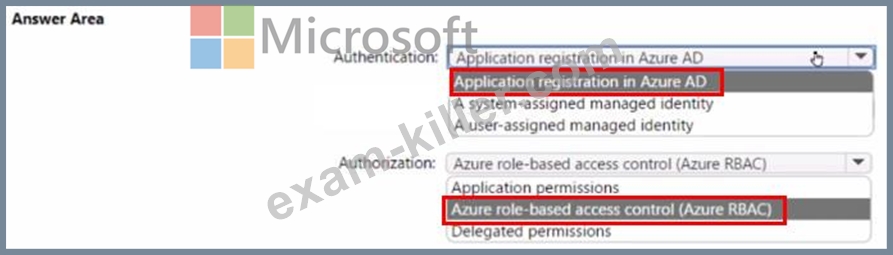
NEW QUESTION # 16
You need to design an architecture to capture the creation of users and the assignment of roles. The captured data must be stored in Azure Cosmos DB.
Which Azure services should you include in the design? To answer, drag the appropriate services to the correct targets. Each service may be used once, more than once, or not at all. You may need to drag the split bar between panes or scroll to view content.
NOTE: Each correct selection is worth one point.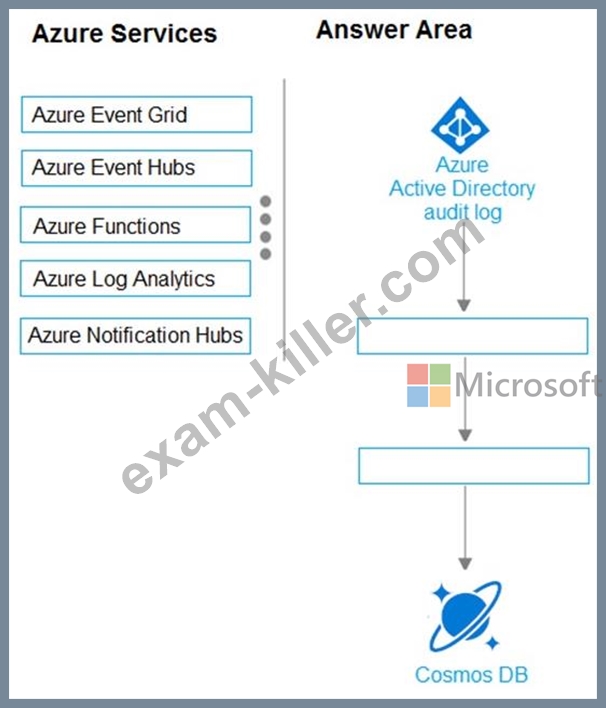
Answer:
Explanation: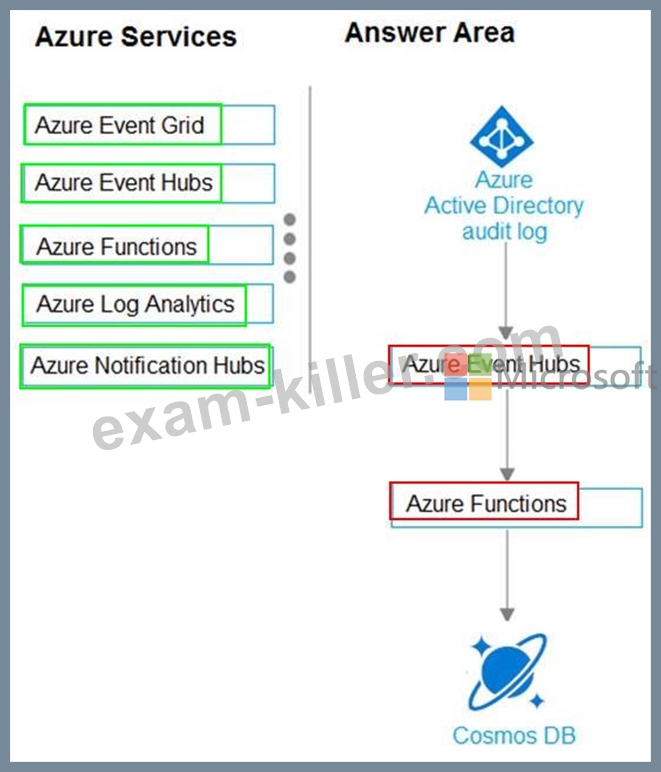
NEW QUESTION # 17
You are designing an application that will use Azure Linux virtual machines to analyze video files. The files will be uploaded from corporate offices that connect to Azure by using ExpressRoute.
You plan to provision an Azure Storage account to host the files.
You need to ensure that the storage account meets the following requirements:
* Supports video files of up to 7 TB
* Provides the highest availability possible
* Ensures that storage is optimized for the large video files
* Ensures that files from the on-premises network are uploaded by using ExpressRoute How should you configure the storage account? To answer, select the appropriate options in the answer area.
NOTE: Each correct selection is worth one point.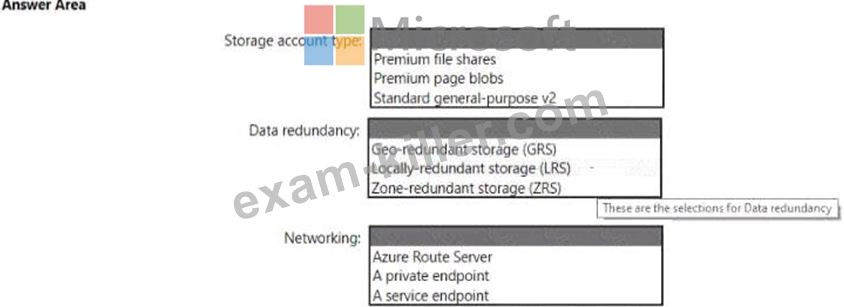
Answer:
Explanation: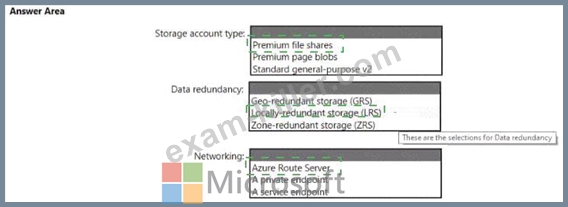
Explanation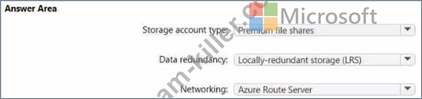
NEW QUESTION # 18
You have an Azure App Service web app that uses a system-assigned managed identity.
You need to recommend a solution to store their settings of the web app as secrets in an Azure key vault The solution must meet the following requirements:
* Minimize changes to the app code,
* Use the principle of least privilege.
What should you include in the recommendation? To answer, select the appropriate options in the answer area.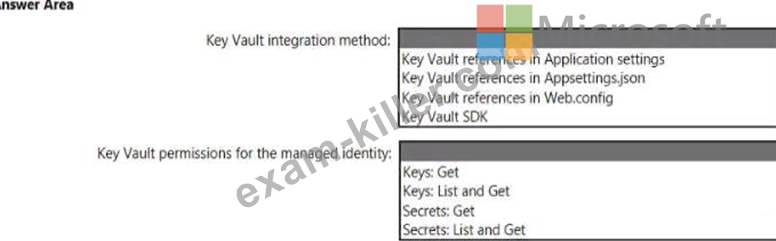
Answer:
Explanation: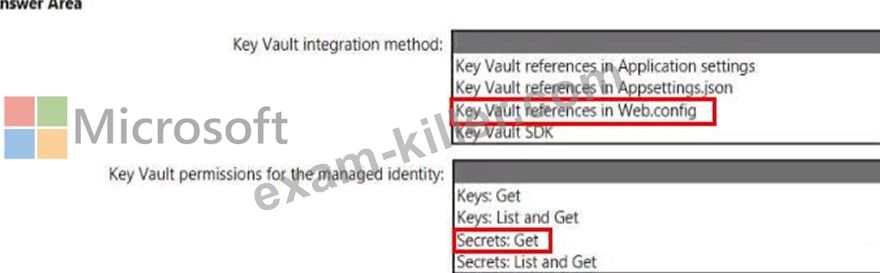
NEW QUESTION # 19
Your company has the divisions shown in the following table.
You plan to deploy a custom application to each subscription. The application will contain the following:
A resource group
An Azure web app
Custom role assignments
An Azure Cosmos DB account
You need to use Azure Blueprints to deploy the application to each subscription.
What is the minimum number of objects required to deploy the application? To answer, select the appropriate options in the answer area.
NOTE: Each correct selection is worth one point.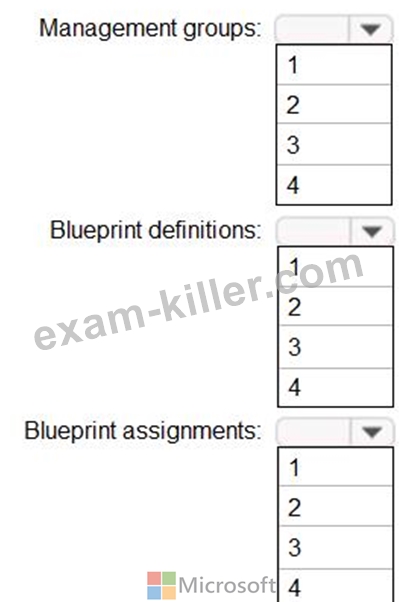
Answer:
Explanation: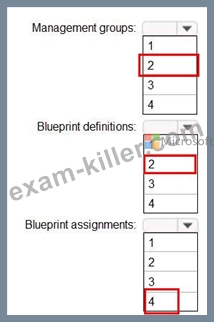
NEW QUESTION # 20
You have an Azure subscription.
You need to deploy an Azure Kubernetes Service (AKS) solution that will use Windows Server 2019 nodes.
The solution must meet the following requirements:
Minimize the time it takes to provision compute resources during scale-out operations.
Support autoscaling of Windows Server containers.
Which scaling option should you recommend?
- A. Virtual nodes with Virtual Kubelet ACI
- B. horizontal pod autoscaler
- C. cluster autoscaler
- D. Kubernetes version 1.20.2 or newer
Answer: A
Explanation:
Explanation
Azure Container Instances (ACI) lets you quickly deploy container instances without additional infrastructure overhead. When you connect with AKS, ACI becomes a secured, logical extension of your AKS cluster. The virtual nodes component, which is based on Virtual Kubelet, is installed in your AKS cluster that presents ACI as a virtual Kubernetes node. Kubernetes can then schedule pods that run as ACI instances through virtual nodes, not as pods on VM nodes directly in your AKS cluster.
Your application requires no modification to use virtual nodes. Deployments can scale across AKS and ACI and with no delay as cluster autoscaler deploys new nodes in your AKS cluster.
Diagram Description automatically generated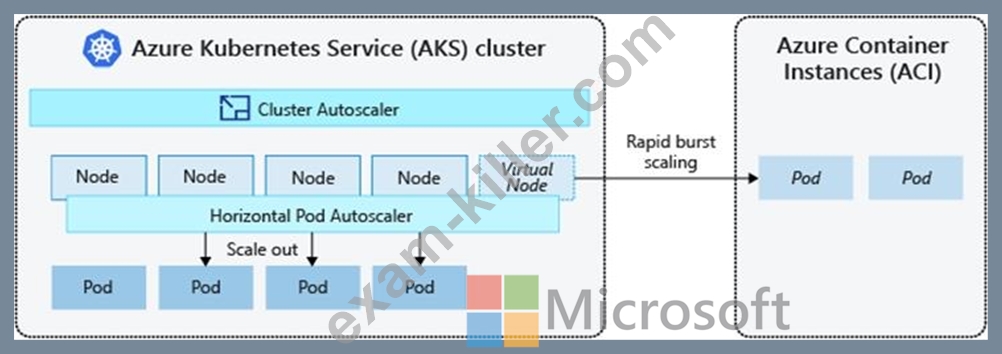
Note: AKS clusters can scale in one of two ways:
* The cluster autoscaler watches for pods that can't be scheduled on nodes because of resource constraints.
The cluster then automatically increases the number of nodes.
* The horizontal pod autoscaler uses the Metrics Server in a Kubernetes cluster to monitor the resource demand of pods. If an application needs more resources, the number of pods is automatically increased to meet the demand.
Reference:
https://docs.microsoft.com/en-us/azure/aks/concepts-scale5
NEW QUESTION # 21
You have the Azure resources shown in the following table.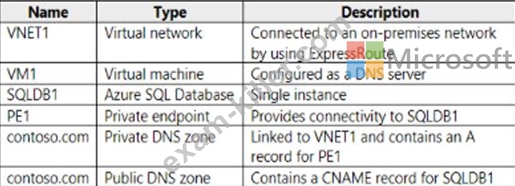
You need to design a solution that provides on-premises network connectivity to SQLDB1 through PE1. How should you configure name resolution? To answer, select the appropriate options in the answer area.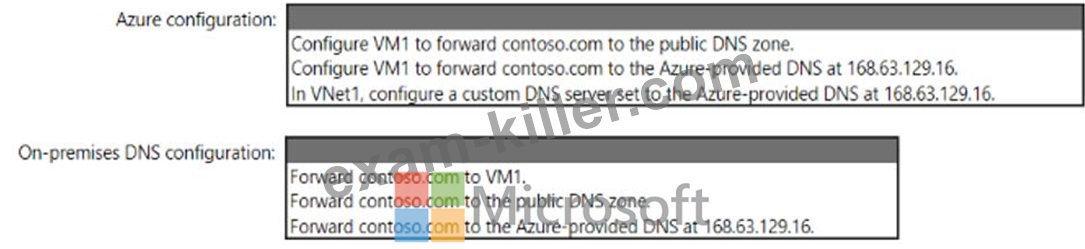
Answer:
Explanation: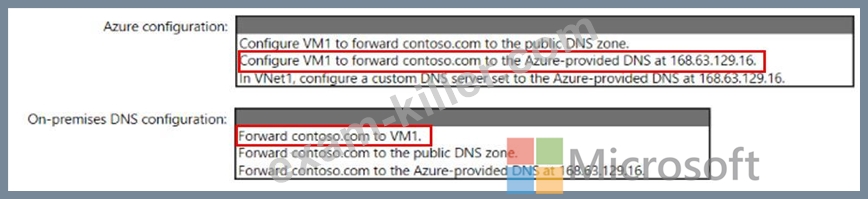
NEW QUESTION # 22
You have an Azure subscription that contains a virtual network named VNET1 and 10 virtual machines. The virtual machines are connected to VNET1.
You need to design a solution to manage the virtual machines from the internet. The solution must meet the following requirements:
* Incoming connections to the virtual machines must be authenticated by using Azure Multi-Factor Authentication (MFA) before network connectivity is allowed.
* Incoming connections must use TLS and connect to TCP port 443.
* The solution must support RDP and SSH.
What should you Include In the solution? To answer, select the appropriate options in the answer area.
NOTE: Each correct selection is worth one point.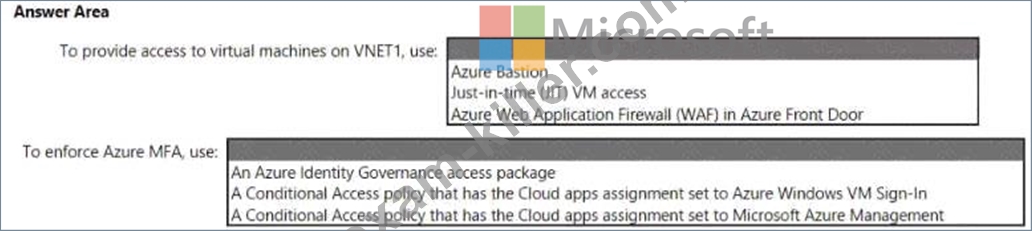
Answer:
Explanation: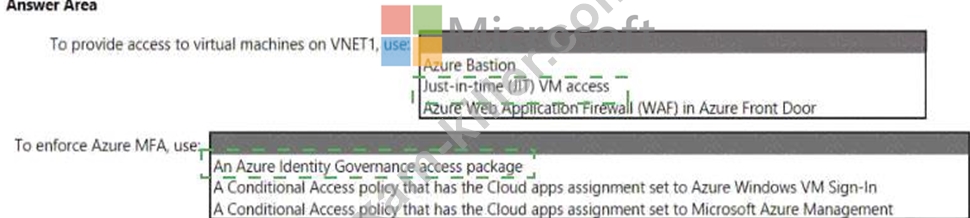
Explanation
NEW QUESTION # 23
You are designing an Azure web app.
You plan to deploy the web app to the North Europe Azure region and the West Europe Azure region.
You need to recommend a solution for the web app. The solution must meet the following requirements:
Users must always access the web app from the North Europe region, unless the region fails.
The web app must be available to users if an Azure region is unavailable.
Deployment costs must be minimized.
What should you include in the recommendation? To answer, select the appropriate options in the answer area.
NOTE: Each correct selection is worth one point.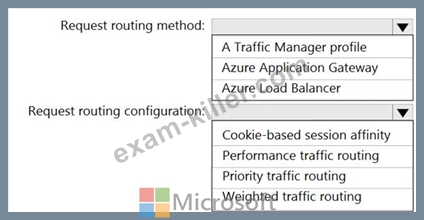
Answer:
Explanation: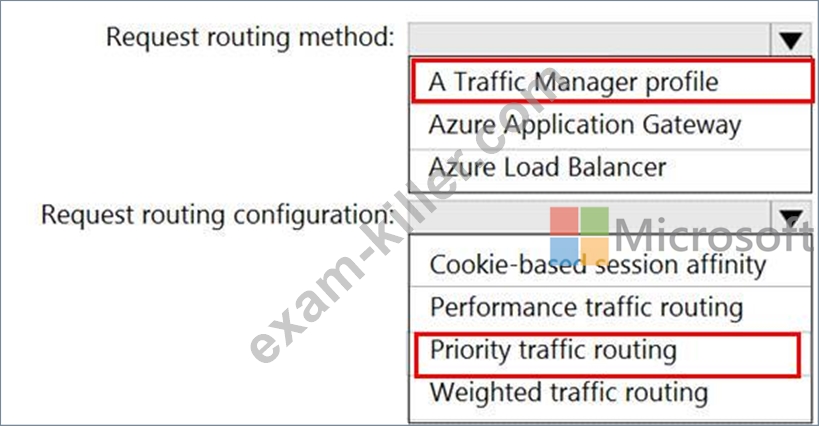
Explanation:
https://docs.microsoft.com/en-us/azure/traffic-manager/traffic-manager-routing-methods#priority-traffic-routing-method
NEW QUESTION # 24
You have a resource group named RG1 that contains the objects shown in the following table.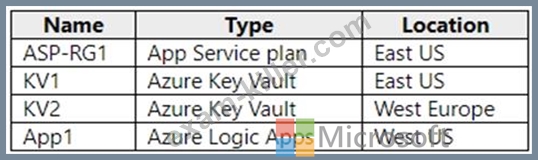
You need to configure permissions so that App1 can copy all the secrets from KV1 to KV2. App1 currently has the Get permission for the secrets in KV1.
Which additional permissions should you assign to App1? To answer, select the appropriate options in the answer area.
NOTE: Each correct selection is worth one point.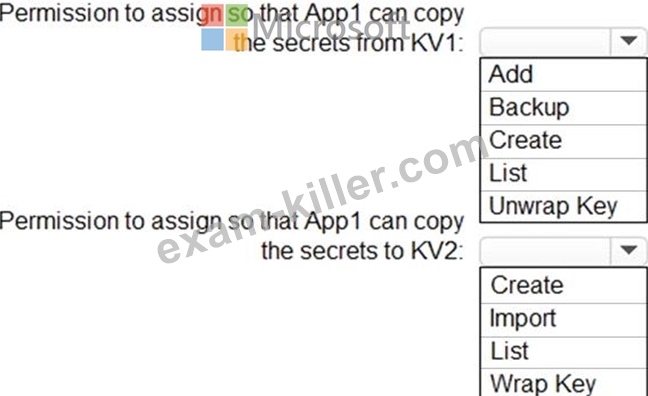
Answer:
Explanation: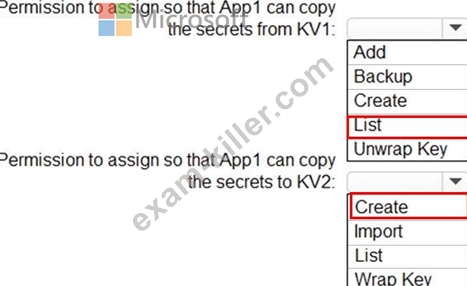
Reference:
https://docs.microsoft.com/en-us/rest/api/keyvault/
NEW QUESTION # 25
You plan to develop a new app that will store business critical dat
a. The app must meet the following requirements:
Prevent new data from being modified for one year.
Minimize read latency.
Maximize data resiliency.
You need to recommend a storage solution for the app.
What should you recommend? To answer, select the appropriate options in the answer area.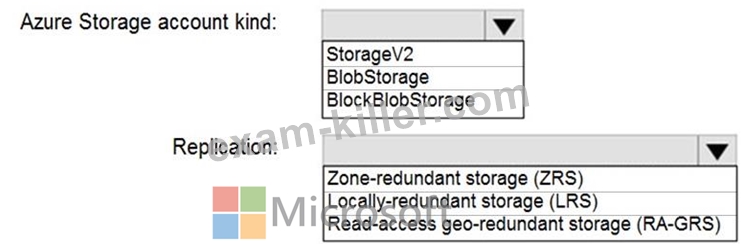
Answer:
Explanation: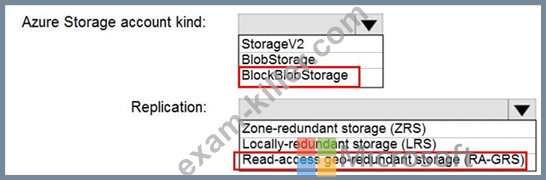
Reference:
https://docs.microsoft.com/en-us/azure/storage/common/storage-account-overview
https://docs.microsoft.com/en-us/azure/storage/common/storage-redundancy?toc=/azure/storage/blobs/toc.json
NEW QUESTION # 26
You are designing an Azure web app.
You plan to deploy the web app to the North Europe Azure region and the West Europe Azure region.
You need to recommend a solution for the web app. The solution must meet the following requirements:
Users must always access the web app from the North Europe region, unless the region fails.
The web app must be available to users if an Azure region is unavailable.
Deployment costs must be minimized.
What should you include in the recommendation? To answer, select the appropriate options in the answer area.
NOTE: Each correct selection is worth one point.
Answer:
Explanation: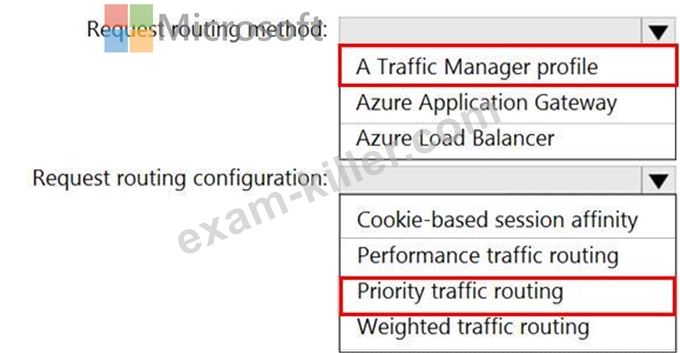
NEW QUESTION # 27
You need to design a storage solution for an app that will store large amounts of frequently used data. The solution must meet the following requirements:
* Maximize data throughput.
* Prevent the modification of data for one year.
* Minimize latency for read and write operations.
Which Azure Storage account type and storage service should you recommend? To answer, select the appropriate options in the answer area.
NOTE: Each correct selection is worth one point.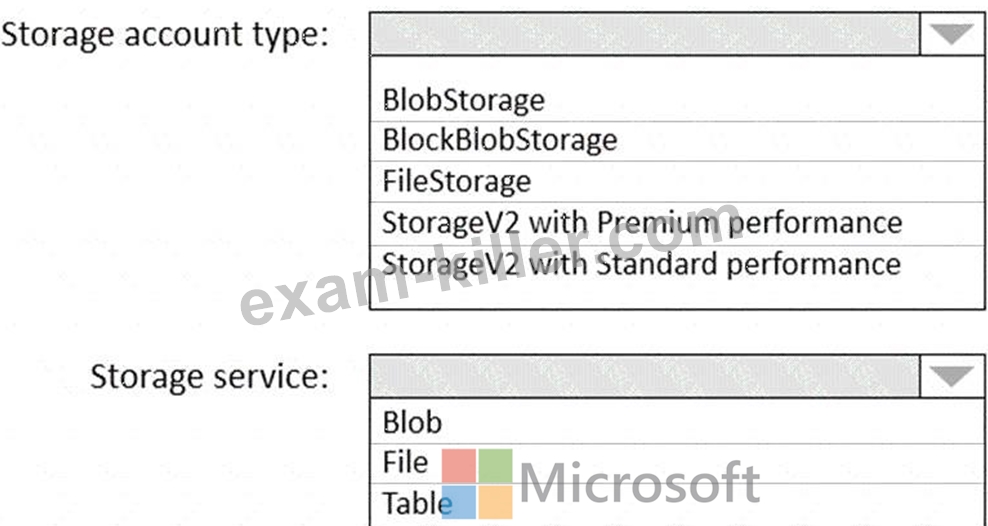
Answer:
Explanation: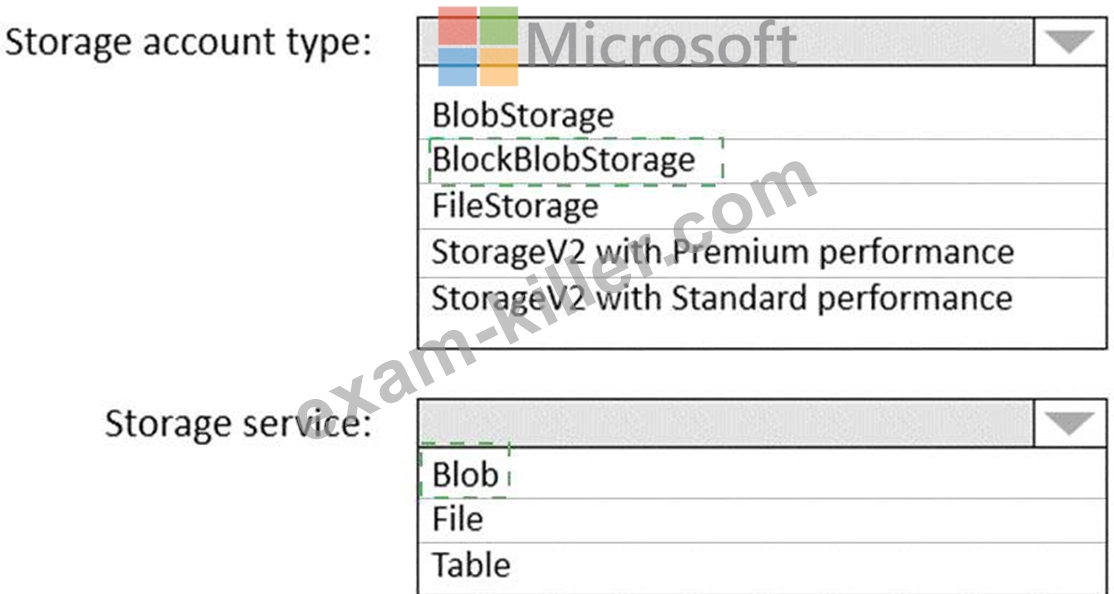
Explanation
Box 1: BlockBlobStorage
Block Blob is a premium storage account type for block blobs and append blobs. Recommended for scenarios with high transactions rates, or scenarios that use smaller objects or require consistently low storage latency.
Box 2: Blob
The Archive tier is an offline tier for storing blob data that is rarely accessed. The Archive tier offers the lowest storage costs, but higher data retrieval costs and latency compared to the online tiers (Hot and Cool).
Data must remain in the Archive tier for at least 180 days or be subject to an early deletion charge.
Reference:
https://docs.microsoft.com/en-us/azure/storage/blobs/archive-blob
NEW QUESTION # 28
You have an on-premises Microsoft SQL Server database named SQL1.
You plan to migrate SQL 1 to Azure.
You need to recommend a hosting solution for SQL1. The solution must meet the following requirements:
* Support the deployment of multiple secondary, read-only replicas.
* Support automatic replication between primary and secondary replicas.
* Support failover between primary and secondary replicas within a 15-minute recovery time objective (RTO).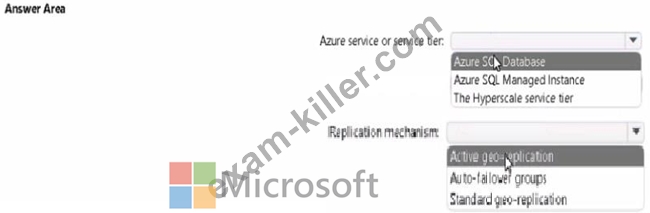
Answer:
Explanation: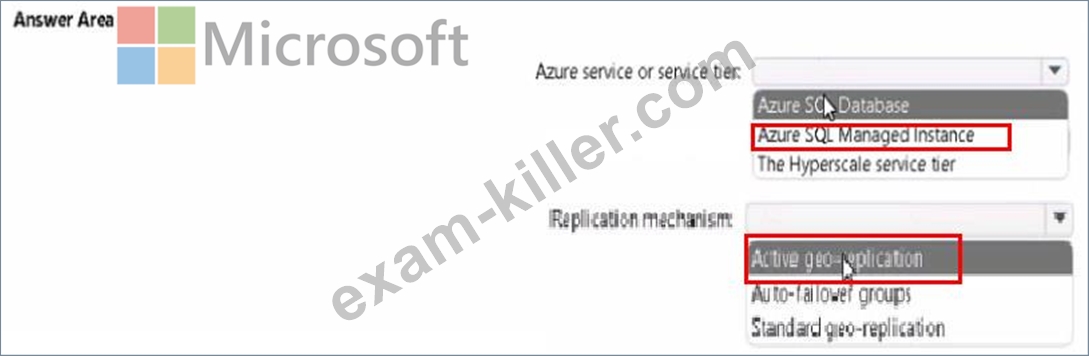
NEW QUESTION # 29
......
AZ-305 PDF Pass Leader, AZ-305 Latest Real Test: https://www.exam-killer.com/AZ-305-valid-questions.html
Valid AZ-305 Test Answers & AZ-305 Exam PDF: https://drive.google.com/open?id=1tNLdh4E_W6WnfrIt3-VSegEwwM0AOunr
