

Use Real OGEA-101 - 100% Cover Real Exam Questions [Oct-2025]
Dumps Brief Outline Of The OGEA-101 Exam - Exam-Killer
NEW QUESTION # 58
Complete the following sentence:
Presenting different_________and_________to stakeholders helps architects to extract hidden agendas principles and requirements that could impact the final Target Architecture
- A. Alternatives Trade-offs
- B. Business Scenarios Business Models
- C. Architecture Views Architecture Viewpoints
- D. Solutions Applications
Answer: C
Explanation:
According to the TOGAF Standard, an architecture view is a representation of a system from the perspective of a related set of concerns1. An architecture viewpoint is a specification of the conventions for a particular kind of architecture view1. Presenting different architecture views and architecture viewpoints to stakeholders helps architects to extract hidden agendas, principles, and requirements that could impact the final target architecture. This is because different stakeholders may have different concerns and interests in the system, and by showing them how the system addresses their concerns from different perspectives, the architects can elicit more feedback and validation from them2. For example, a business stakeholder may be interested in the business architecture view, which focuses on the business processes, functions, and capabilities of the system3. A security stakeholder may be interested in the enterprise security view, which addresses the security aspects of the system, such as confidentiality, integrity, and availability3. By presenting these views to the respective stakeholders, the architects can ensure that the system meets their expectations and needs, and also identify any potential issues or gaps that may affect the target architecture. References: 1: The TOGAF Standard, Version 9.2 - Architectural Artifacts - TheOpen Group1; 2: Understanding TOGAF Views and Viewpoints in Enterprise Architecture2; 3: Developing Architecture Views - The Open Group4
NEW QUESTION # 59
Which of the following are the four purposes that typically frame the planning horizon, depth and breadth of an Architecture Project, and the contents of the EA Repository-?
- A. General Foundational Subordinate and Superior Architecture
- B. Strategy Portfolio Project Solution Delivery
- C. Avant-Garde Big-Bang, Discreet and Cohesive
- D. Segment, Capability. Enterprise and End-to-end Target Architecture
Answer: B
Explanation:
Strategy Portfolio Project Solution Delivery are the four purposes that typically frame the planning horizon, depth and breadth of an Architecture Project, and the contents of the EA Repository. They correspond to different levels of abstraction and granularity in the architecture development process. Reference: The TOGAF Standard, Version 9.2 - The Open Group, Section 2.4 Architecture Repository.
NEW QUESTION # 60
Complete the sentence. The four purposes that typically frame the planning horizon, depth and breadth of an Architecture Project, and the contents of the EA Repository are Strategy, Portfolio,
- A. Project, and Solution Delivery.
- B. Discreet, and Cohesive.
- C. Segment, and End-to-end Target Architecture.
- D. Subordinate, and Superior Architecture.
Answer: C
Explanation:
The planning horizon, depth, and breadth of an Architecture Project, along with the contents of the EA Repository, are typically framed by Strategy, Portfolio, Segment, and End-to-end Target Architecture. The 'Segment' refers to a part of the organization, typically addressed in a Segment Architecture, while 'End-to-end Target Architecture' encompasses the complete view of the planned architecture across the entire organization.
NEW QUESTION # 61
Consider the following ADM phases objectives.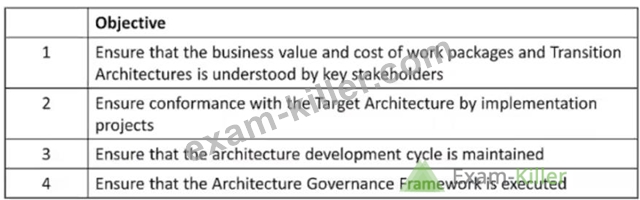
Which phase does each objective match?
- A. 1F-2G-3H-4H
- B. 1H-2F-3F-4G
- C. 1F-2G-3G-4H
- D. 1G-2H-3H-4F
Answer: B
Explanation:
According to the TOGAF Standard, Version 9.2, the ADM phases and their objectives are as follows1:
Preliminary Phase: To prepare and initiate the architecture development cycle, including defining the architecture framework, principles, and governance.
Phase A: Architecture Vision: To define the scope, vision, and stakeholders of the architecture initiative, and to obtain approval to proceed.
Phase B: Business Architecture: To describe the baseline and target business architecture, and to identify the gaps between them.
Phase C: Information Systems Architectures: To describe the baseline and target data and application architectures, and to identify the gaps between them.
Phase D: Technology Architecture: To describe the baseline and target technology architecture, and to identify the gaps between them.
Phase E: Opportunities and Solutions: To identify and evaluate the opportunities and solutions for implementing the target architecture, and to define the work packages and transition architectures.
Phase F: Migration Planning: To finalize the implementation and migration plan, and to ensure alignment with the enterprise portfolio and project management.
Phase G: Implementation Governance: To provide architecture oversight and guidance for the implementation projects, and to manage any architecture change requests.
Phase H: Architecture Change Management: To monitor the changes in the business and technology environment, and to assess the impact and performance of the architecture.
Requirements Management: To manage the architecture requirements throughout the ADM cycle, and to ensure alignment with the business requirements.
Based on the above definitions, we can match each objective with the corresponding phase as follows:
Objective 1: Ensure that the business value and cost of work packages and transition architectures is understood by key stakeholders. This objective is achieved in Phase H: Architecture Change Management, where the value realization and cost-benefit analysis of the architecture are performed2.
Objective 2: Ensure conformance with the Target Architecture by implementation projects. This objective is achieved in Phase F: Migration Planning, where the conformance requirements and criteria for the implementation projects are defined3.
Objective 3: Ensure that the architecture development cycle is maintained. This objective is achieved in Phase F: Migration Planning, where the architecture roadmap and iteration cycle are maintained3.
Objective 4: Ensure that the Architecture Governance Framework is executed. This objective is achieved in Phase G: Implementation Governance, where the architecture governance processes and procedures are applied to the implementation projects4.
Reference:
1: The TOGAF Standard, Version 9.2, Chapter 5: Architecture Development Method (ADM)
2: The TOGAF Standard, Version 9.2, Chapter 21: Architecture Change Management
3: The TOGAF Standard, Version 9.2, Chapter 20: Migration Planning
4: The TOGAF Standard, Version 9.2, Chapter 19: Implementation Governance
NEW QUESTION # 62
What are the following activities part of?
. Risk classification
. Risk identification
. Initial risk assessment
- A. Risk Management
- B. Phase G
- C. Security Architecture
- D. Phase A
Answer: A
Explanation:
Risk management is a generic technique that can be applied across all phases of the Architecture Development Method (ADM), as well as in the Preliminary Phase and the Requirements Management Phase2.
Risk management involves the following steps1:
*Risk identification: This step involves identifying the potential risks that may affect the architecture project, such as technical, business, organizational, environmental, or legal risks. The risks can be identified through various sources, such as stakeholder interviews, workshops, surveys, checklists, historical data, or expert judgment.
*Risk classification: This step involves categorizing the risks based on their nature, source, impact, and priority. The risks can be classified according to different criteria, such as time, cost, scope, quality, security, or compliance. The classification helps in prioritizing the risks and allocating resources and efforts to address them effectively.
*Initial risk assessment: This step involves assessing the likelihood and impact of each risk, and determining the initial level of risk. The likelihood is the probability of the risk occurring, and the impact is the severity of the consequences if the risk occurs. The initial level of risk is the product of the likelihood and impact, and it indicates the urgency and importance of the risk. The initial risk assessment helps in identifying the most critical risks that need immediate attention and mitigation.
References: 1: The TOGAF Standard, Version 9.2 - Risk Management 2: TOGAF ADM: Top 10 techniques - Part 9: Risk Management
NEW QUESTION # 63
Which of the following statements about architecture partitioning are correct*?
1 Partitions are used to simplify the management of the Enterprise Architecture
2 Partitions are equivalent to architecture levels
3 Partitions enable different teams to work on different element of the architecture at the same time.
4 Partitions reflect the organization's structure
- A. 2 & 4
- B. 1 & 4
- C. 1 & 3
- D. 2 & 3
Answer: C
Explanation:
Statements 1 and 3 about architecture partitioning are correct. Architecture partitioning is the technique of dividing an architecture into smaller and more manageable parts that can be developed, maintained, and governed independently. Partitions are used to simplify the management of the Enterprise Architecture and to enable different teams to work on different elements of the architecture at the same time. Partitions are not equivalent to architecture levels, which are different degrees of abstraction or detail in an architecture.
Partitions do not necessarily reflect the organization's structure, which may change over time or differ from the architecture's scope and boundaries. Reference: The TOGAF Standard | The Open Group Website, Section 2.5 Architecture Partitioning.
NEW QUESTION # 64
What are the following activities part of?
. Risk classification
. Risk identification
. Initial risk assessment
- A. Risk Management
- B. Phase G
- C. Security Architecture
- D. Phase A
Answer: A
Explanation:
Risk management is a generic technique that can be applied across all phases of the Architecture Development Method (ADM), as well as in the Preliminary Phase and the Requirements Management Phase2. Risk management involves the following steps1:
* Risk identification: This step involves identifying the potential risks that may affect the architecture project, such as technical, business, organizational, environmental, or legal risks. The risks can be identified through various sources, such as stakeholder interviews, workshops, surveys, checklists, historical data, or expert judgment.
* Risk classification: This step involves categorizing the risks based on their nature, source, impact, and priority. The risks can be classified according to different criteria, such as time, cost, scope, quality, security, or compliance. The classification helps in prioritizing the risks and allocating resources and efforts to address them effectively.
* Initial risk assessment: This step involves assessing the likelihood and impact of each risk, and determining the initial level of risk. The likelihood is the probability of the risk occurring, and the impact is the severity of the consequences if the risk occurs. The initial level of risk is the product of the likelihood and impact, and it indicates the urgency and importance of the risk. The initial risk assessment helps in identifying the most critical risks that need immediate attention and mitigation.
NEW QUESTION # 65
What are the four architecture domains that the TOGAF standard deals with?
- A. Capability, Segment, Enterprise, Federated
- B. Application, Data, Information, Knowledge
- C. Business, Data, Application, Technology
- D. Baseline, Candidate, Transition, Target
Answer: C
Explanation:
The TOGAF standard divides Enterprise Architecture into four primary architecture domains: business, data, application, and technology. These domains represent different aspects of an enterprise and how they relate to each other. The business domain defines the business strategy, governance, organization, and key business processes. The data domain describes the structure of the logical and physical data assets and data management resources. The application domain provides a blueprint for the individual applications to be deployed, their interactions, and their relationships to the core business processes. The technology domain describes the logical software and hardware capabilities that are required to support the deployment of business, data, and application services. Other domains, such as motivation, security, or governance, may span across these four primary domains. Reference:
* The TOGAF Standard, Version 9.2 - Core Concepts
* Domains - The Open Group
* TOGAF Standard - Introduction - Definitions - The Open Group
* The TOGAF Standard, Version 9.2 - Definitions - The Open Group
* TOGAF and the history of enterprise architecture | Enable Architect
NEW QUESTION # 66
Exhibit: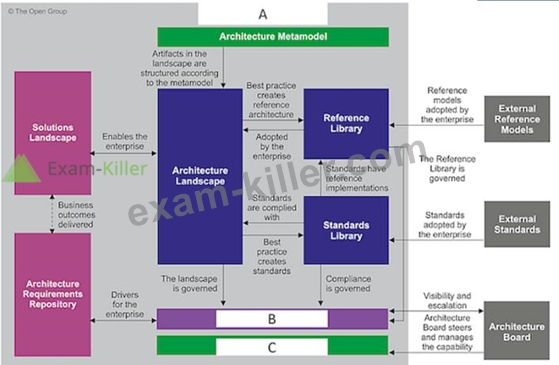
Consider the illustration. What are the items labelled A, B, and C?
- A. A-Enterprise Repository, B-Board repository, C-Enterprise Capability
- B. A-Architecture Repository, B-Governing Board, C-Enterprise Capability
- C. A-Enterprise Repository, B-Governance Repository, C-Board Repository
- D. A-Architecture Repository, B-Governance Repository, C-Architecture Capability
Answer: B
Explanation:
* A-Architecture Repository: This is a part of the Architecture Metamodel that contains artifacts structured according to the metamodel. It includes the Architecture Landscape which is adopted by the enterprise and governed by certain standards and practices.
* B-Governing Board: The Governing Board ensures visibility and escalation, meaning it oversees and manages the capability of the architecture landscape. It plays a crucial role in governance.
* C-Enterprise Capability: This refers to how well an enterprise can execute its mission, meet business objectives or satisfy its stakeholders' needs and expectations. It's influenced by both internal factors (like resources, processes) and external ones (like market trends).
NEW QUESTION # 67
When considering the scope of an architecture, what dimension considers to what level of detail the architecting effort should go?
- A. Breadth
- B. Architecture Domains
- C. Project
- D. Depth
Answer: D
Explanation:
The scope of an architecture is the extent and level of detail of the architecture work. The scope of an architecture can be defined along four dimensions: project, breadth, depth, and architecture domains. The project dimension considers the boundaries and objectives of the architecture project, such as the time frame, budget, resources, and deliverables. The breadth dimension considers the coverage and completeness of the architecture across the enterprise, such as the organizational units, business functions, processes, and locations. The depth dimension considers the level of detail and specificity of the architecture, such as the granularity, abstraction, and precision of the architectural elements and relationships. The architecture domains dimension considers the aspects or segments of the architecture, such as the business, data, application, and technology domains.
Therefore, the depth dimension is the one that considers to what level of detail the architecting effort should go.
The TOGAF Standard, Version 9.2, Part III: ADM Guidelines and Techniques, Chapter 25: Architecture Scope : The TOGAF Standard, Version 9.2, Part III: ADM Guidelines and Techniques, Chapter 25.2: Scope Dimensions : The TOGAF Standard, Version 9.2, Part III: ADM Guidelines and Techniques, Chapter 25.2.1:
Project, Breadth, Depth, and Architecture Domains
NEW QUESTION # 68
Consider the following ADM phases objectives.
Objective
1-Determine whether an incremental approach is required, and if so identify Transition Architectures that will deliver continuous business value
2-Generate the initial complete version of the Architecture Roadmap, based upon the gap analysis and candidate Architecture Roadmap components from Phases B, C, and D
3-Finalize the Architecture Roadmap and the supporting Implementation and Migration Plan
4-Ensure that the business value and cost of work packages and Transition Architectures is understood by key stakeholders Which phase does each objective match?
- A. 1E-2E-3F-4F
- B. 1G-2E-3F-4F
- C. 1E-2F-3E-4F
- D. 1F-2E-3F-4G
Answer: B
Explanation:
According to the TOGAF standard, the objectives of each ADM phase are as follows1:
*Phase E: Opportunities and Solutions
oDetermine whether an incremental approach is required, and if so identify Transition Architectures that will deliver continuous business value oIdentify and group major work packages within the Architecture Roadmap oIdentify and group major implementation projects to realize the Architecture Roadmap oIdentify dependencies between increments and projects oEstimate cost, benefit, and risk at a high level for each increment and project oConduct initial prioritization and sequencing of the Architecture Roadmap and projects
*Phase F: Migration Planning
oGenerate the initial complete version of the Architecture Roadmap, based upon the gap analysis and candidate Architecture Roadmap components from Phases B, C, and D oConfirm the Transition Architectures with relevant stakeholders oCreate the Implementation and Migration Plan, including Transition Architectures, work packages, projects, and other activities oConfirm and agree the Architecture Roadmap and Implementation and Migration Plan with relevant stakeholders
*Phase G: Implementation Governance
oFinalize the Architecture Roadmap and the supporting Implementation and Migration Plan oEnsure conformance with the Target Architecture by implementation projects oPerform appropriate Architecture Governance functions for the solution and any implementation-driven architecture Change Requests oEnsure that the architecture lifecycle is maintained oEnsure that the Architecture Governance Framework is executed
*Phase H: Architecture Change Management
oEnsure that the business value and cost of work packages and Transition Architectures is understood by key stakeholders oManage risks and issues related to the Architecture Roadmap and Implementation and Migration Plan oMonitor the implementation projects and Transition Architectures oManage changes to the architecture baseline oManage changes to the Architecture Capability Therefore, the correct matching of the objectives and the phases is:
*1G: Determine whether an incremental approach is required, and if so identify Transition Architectures that will deliver continuous business value
*2E: Generate the initial complete version of the Architecture Roadmap, based upon the gap analysis and candidate Architecture Roadmap components from Phases B, C, and D
*3F: Finalize the Architecture Roadmap and the supporting Implementation and Migration Plan
*4F: Ensure that the business value and cost of work packages and Transition Architectures is understood by key stakeholders
NEW QUESTION # 69
When considering Architecture Governance, what is the benefit that derives from discipline?
- A. All decision-making will be established so as to minimize conflicts of interest
- B. All parties will have a commitment to adhere to procedures and process
- C. Groups within the organization are accountable for their actions
- D. Actions implemented and their decision support will be available for inspection
Answer: B
Explanation:
TOGAF's governance guidance distinguishes benefits such as transparency, accountability, and discipline in operating governance processes. Formal TOGAF conformance topics include "The benefits of Architecture Governance," which include establishing and enforcing processes and controls (discipline) for architecture decision-making and compliance. togaf-cert.opengroup.org Reference: The Open Group, TOGAF Conformance Requirements (Multi-Level)-Unit on Architecture Governance (KLP 44.2-2 "The benefits of Architecture Governance").
NEW QUESTION # 70
Consider the following statement.
Projects may cycle between ADM phases, in planned cycles covering multiple phases.
What does it illustrate?
- A. Implementation governance
- B. Requirements management
- C. Enterprise Architecture
- D. Iteration
Answer: D
Explanation:
The statement "Projects may cycle between ADM phases, in planned cycles covering multiple phases" illustrates the concept of iteration, which is the process of repeating the ADM phases or steps within a phase to refine the architecture outputs and address the changing requirements and stakeholder concerns. Iteration can occur at different levels of granularity and scope, such as within a single phase, across multiple phases, or across the entire ADM cycle. Iteration can also be applied to different architecture domains, such as business, data, application, and technology. Iteration is a key feature of the ADM that enables the development of architectures that are fit for purpose, adaptable, and responsive to change. References: : The TOGAF Standard, Version 9.2, Part III: ADM Guidelines and Techniques, Chapter 24: Applying Iteration to the ADM
NEW QUESTION # 71
Consider the following chart:
Which important concept for Enterprise Architecture Practitioners does it illustrate?
- A. ADM phases must be run simultaneously until the relevant information has been produced.
- B. An Enterprise Architecture must be developed in phases with a limited fixed duration.
- C. ADM phases must be run in a sequenced approach to produce the Architecture.
- D. Enterprise Architects must use Gantt charts to communicate with Stakeholders.
Answer: C
Explanation:
The chart shown is a Gantt chart, which is commonly used for project management to illustrate a project schedule. In the context of TOGAF (The Open Group ArchitectureFramework), which is a framework for enterprise architecture, this Gantt chart is demonstrating the sequenced approach to the Architecture Development Method (ADM). The ADM is the core process of TOGAF which provides a tested and repeatable process for developing architectures. The ADM is described as being iterative, over the whole process, between phases, and within phases. For each iteration of the ADM, a fresh decision must be taken about each of the parameters (scope, granularity, time period, and architecture assets).
The ADM consists of a number of phases that have to be followed in sequence:
* Preliminary Phase: Framework and principles
* Phase A: Architecture Vision
* Phase B: Business Architecture
* Phase C: Information Systems Architectures, including Data and Application Architectures
* Phase D: Technology Architecture
* Phase E: Opportunities and Solutions
* Phase F: Migration Planning
* Phase G: Implementation Governance
* Phase H: Architecture Change Management
* Requirements Management
Each phase is dependent on the outputs of the previous phase and the Requirements Management phase runs throughout. The Gantt chart clearly shows the dependency and sequence in which these phases occur, implying that a structured approach is followed to produce the enterprise architecture.
NEW QUESTION # 72
Consider the following chart:
Which important concept for Enterprise Architecture Practitioners does it illustrate?
- A. ADM phases must be run simultaneously until the relevant information has been produced.
- B. An Enterprise Architecture must be developed in phases with a limited fixed duration.
- C. ADM phases must be run in a sequenced approach to produce the Architecture.
- D. Enterprise Architects must use Gantt charts to communicate with Stakeholders.
Answer: C
Explanation:
The chart shown is a Gantt chart, which is commonly used for project management to illustrate a project schedule. In the context of TOGAF (The Open Group Architecture Framework), which is a framework for enterprise architecture, this Gantt chart is demonstrating the sequenced approach to the Architecture Development Method (ADM). The ADM is the core process of TOGAF which provides a tested and repeatable process for developing architectures. The ADM is described as being iterative, over the whole process, between phases, and within phases. For each iteration of the ADM, a fresh decision must be taken about each of the parameters (scope, granularity, time period, and architecture assets).
The ADM consists of a number of phases that have to be followed in sequence:
Preliminary Phase: Framework and principles
Phase A: Architecture Vision
Phase B: Business Architecture
Phase C: Information Systems Architectures, including Data and Application Architectures Phase D: Technology Architecture Phase E: Opportunities and Solutions Phase F: Migration Planning Phase G: Implementation Governance Phase H: Architecture Change Management Requirements Management Each phase is dependent on the outputs of the previous phase and the Requirements Management phase runs throughout. The Gantt chart clearly shows the dependency and sequence in which these phases occur, implying that a structured approach is followed to produce the enterprise architecture.
The TOGAF Standard, Version 9.2, a standard of The Open Group
The TOGAF documentation available at https://publications.opengroup.org/standards/architecture and
https://publications.opengroup.org/guides/architecture
NEW QUESTION # 73
What is the purpose of the Preliminary Phase?
- A. Defining the Enterprise Strategy.
- B. Describing the target architecture.
- C. Developing an Enterprise Architecture Capability.
- D. Identifying the stakeholders and their requirements.
Answer: C
Explanation:
An Enterprise Architecture Capability is the ability of the organization to perform effective and efficient architecture work, including the definition, governance, and management of its architectures2. The Preliminary Phase involves the following activities1:
* Reviewing the organizational context, scope, and drivers for conducting Enterprise Architecture
* Establishing the Architecture Capability desired by the organization, including the maturity level, roles, responsibilities, processes, and tools
* Defining and establishing the Organizational Model for Enterprise Architecture, which describes how the architecture function is organized and integrated within the enterprise
* Defining and establishing the Architecture Governance framework, which provides the mechanisms for ensuring the quality, consistency, and compliance of the architecture work
* Selecting and implementing the tools that support the Architecture Capability, such as repositories, modeling tools, and communication tools
* Defining the Architecture Principles that will guide and constrain the architecture work, based on the business principles, goals, and drivers of the organization
* Defining the Organization-Specific Architecture Framework, which is an adaptation of the generic TOGAF ADM to suit the specific requirements, standards, and practices of the organization The Preliminary Phase is essential for preparing the organization for the successful development and implementation of its architectures, as well as for ensuring the alignment of the architecture work with the business strategy and objectives1.
NEW QUESTION # 74
......
The Open Group OGEA-101 Exam Syllabus Topics:
| Topic | Details |
|---|---|
| Topic 1 |
|
| Topic 2 |
|
| Topic 3 |
|
| Topic 4 |
|
| Topic 5 |
|
| Topic 6 |
|
Certification Training for OGEA-101 Exam Dumps Test Engine: https://www.exam-killer.com/OGEA-101-valid-questions.html
OGEA-101 Training & Certification Get Latest Enterprise Architecture : https://drive.google.com/open?id=1o5THpe16dEZUIHtDhvx9G_pP7JaFOA_p
