

Pass Nutanix NCP-CN Exam Info and Free Practice Test
New 2026 Latest Questions NCP-CN Dumps - Use Updated Nutanix Exam
Nutanix NCP-CN Exam Syllabus Topics:
| Topic | Details |
|---|---|
| Topic 1 |
|
| Topic 2 |
|
| Topic 3 |
|
| Topic 4 |
|
NEW QUESTION # 62
Recently, the reliability of some developer platforms has been impacted by out-of-memory errors, causing pods to crash and then remain in a pending state. A Cloud Engineer has been tasked with collecting and reviewing centralized metrics across the various platform environments to identify differences between them and better understand what is causing these performance issues. What should the engineer do to address this request?
- A. Utilize Thanos to collect and present centralized metrics on NKP attached and managed clusters. Then visualize these collected and centralized metrics in Grafana.
- B. Utilize Prometheus to collect and present centralized metrics on NKP attached and managed clusters. Then configure Thanos Query to monitor and send out alerts based on the metric thresholds that have been configured within it.
- C. Utilize Fluentd and Fluent Bit to collect and present centralized metrics on NKP attached and managed clusters. Then configure Thanos Query to monitor and send out alerts based on the metric thresholds that have been configured within it.
- D. Utilize Fluentd and Fluent Bit to collect and present centralized metrics on NKP attached and managed clusters. Then visualize these collected and centralized metrics in Grafana.
Answer: B
NEW QUESTION # 63
After loading the NKP bundles to a private registry in an air-gapped environment, a Platform Engineer now needs the Konvoy bootstrap image to create the bootstrap cluster. The Konvoy image has not been loaded into the registry. Which is the most viable command to load the Konvoy bootstrap image on the bastion host?
- A. nkp load image -f konvoy-bootstrap-image-<version>.tar --to-registry=<REGISTRY_URL>
- B. nkp push bundle --bundle konvoy-bootstrap-image-<version>.tar --to-registry=<REGISTRY_URL>
- C. docker image tag konvoy-bootstrap-image-<version>.tar version docker.io/konvoy-bootstrap version
- D. docker load -i konvoy-bootstrap-image-<version>.tar
Answer: D
NEW QUESTION # 64 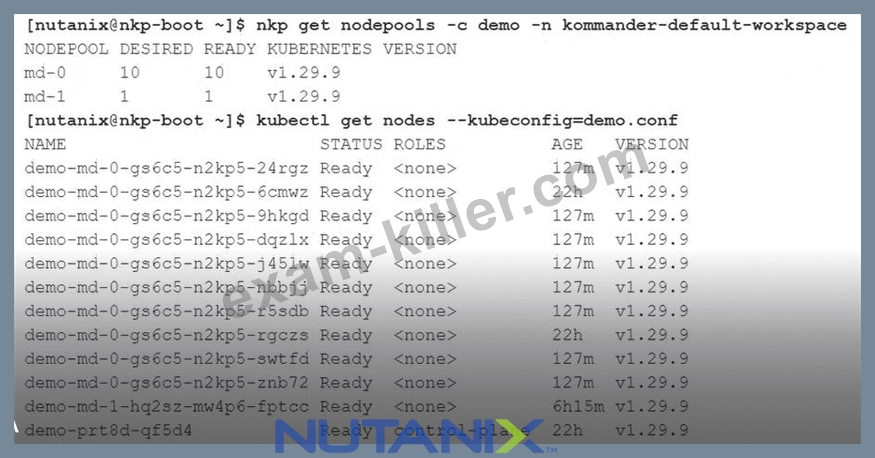
Looking at the nodepools for the Kubernetes cluster named demo, there is a node pool named md-1 with only one worker. This worker should be deleted along with the node pool md-1.
How should this task be accomplished?
- A. Run ncli vm.delete demo-md-1-hQ2sz-mw4p6-fptc
- B. Run nkp node scale nodepool md-1 --replicas=0 --cluster-name=demo
- C. Run nkp delete nodepool md-1 --cluster-name=demo
- D. Run acli vm.delete demo-md-1-hQ2sz-mw4p6-fptc
Answer: C
NEW QUESTION # 65
A Platform Engineer is attaching existing Kubernetes clusters to NKP, but a particular Kubernetes Amazon EKS cluster is getting errors with application deployments. These errors are related to persistent volumes.
What could be the issue, and what can the engineer do?
- A. The storage appliance is having issues. The storage engineer should be contacted to take a look.
- B. There is no compatible storage to be attached to the EKS cluster. Ask for compatible storage.
- C. There could be a misconfiguration in the ConfigMap. It should be adjusted to NKP requirements.
- D. There is no default StorageClass. Storage classes should be reviewed, and only one should be set as default.
Answer: D
Explanation:
When attaching an Amazon EKS cluster to NKP for fleet management, persistent volume (PV) errors during application deployments often indicate issues with storage configuration. The NKPA course identifies a common cause: the absence of a default StorageClass. Kubernetes requires a default StorageClass to automatically provision PVs for PersistentVolumeClaims (PVCs) when none is specified. Without a default, applications fail to bind PVCs, resulting in deployment errors.
The Nutanix Cloud Native (NCP-CN) 6.10 Study Guide states: "For attached EKS clusters, ensure a default StorageClass is configured to support dynamic provisioning of persistent volumes. Review existing StorageClasses and set one as default using the storageclass.kubernetes.io/is-default-class annotation." The engineer should run kubectl get storageclass to list available StorageClasses, verify their configurations, and set one as default by patching it with kubectl patch storageclass <name> -p '{"metadata": {"annotations":
{"storageclass.kubernetes.io/is-default-class":"true"}}}'. In EKS, the default StorageClass is typically backed by Amazon EBS (e.g., gp2 or gp3).
Incorrect Options:
* A. The storage appliance is having issues: This assumes a hardware issue, which is not indicated by PV errors. The NKPA course suggests checking Kubernetes configurations first.
* B. There is no compatible storage: EKS supports EBS and EFS, which are compatible with NKP. The issue is likely configuration, not compatibility.
* D. There could be a misconfiguration in the ConfigMap: ConfigMaps are not directly related to PV provisioning. The NKPA course points to StorageClass issues for PV errors.
:
Nutanix Kubernetes Platform Administration (NKPA) Course, Section on Fleet Management.
Nutanix Cloud Native (NCP-CN) 6.10 Study Guide, Chapter on Storage Configuration.
Nutanix Cloud Bible, NutanixKubernetesPlatform Section: https://www.nutanixbible.com Amazon EKS Storage Documentation: https://docs.aws.amazon.com/eks
NEW QUESTION # 66
A company has 30 Edge devices with lightweight Kubernetes, and developers need to push the application to every edge device. An NKP administrator has the NKP Ultimate license tier configured and has access to all kubeconfig files for the 30 edge devices. What is the most efficient way that the administrator can lifecycle manage the application deployments?
- A. Create a GitHub configuration, deploy it to the 30 edge devices, and configure them to use a GitHub account.
- B. Create a script to automate the deployment to every edge device.
- C. Ask the developers to delete the lightweight Kubernetes and deploy new Kubernetes clusters with NKP.
- D. Create a new Workspace and attach the 30 edge devices to this workspace with Attach Cluster.
Answer: D
Explanation:
The NKPA course emphasizes that NKP's fleet management capabilities allow administrators to manage multiple Kubernetes clusters, including lightweight clusters on edge devices, by attaching them to an NKP workspace. With the NKP Ultimate license tier, the administrator has access to advanced fleet management features, including GitOps-based application deployment across attached clusters.
The most efficient way to lifecycle manage application deployments across the 30 edge devices is to create a new workspace and attach the 30 edge devices to this workspace using the Attach Cluster functionality (Option D). Once attached, NKP can use GitOps (via Flux) to push applications to all clusters in the workspace simultaneously, ensuring consistent deployment and lifecycle management. The Nutanix Cloud Native (NCP-CN) 6.10 Study Guide states: "For managing edge devices with lightweight Kubernetes, attach the clusters to an NKP workspace using the Attach Cluster feature, enabling centralized application deployment and lifecycle management via GitOps." The administrator can use the kubeconfig files to attach each cluster via the NKP UI or CLI (e.g., nkp attach cluster).
Incorrect Options:
* A. Create a GitHub configuration for each device: This is manual and inefficient compared to NKP's centralized GitOps management.
* B. Create a script to automate deployment: Scripting is error-prone and lacks NKP's built-in fleet management capabilities.
* C. Delete lightweight Kubernetes and deploy new clusters: This is unnecessary, as NKP can manage existing clusters, including lightweight ones.
:
Nutanix Kubernetes Platform Administration (NKPA) Course, Section on Fleet Management.
Nutanix Cloud Native (NCP-CN) 6.10 Study Guide, Chapter on Attaching Clusters.
Nutanix Cloud Bible, NutanixKubernetesPlatform Section: https://www.nutanixbible.com
NEW QUESTION # 67
A Platform Engineer needs to create an NKP cluster on vSphere infrastructure, using the vSphere provisioning method. The cluster needs to have 3 worker node pools:
* First node pool should consist of 6 worker nodes
* Second node pool should consist of 3 worker nodes
* Third node pool should consist of 3 worker nodesAdditionally, the worker nodes in the first node pool should be set to 10 CPUs, the second node pool workers should be set to 8 CPUs, and the third node pool workers should be set to 6 CPUs. What is the proper way to create the NKP cluster using the NKP CLI?
- A. First, execute the nkp create cluster vsphere command, including the following parameters:
--worker-replicas 6
--worker-cpus 10
Then, execute the nkp create nodepools vsphere command, including the following parameters:
--replicas 3,3
--cpus 8,6 - B. First, execute the nkp create cluster vsphere command, including the following parameters:
--worker-replicas 6
--worker-cpus 10
Then, execute the nkp create nodepool vsphere command, including the following parameters:
--replicas 3
--cpus 6 - C. First, execute the nkp create cluster vsphere command, including the following parameters:
--worker-replicas 6
--worker-cpus 10
Then, execute the nkp create nodepool vsphere command, including the following parameters:
--worker-replicas 3
--worker-cpus 8
Then, execute the nkp create nodepool vsphere command, including the following parameters:
--worker-replicas 3
--worker-cpus 6 - D. When executing the nkp create cluster vsphere command, include the following parameters:
--node-pools 3
--worker-replicas 6,3,3
--worker-cpus 10,8,6
Answer: C
Explanation:
The NKPA course details the process of creating an NKP cluster on vSphere using the NKP CLI, including the configuration of multiple node pools with specific worker node counts and CPU settings. The correct approach involves creating the cluster with the initial node pool and then adding additional node pools separately.
The steps in Option A align with this process:
* nkp create cluster vsphere --worker-replicas 6 --worker-cpus 10: This command creates the NKP cluster on vSphere with the first node pool, consisting of 6 worker nodes, each with 10 CPUs.
* nkp create nodepool vsphere --worker-replicas 3 --worker-cpus 8: This adds the second node pool to the cluster with 3 worker nodes, each with 8 CPUs.
* nkp create nodepool vsphere --worker-replicas 3 --worker-cpus 6: This adds the third node pool with 3 worker nodes, each with 6 CPUs.
The Nutanix Cloud Native (NCP-CN) 6.10 Study Guide states: "To create an NKP cluster with multiple node pools on vSphere, use nkp create cluster vsphere to define the first node pool, then add additional node pools with nkp create nodepool vsphere, specifying --worker-replicas and --worker-cpus for each pool." This method ensures precise control over each node pool's configuration.
Incorrect Options:
* B: The second nkp create nodepool command uses --replicas and --cpus, which are not the correct flags.
The NKPA course specifies --worker-replicas and --worker-cpus.
* C: The --node-pools, --worker-replicas 6,3,3, and --worker-cpus 10,8,6 flags are not supported in a single nkp create cluster command. Node pools must be created separately.
* D: There is no nkp create nodepools command; the correct command is nkp create nodepool.
Additionally, --replicas and --cpus are incorrect flags.
:
Nutanix Kubernetes Platform Administration (NKPA) Course, Section on Cluster Creation.
Nutanix Cloud Native (NCP-CN) 6.10 Study Guide, Chapter on Building NKP Clusters.
Nutanix Cloud Bible, NutanixKubernetesPlatform Section: https://www.nutanixbible.com
NEW QUESTION # 68
An ecommerce company decides to apply an autoscaling configuration in its NKP cluster due to the fact that on holidays, they experience service drops due to a huge increase of simultaneous traffic.
Which statement best describes the configuration shown in the exhibit?
- A. The autoscaler could increase the number of nodes as needed, but never reduce it below 3.
- B. The autoscaler could increase the number of nodes up to 15, but never reduce the number below 3.
- C. The autoscaler could increase the number of nodes up to 3, but never reduce it below 15.
- D. The autoscaler could have 15 or 3 nodes.
Answer: B
NEW QUESTION # 69
A Platform Engineer wants to deploy a custom OS image for multiple NKP clusters for Nutanix AHV and AWS. Which two tools come bundled to facilitate creating and placing a custom image into the respective image repository?
- A. Nutanix Image Builder
- B. Konvoy Image Builder
- C. Ansible
- D. Terraform
Answer: A,B
Explanation:
Comprehensive and Detailed Explanation:
Both the Konvoy Image Builder (KIB) and the Nutanix Image Builder (NIB) are included tools used to create and manage custom OS images suitable for NKP deployments. KIB is responsible for building images that conform to the standards required by Konvoy-based environments, while NIB is designed for direct integration with the Nutanix AHV infrastructure. These tools support automated preparation, hardening, and upload of images to the appropriate repositories.
References: Nutanix Kubernetes Platform Administration Guide - Image Preparation Tools
NEW QUESTION # 70
A Platform Engineer is attempting to delete an attached cluster from the NKP UI, but it is stuck in a 'deleting' state and does not get removed. How can the engineer resolve this attempt to detach the cluster so that it is removed from the UI and no longer managed by NKP?
- A. Run the nkp delete kommandercluster command in the context of the NKP attached cluster.
- B. Run the kubectl delete kommandercluster command in the context of the NKP management cluster.
- C. Run the kubectl delete cluster command in the context of the NKP management cluster.
- D. Run the nkp delete cluster command in the context of the NKP attached cluster.
Answer: B
NEW QUESTION # 71
Which option is enabled with the NKP Pro licensing tier?
- A. Kubernetes Dashboard
- B. AI OPS
- C. Fleet Management
- D. Insights
Answer: C
Explanation:
Comprehensive and Detailed Explanation:
The NKP Pro licensing tier includes Fleet Management, which enables centralized lifecycle management of multiple Kubernetes clusters. This feature is critical for managing larger environments, providing visibility and control over fleet-wide configurations and updates. Other features, like AI OPS and advanced observability, are typically associated with higher tiers (e.g., Ultimate).
References: Nutanix Licensing and Features Matrix
NEW QUESTION # 72
A development team is working on a new application that requires access to certain cluster resources. The team needs to ensure that they have limited permissions to avoid unauthorized changes in other environments. Among the tasks they will perform are the following:
Deploy new versions of the application to their specific namespace.
Scale deployments according to demand.
View logs and metrics of their applications to monitor performance.When using the NKP GUI, what type of access should the team configure?
- A. NKP Role
- B. Cluster Role
- C. Kommander Role
- D. Cluster Admin
Answer: A
NEW QUESTION # 73
A Platform Engineer has deployed NKP and wants to utilize its OOB data storage feature.
What should the engineer enable to support backups within the NKP environment?
- A. Objects S3
- B. Volumes iSCSI
- C. Rook Ceph
- D. MinIO
Answer: C
NEW QUESTION # 74
A Platform Engineer has been tasked with setting up a secure and isolated environment for managing an NKP environment. The environment will have no access to the Internet but will be required to create additional NKP clusters in the future. The security team has recommended using a bastion host to achieve this goal.
What is the primary purpose of a bastion host in this scenario?
- A. To act as a firewall for the cluster, blocking all incoming traffic.
- B. To store and manage sensitive data related to the cluster.
- C. To provide a secure point for creating and operating NKP clusters.
- D. To serve as a load balancer for the NKP clusters.
Answer: C
Explanation:
In an air-gapped NKP environment with no Internet access, a bastion host is a critical component for secure management. The NKPA course defines the primary purpose of a bastion host as providing a secure point for creating and operating NKP clusters. The bastion host acts as a jump server, allowing administrators to securely access the isolated environment, manage cluster deployments, and perform operations like cluster creation, scaling, and upgrades without exposing the environment to external threats.
The Nutanix Cloud Native (NCP-CN) 6.10 Study Guide states: "In a dark site NKP deployment, a bastion host serves as a secure entry point for administrators to create, manage, and operate NKP clusters, ensuring isolation from external networks." The bastion host is configured with SSH keys and tools like the NKP CLI to facilitate secure interactions with the cluster infrastructure.
Incorrect Options:
* A. To store and manage sensitive data: The bastion host is not a storage system; its role is access and management, not data storage.
* C. To serve as a load balancer: A bastion host does not perform load balancing; that role is handled by Kubernetes components like MetalLB or cloud-native load balancers.
* D. To act as a firewall: While a bastion host enhances security, it is not a firewall. Firewalls are separate components in the network architecture.
:
Nutanix Kubernetes Platform Administration (NKPA) Course, Section on Dark Site Deployments.
Nutanix Cloud Native (NCP-CN) 6.10 Study Guide, Chapter on NKP Deployment Prerequisites.
Nutanix Cloud Bible, NutanixKubernetesPlatform Section: https://www.nutanixbible.com
NEW QUESTION # 75 
A Platform Engineer sees no insight in all workspaces, and it is a critical feature to control all the alerts on all company's Kubernetes clusters. What does the engineer need to do to begin generating NKP Insights?
- A. Create a persistent volume claim and assign it to nkp-insights; this application requires volumes to save logs and data. Install nkp-insights with nkp create appdeployment nkp-insights --app nkp-insights-1.2.2 --workspace kommander-workspace
- B. Install nkp-insights in every Kubernetes cluster with kubectl apply -f nkp-insights-1.2.2 --kubeconfig=<cluster>.conf
- C. Acquire the NKP Insights Add-on license.
Answer: A
NEW QUESTION # 76 
A Platform Engineer is preparing to deploy an NKP cluster in an air-gapped environment. The NKP cluster will be deployed on Nutanix infrastructure using the CAPI Nutanix provisioner (CAPX). The engineer has decided to create the bootstrap cluster first, then NIB-prep an Ubuntu 22.04 OS image that the Linux engineering team has provided in Prism Central. After that, the engineer will deploy the NKP cluster.
However, during the first step of creating a bootstrap cluster, the engineer received the error shown in the exhibit. What could be the reason?
- A. The Ubuntu 22.04 OS image needs to be NIB-prepped prior to creating the bootstrap.
- B. The nkp create bootstrap command needs to be executed as root.
- C. The bootstrap cluster image needs to be loaded prior to creating the bootstrap cluster.
- D. The CAPI provisioning method needs to be specified as part of the command nkp create bootstrap nutanix.
Answer: C
Explanation:
The exhibit indicates an error during the creation of a bootstrap cluster using the nkp create bootstrap command in an air-gapped environment. The NKPA course explains that a bootstrap cluster is a temporary Kubernetes cluster used to initialize Cluster API (CAPI) components for provisioning the target NKP cluster.
In an air-gapped environment, all required resources, including container images, must be available locally since there is no Internet access to pull them from public registries.
The most likely reason for the error is that the bootstrap cluster image needs to be loaded prior to creating the bootstrap cluster (Option B). The course specifies that in air-gapped deployments, the bootstrap cluster image (typically a kind or k3s image used by CAPI) must be pre-loaded into a local container registry or the bastion host before running nkp create bootstrap. This image is part of the Air-Gapped Bundle provided by Nutanix, which includes all necessary container images for NKP deployment. Without pre-loading this image, the nkp create bootstrap command fails because it cannot pull the required image.
The Nutanix Cloud Native (NCP-CN) 6.10 Study Guide states: "In an air-gapped NKP deployment, ensure the bootstrap cluster image (e.g., kindest/node) is loaded into a local registry or host before executing nkp create bootstrap, as the command requires this image to create the temporary cluster." The engineer must extract the bootstrap image from the Air-Gapped Bundle, load it using docker load or similar, and configure the local registry to make it accessible during the bootstrap process.
Incorrect Options:
* A. The CAPI provisioning method needs to be specified as nkp create bootstrap nutanix: The nkp create bootstrap command does not require a provisioning method like nutanix at this stage; the provider (e.g., CAPX for Nutanix) is specified during the actual cluster creation (nkp create cluster), not bootstrap creation.
* C. The Ubuntu 22.04 OS image needs to be NIB-prepped prior to creating the bootstrap: The Ubuntu 22.04 image is for the target NKP cluster nodes, not the bootstrap cluster, which uses a pre- built image (e.g., kind). NIB-prepping this image is a later step.
* D. The nkp create bootstrap command needs to be executed as root: While some commands may require elevated privileges, the NKPA course does not specify that nkp create bootstrap must be run as root. The error is more likely related to missing images in an air-gapped setup.
:
Nutanix Kubernetes Platform Administration (NKPA) Course, Section on Bootstrap Cluster Creation in Air- Gapped Environments.
Nutanix Cloud Native (NCP-CN) 6.10 Study Guide, Chapter on Air-Gapped Deployments.
Nutanix Cloud Bible, NutanixKubernetesPlatform Section: https://www.nutanixbible.com Cluster API Documentation: https://cluster-api.sigs.k8s.io
NEW QUESTION # 77
......
Latest NCP-CN Exam Dumps Nutanix Exam: https://www.exam-killer.com/NCP-CN-valid-questions.html
Pass Nutanix NCP-CN PDF Dumps Recently Updated 111 Questions: https://drive.google.com/open?id=1JXiU-FwUulW11lNXkQtJV7Vw2Ssn5zq0
