

[Nov-2025] L4M3 Exam Dumps Pass with Updated 2025 CIPS Commercial Contracting
Free L4M3 Exam Dumps to Pass Exam Easily
CIPS L4M3 exam is ideal for professionals who are involved in the procurement and contracting process, including contract managers, procurement managers, and supply chain professionals. L4M3 exam provides a comprehensive understanding of the commercial contracting process and enables professionals to develop skills and techniques that are essential for effective contract management. Successful completion of the CIPS L4M3 exam demonstrates a commitment to professional development and provides a competitive advantage in the job market.
CIPS L4M3 exam is a crucial milestone for procurement professionals who want to excel in the field of commercial contracting. L4M3 exam is designed to test the candidates’ knowledge and skills in drafting, negotiating and managing commercial contracts. It is a level 4 exam, which means that it is ideal for procurement professionals who have some experience in the field and are looking to advance their careers.
NEW QUESTION # 66
CMS Corp goes into a gainshare agreement with the contractor, EIP Ltd. Both parties agree that the final fee will be calculated on target cost - target fee basis. Which of the following will affect the final fee payable in this gainshare agreement? Select TWO that apply:
- A. Purchaser goodwill
- B. Supplier share
- C. Accrual expense
- D. Final price
- E. Actual cost
Answer: B,E
Explanation:
An incentive contract is a sub-segment of a fixed-price or cost-reimbursement contract when there are specific cost or time commitments that are desired for a project. The standard incentive contract will allow for a fixed price to be paid for work to be completed by a specific deadline and at a specific cost.
There are two major types of incentive contracts: Cost-plus-incentive fee and Fixed-price incentive (firm target) contracts. Both types have the same formula for calculating final fee and final price.
The target fee is the amount that will be paid if the actual costs (which can be proven) match the target costs The actual fee will be adjusted in proportion to the difference between the target cost and the actual cost. The usual calculation is:
Target fee + ((target cost - actual cost) x Supplier share) = final fee The final price then becomes:
Actual cost + final fee = final price
Reference:
LO 3, AC 3.3
NEW QUESTION # 67
Which of the following is the contract provision that relieves the parties from performing their contractual obligations when certain circumstances like natural disasters, terrorist attacks, etc arise?
- A. Liquidated damage clause
- B. Insurance clause
- C. Exclusion clause
- D. Indemnity clause
Answer: C
Explanation:
The contract provision that relieves the parties from performing their contractual obligations when certain circumstances like natural disasters, terrorist attacks, etc arise is called Force majeure. Force majeure is an example of exclusion clause.
An exemption clause in a contract is a term which either limits or excludes a party's liability for a breach of contract. In order for an exclusion clause to be binding and operable upon the parties, the clause must:
1. The clause must be incorporated into the contract as a term.
2. The clause must pass the test of construction.
3. The clause must not be rendered unenforceable by the statutory provisions in the Unfair Contract Terms Act 1977 or the Consumer Rights Act 2015 (enacting the Consumer Rights Bill 2013-14).
Reference:
- Exclusion Clauses Lecture
- CIPS study guide page 149
LO 3, AC 3.2
NEW QUESTION # 68
A Key Performance Indicator (KPI) states "Measure the effort exerted by the project team to control costs throughout the contract duration." Is this KPI appropriate for measuring the management of contract costs?
- A. Yes, the KPI is achievable, relevant and time-bound
- B. No, the project team is not responsible for managing costs
- C. No, the metric is not sufficiently specific and measurable
- D. Yes, increased efforts to control costs ensure that costs will be managed effectively
Answer: C
Explanation:
Effective KPIs must be SMART: specific, measurable, achievable, relevant, and time-bound. "Effort exerted" is vague and not objectively measurable, making the KPI unsuitable. A better KPI would involve actual cost data or variance against a defined budget.
Reference:CIPS L4M3 Commercial Contracting Study Guide, Chapter 4, Section 4.3.1 - Characteristics of effective KPIs.
NEW QUESTION # 69
Rochdale Ltd is looking for a new IT system to automate some of its operations. In designing the specification, procurement manager supposes that it should be done solely by the IT department who have deep expertise on this matter. Is procurement manager's opinion appropriate?
- A. Yes, because designing complex specification would waste procurement manager's time
- B. No, because designing complex specification could only be outsourced
- C. No, because challenging the user's demand is the role of procurement
- D. Yes, because procurement professional has no expertise in IT sector
Answer: C
Explanation:
Procurement professionals have a role in challenging specifications. Technical experts can get things wrong and asking naive questions can be useful in bringing these to light. The challenging may include:
- Does the organisation really need these features/functions?
- With this specification, are there many available suppliers in the market?
- How many does the organisation really need?
etc
Reference:
LO 1, AC 1.1
NEW QUESTION # 70
Northern Province Authority (NPA) seeks to use market dialogue to improve the contract specification for a new procurement tender of a domestic waste collection contract. Which of the following topics would be appropriate for dialogue with potential suppliers?
- A. Contract terms
- B. Pricing proposals
- C. Service innovation
- D. Human resourcing
Answer: C
Explanation:
Early market dialogue is used to explore supplier capabilities and gather ideas, particularly in complex or innovative services. Discussing service innovation with suppliers helps the buyer shape better specifications and outcomes. Topics like pricing and contract terms should remain within formal procurement stages to ensure fairness.
Reference:CIPS L4M3 Commercial Contracting Study Guide, Chapter 2, Section 2.1.1 - Use of early market engagement and its limitations.
NEW QUESTION # 71
Consequences and actions that arise from certain KPI scores must be...? Select TWO that apply.
- A. Unilaterally imposed by the purchaser
- B. Deliberately omitted
- C. Terminated
- D. Mutually agreed
- E. Documented
Answer: D,E
Explanation:
Supplier performance management and monitoring is a fundamental part of contract management. It starts with setting KPIs, targets and consequences or actions that arise from KPI scores. The measures, objectives and targets used in the monitoring of the supplier's performance must reflect those that were agreed when the contract was let. That is why it is important to specify a commitment to continuous improvement at the outset. It would be unfair to the supplier to suddenly introduce a range of measures after the contract had begun - however if such an introduction mid-term through the contract is unavoidable then it should be negotiated and agreed in a professional manner and not merely imposed on the supplier.
In conclusion, the details of how KPIs will be monitored and the actions or consequences resulting from scores achieved must be documented and agreed between the parties. This details may be embedded in the specification or the main body of the contract or it may be set out in a SLA.
Reference:
- Performance Monitoring of Suppliers - CIPS Knowledge summary
- CIPS study guide page 101-109
LO 2, AC 2.2
NEW QUESTION # 72
The model form contract invented by Institute of Civil Engineers is...?
- A. NEC
- B. JCT
- C. FIDIC
- D. IMechE/IET
Answer: A
Explanation:
NEC - New Engineering Contracts is a family of contracts invented by Institute of Civil Engineers. The contracts are suitable for procuring a diverse range of works, services and supply, ranging from major framework projects through to minor works and the purchase of supplies and goods.
FIDIC is a French language acronym for Federation Internationale Des Ingenieurs-Conseils, which means the international federation of consulting engineers. It was started in 1913 by the trio of France, Belgium and Switzerland. The United Kingdom joined the Federation in 1949. FIDIC is headquartered in Switzerland and now boasts of membership from over 60 different countries. FIDIC published its first contract, titled The Form of contract for works of Civil Engineering construction, in 1957. As the title indicated, this first contract was aimed at the Civil Engineering sector and it soon became known for the colour of its cover, and thus, The Red Book. It has become the tradition that FIDIC contracts are known in popular parlance by the colour of their cover. This first contract by FIDIC was undertaken jointly with the International federation of Building and Public works. FIDIC's concerted effort at achieving broad consultation and acceptance of its contract forms has seen subsequent editions of its contracts being ratified by the International Federation of Asian and Western Pacific Contractors Association, Associated General Contractors of America and the Inter-American Federation of the Construction Industry, Multilateral Development Banks among others. Because of the broad support it enjoys, FIDIC contracts are the foremost contracts in international construction.
The Joint Contracts Tribunal, also known as the JCT, produces standard forms of contract for construction, guidance notes and other standard documentation for use in the construction industry in the United Kingdom.
From its establishment in 1931, JCT has expanded the number of contributing organisations.
IMechE/IET: Institution of Mechanical Engineers/Institution of Engineering and Technology - two separate institutes that issue jointly agreed model forms covering the design, supply and installation of electrical, electronic and mechanical plant including special conditions for the ancillary development of software.
Reference: CIPS study guide page 142
LO 3, AC 3.1
NEW QUESTION # 73
Company A sends a purchase order complete with a set of conditions of contract for the provision of professional services to Company B. Company B responds with an invoice complete with a set of its own conditions of contract. Company A pays the invoice. Whichconditions of contract take legal precedence?
- A. Company B's
- B. Neither Company A's nor Company B's
- C. Company A's
- D. Both Company A's and Company B's
Answer: A
Explanation:
This scenario illustrates the "battle of the forms," where each party attempts to impose its own terms. The general legal principle is that the last set of terms sent before performance (in this case, Company B's invoice) takes precedence if the other party proceeds without objection (Company A's payment). Therefore, Company B's terms would likely govern the contract.
Reference:CIPS L4M3 Commercial Contracting Study Guide, Chapter 1, Section 1.2.3 - Principles relating to the battle of the forms and precedence of contract terms.
NEW QUESTION # 74
To expand its operation, Steel Co. decides to build a new plant. Despite of excitement, the senior management is very concerned about the complexity and risks of such project. Hugo, the procurement manager, suggests that the company can adopt a model form of contract. What is the advantage of using model form of contract?
- A. It shifts the balance of power in the favour of the buyer rather than the contractor
- B. The company does not need to draft the drawings as well as specification anymore
- C. Model form of contract eliminates the need for legal advice totally
- D. The company could avoid the need to draft a complex contract from blank
Answer: D
Explanation:
Advantages and Disadvantages of using model form contracts.
Model form contracts save a lot of time and money. They are written by industry experts and the buyers and suppliers both understand what is included in the contract.
They are mainly used in Construction and term maintenance contacts. Typical ones are JCT and NEC.
Without the use of model form contracts the buyer and supplier will take a long time to write the terms, negotiate and finalise the contract.
This is time and money wasted.
However, model form contracts require buyers and suppliers to have training so you understand them.
Finally, if you are a buyer in a powerful position you cannot exploit that with a model form contract as these are written for mutual benefit.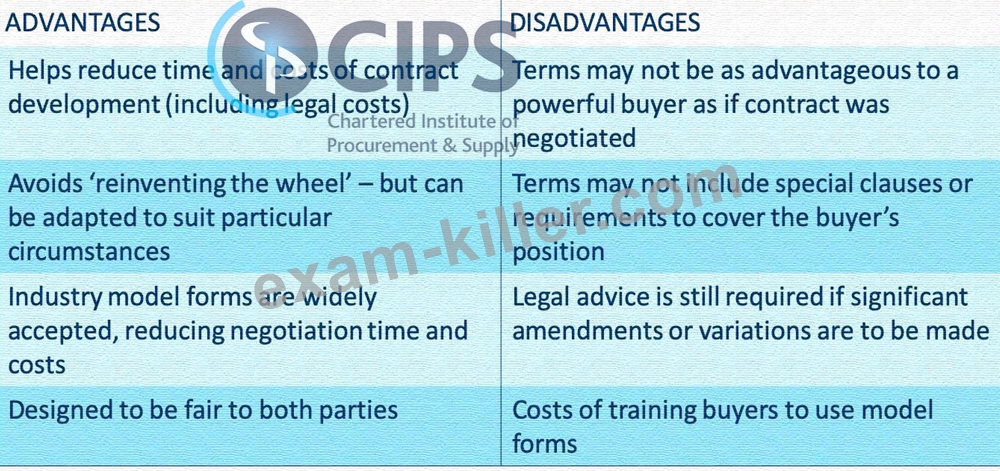
Reference:
- Procurement Study Buddy on Facebook
- CIPS study guide page 147
NEW QUESTION # 75
Which of the following will always give rise to a claim of misrepresentation?
1. Silence
2. False thought
3. Statement of fact
4. Representation by conduct
- A. 1 and 3 only
- B. 3 and 4 only
- C. 2 and 4 only
- D. 1 and 2 only
Answer: B
Explanation:
A misrepresentation is a false statement of fact or law which induces the representee to enter a contract.
Where a statement made during the course of negotiations is classed as a representation rather than a term an action for misrepresentation may be available where the statement turns out to be untrue.
For a party to claim for misrepresentation, there must be a false statement of fact or law as oppose to opinion or estimate of future events. It does not matter whether the incorrect information is given by words or takes the form of misleading conduct.
Silence will not generally amount to a misrepresentation. However, it can become a misrepresentation in some exceptional circumstances.
In the L4M3 study guide, the author states that "A statement of law is not misrepresentation". This is untrue in both common law and civil law systems. In the UK, false statement of law will now amount to an actionable misrepresentation (see Pankhania v Hackney [2002] EWHC 2441).
Reference:
- Misrepresentation
- L4M3 study guide page 53-55
LO 1, AC 1.2
NEW QUESTION # 76
Under general legal principles of contract formation, which of the following will always automatically result in the termination of an offer?
1. Negotiation
2. Rejection
3. Failure conditionality
4. Non-disclosure
- A. 2 and 3 only
- B. 3 and 4 only
- C. 1 and 4 only
- D. 1 and 2 only
Answer: A
Explanation:
There are a number of ways for an offer to be terminated. They are events that may occur after an offer has been made which bring it to an end so that it can no longer be accepted. An offer is terminated in the following circumstances:
1. Revocation
2. Rejection
3. Lapse of time
4. Conditional Offer (or Failure of Conditionality)
5. Operation of law
6. Death
7. Acceptance
8. Illegality
Reference:
- How Is an Offer Terminated?
- CIPS study guide page 31-32
LO 1, AC 1.2
NEW QUESTION # 77
An example of a qualitative performance measure could be one that relates to opinions about the service quality of the supplier. Is this correct?
- A. Yes, this is often how satisfaction is measured
- B. Yes, this will relate to the actual number of complaints received
- C. No, this will relate to how much prices have increased by
- D. No, this type of measure will relate to the number of incomplete deliveries
Answer: A
Explanation:
Qualitative performance measures capture subjective or non-numerical aspects of service, such as customer satisfaction, perceptions, and opinions. These are often gathered through surveys or interviews. While quantitative data is crucial, qualitative insights can reveal hidden issues and improve relationship management.
Reference:CIPS L4M3 Commercial Contracting Study Guide, Chapter 4, Section 4.3.2 - Qualitative and quantitative performance measures.
NEW QUESTION # 78
Under hire purchase agreement, when will the ownership of asset legally belong to the purchaser?
- A. When the purchaser takes possession of the asset
- B. When the down payment is made
- C. When the final instalment is paid
- D. When the agreement is signed
Answer: C
Explanation:
Hire purchase is an arrangement for buying expensive consumer goods, where the buyer makes an initial down payment and pays the balance plus interest in installments. Ownership is not transferred until the end of the agreement, hire purchase plans offer more protection to the vendor than other sales or leasing methods for unsecured items. That's because the items can be repossessed more easily should the buyer be unable to keep up with the repayments.
The answer is 'When the final instalment is paid'.
Reference:
- Hire Purchase Agreements
- CIPS study guide page 70
LO 1, AC 1.3
NEW QUESTION # 79
Which of the following best defines an 'express' term in general contract arrangements?
- A. It is the term that is added to the contract by the law or based upon the facts of the case.
- B. It is not necessarily discussed by the parties, but nonetheless forms part of the contract
- C. It is a standard set of terms and conditions published by CIPS
- D. It is clearly agreed between the parties, and is virtually always written down in the contract
Answer: D
Explanation:
Express terms are the terms of the agreement which are expressly agreed between the parties. Ideally, they will be written down in a contract between the parties but where the contract is agreed verbally, they will be the terms discussed and agreed between the parties.
Implied terms are terms implied into the contract by the courts. They are not expressly set out in the contract but are taken to be as effective as if they were and as if they had been included from day one of the contract. The express terms and any implied terms together create the legally binding obligations on the parties.
Reference:
- Contracts: Express and Implied Terms
- CIPS study guide 126-132
LO 3, AC 3.1
NEW QUESTION # 80
Since services are intangible, so KPIs for services must be qualitative in all circumstances. Is this statement correct?
- A. No, KPIs for services must always be quantitative so that they can be measured easily
- B. Yes, quantitative KPIs are limited to timeliness of supply of goods, defective rates and in-full quantities, which are applied to monitor supplier of physical goods
- C. Yes, the only measure mattered to supply of services is end-users' satisfaction
- D. No, some KPIs for services are measurable by means of outcome, time and space performed
Answer: D
Explanation:
KPIs are used to monitor supplier's performance. They can be qualitative or quantitative. Of course, service providers can be monitored by quantitative KPIs regarding the outcome achieved (such as uptime in IT contracts), timeliness of deliveries (such as in construction contracts)...
Reference:
LO 2, AC 2.2
NEW QUESTION # 81
While it is recognised that longer-term contracts have the potential to drive significant benefits for the organisation, a number of situations are more suited to making one-off purchases. Which of the below situations is likely to be more suited to a one-off purchase?
- A. The purchase of internal and external audit services
- B. A requirement for the maintenance of buildings
- C. The purchase of compatible IT infrastructure equipment
- D. The ordering of equipment for a special project
Answer: D
Explanation:
One-off purchases are ideal for unique, non-recurring needs such as equipment for a special project. These purchases are typically not repeated, do not require long-term supplier relationships, and are handled separately from strategic or ongoing procurement activities.
Reference:CIPS L4M3 Commercial Contracting Study Guide, Chapter 4, Section 4.1.2 - Types of procurement arrangements.
NEW QUESTION # 82
A senior buyer is preparing specification for the next purchase. He intends to embed social and environmental criteria that align with his organisation's overarching strategy. Which of the following provides the social and environmental objectives that an organisation pursues?
- A. Economy of scale
- B. Procurement Systems and Technology
- C. Economic performance
- D. Organisation's CSR policies
Answer: D
Explanation:
The organisation should have an overarching strategies or policies which sets out the social and environmental objectives to be pursued via procurement and the supply chain generally. Some of these will be about the specification, but that must be tied in other aspects of the sourcing strategy. These objectives, policies and strategies can be found in corporate social responsibility policy.
Reference: CIPS study guide page 96
LO 2, AC 2.1
NEW QUESTION # 83
Which of the following are the conditions for revocation of offer to be valid?
1. The offeree has not received the offer yet
2. Revocation of offer must be communicated with the offeree
3. Revocation of offer must be sent via email
4. Offeree has not accepted the offer yet
- A. 1 and 3 only
- B. 2 and 4 only
- C. 1 and 4 only
- D. 2 and 3 only
Answer: B
Explanation:
A revocation of offer is the withdrawal of a previous offer to engage in some sort of legally binding contract.
The previous offer had to have been such that it would have immediately become legally binding if the other party had formally agreed to it.
A core ruling defining revocation of offers was established by Payne v. Cave. This case established that neither party is bound to an agreement until an offer has been made by one and formally accepted by the other.
If an offer has been made, the offering party has a right to withdraw it up to formal acceptance by the offeree.
Revocation basically serves as formal, legally verifiable notice that a withdrawal was made, and it's valid so long as it is communicated to the offeree before they accept.
The case of Byrne v. Van Tienhoven supports this by establishing that the withdrawal of an offer by telegram is only valid if the telegram is received before the offer is accepted. The case of Dickinson v. Dodds further establishes that the party making the offer can communicate the revocation through a third party.
Reference:
- What Is a Revocation of Offer?
- CIPS study guide page 31
LO 1, AC 1.2
NEW QUESTION # 84
Which of the following is the most suitable model contract for car lift manufacturing?
- A. IMechE/IET
- B. FIDIC
- C. CIPS
- D. ITC
Answer: A
Explanation:
IMechE/IET: Institution of Mechanical Engineers/Institution of Engineering and Technology - two separate institutes that issue jointly agreed model forms covering the design, supply and installation of electrical, electronic and mechanical plant including special conditions for the ancillary development of software. Car lifts are mechanical products, so IMechE/IET is the most suitable model contract for this type of product.
FIDIC is a French language acronym for Federation Internationale Des Ingenieurs-Conseils, which means the international federation of consulting engineers. It was started in 1913 by the trio of France, Belgium and Switzerland. The United Kingdom joined the Federation in 1949. FIDIC is headquartered in Switzerland and now boasts of membership from over 60 different countries. FIDIC published its first contract, titled The Form of contract for works of Civil Engineering construction, in 1957. As the title indicated, this first contract was aimed at the Civil Engineering sector and it soon became known for the colour of its cover, and thus, The Red Book. It has become the tradition that FIDIC contracts are known in popular parlance by the colour of their cover. This first contract by FIDIC was undertaken jointly with the International federation of Building and Public works. FIDIC's concerted effort at achieving broad consultation and acceptance of its contract forms has seen subsequent editions of its contracts being ratified by the International Federation of Asian and Western Pacific Contractors Association, Associated General Contractors of America and the Inter-American Federation of the Construction Industry, Multilateral Development Banks among others. Because of the broad support it enjoys, FIDIC contracts are the foremost contracts in international construction.
The Chartered Institute of Procurement and Supply (CIPS) has some model contracts for IT functions including: supply and installation of computer equipment, support and maintenance of bespoke software, servicing of computer equipment,...
The International Trade Centre (ITC) produces contracts specifically designed for small companies doing international business, covering the sale of goods, distribution, services and joint ventures.
Reference: CIPS study guide page 142
LO 3, AC 3.1
NEW QUESTION # 85
A tire manufacturer entered into a contract with a distributor. In the contract, the distributor is prohibited from selling the tire under the price list. The distributor must pay $5 for each tire sold in breach. The amount of $5 is known as...?
- A. Caveat Emptor
- B. Liquidated damages
- C. Quantum meruit
- D. Penalty
Answer: B
Explanation:
This scenario is in fact based on a famous case law: Dunlop Pneumatic Tyre Company v New Garage & Motor co [1915] AC 79. In this case law, the House of Lords identified the clause as liquidated damages, and therefore enforceable.
However, if this case had happened in 2015 or afterwards, there would be some legal issues:
- The price agreement is prohibited by Competition Act 1998
- If the agreement is allowed by Competition Act, as in the case Cavendish Square Holding BV (Appellant) v Talal El Makdessi (Respondent), the clause can also be identified as a penalty and it is still enforceable.
Reference:
LO 3, AC 3.2
NEW QUESTION # 86
Which of the following should include in the service level agreement that is an appendix of a contract?
1. How often the service is measured
2. Minimum qualification of supplier staffs
3. Remedies to resolve dispute
4. On time service delivery
- A. 1, 2 and 4 only
- B. 2, 3 and 4 only
- C. 1, 2 and 3 only
- D. 1, 3 and 4 only
Answer: A
Explanation:
When the SLA is a schedule or an appendix to the contract, it should clearly state the following:
1. KPIs: how they are to be measured, who measures them and how often
2. How the measurements convert into scores
3. Any other service level standards, which may be of lesser importance than the KPIs
4. Minimum acceptable standards or scores in each case
5. Range of scores both above and below the minimum acceptable
6. Any mitigating factors which might apply in the event of poor performance
7. Any time period permitted in which to remedy a situation or poor performance.
In this question, "2. Minimum qualification of supplier staffs" and "4. On time service delivery" are the KPIs, while "1. How often the service is measured" is the frequency in which the KPIs are measured.
The remedies available in the event of poor performance should be set out in the body of the contract, along with those for any other contractual breach. These clauses should be cross-referenced in the SLA.
Reference: CIPS study guide page 110-116
LO 2, AC 2.2
NEW QUESTION # 87
Which of the following is the model form of contract for construction which is recommended by World Bank?
- A. JCT
- B. FIDIC
- C. CIPS
- D. ITC
Answer: B
Explanation:
FIDIC is the International Federation of Consulting Engineers (or Federation Internationale des Ingenieurs Conseils in French). FIDIC has produced many publications, including the model form contracts, best practice guidances, research on sustainability, integrity and risk management. FIDIC model form contracts have been developed by this organisation since 1999, now they consist of several different books which are marked by colours. Thus, FIDIC model contracts also have the nickname "Rainbow suite of contracts". Basically, the "Rainbow Suite" include the following books:
* Yellow book: Plant and Design-Build Contract (2 editions: 1999 and 2017)
* Silver book: EPC/Turnkey Contract (2 editions: 1999 and 2017)
* Red book: Construction Contracts (2 editions: 1999 and 2017)
* Emerald book: Conditions of Contract for Underground Works (1st Ed 2019)
* Blue-Green book: Dredgers Contract (2 editions: 2006 and 2016)
* Gold book: Design, Build and Operate Contract Guide
* Pink book: Construction Contract Multilateral Development Bank Harmonised Ed (2 editions: 2005 and 2010) This type of model contract is commonly used around the world because its author, International Federation of Consulting Engineers, collaborates closely with development banks such as World Bank, Africa Development Bank, Asia Development Bank, etc. Every construction project that is financed by these institutions must adopt the FIDIC contracts.
The Joint Contracts Tribunal, also known as the JCT, produces standard forms of contract for construction, guidance notes and other standard documentation for use in the construction industry in the United Kingdom. From its establishment in 1931, JCT has expanded the number of contributing organisations.
ITC (International Trade Centre) produces contracts specifically designed for small companies doing international business, covering the sale of goods, distribution, services and joint ventures. Many small companies are now engaged in international trade, but don't have access to the necessary contract forms to protect themselves. ITC and leading legal experts developed eight generic contract templates that incorporate internationally recognized standards and laws for most small business situations.
CIPS has several model forms of contract designed specifically for IT buying and servicing.
Reference:
LO 3, AC 3.1
NEW QUESTION # 88
Which of the following regulates barriers to the trade of goods between Member States of WTO?
- A. CISG
- B. NAFTA
- C. GATT
- D. TRIPS
Answer: C
Explanation:
- The General Agreement on Tariffs and Trade (GATT) is a legal agreement between many countries, whose overall purpose was to promote international trade by reducing or eliminating trade barriers such as tariffs or quotas. According to its preamble, its purpose was the "substantial reduction of tariffs and other trade barriers and the elimination of preferences, on a reciprocal and mutually advantageous basis."
- CISG is the Vienna Convention on Contracts for the International Sale of Goods. This is a voluntary treaty under United Nations Commission on International Trade Law (UNCITRAL). The purpose of the Vienna Convention is to set out a framework for international transactions based on a uniform approach. It establishes substantive rules that regulate the duties and obligations of both parties, including the delivery of goods, contract formation, and remedies for breach of contract.
- The Agreement on Trade-Related Aspects of Intellectual Property Rights (TRIPS) is an international legal agreement between all the member nations of the World Trade Organization (WTO). It sets down minimum standards for the regulation by national governments of many forms of intellectual property (IP) as applied to nationals of other WTO member nations.
- The North American Free Trade Agreement (NAFTA; Spanish: Tratado de Libre Comercio de America del Norte, TLCAN; French: Accord de libre-echange nord-americain, ALENA) is an agreement signed by Canada, Mexico, and the United States, creating a trilateral trade bloc in North America.
Reference: CIPS study guide page 65-67
LO 1, AC 1.3
NEW QUESTION # 89
An organization has a normal tender process that often last 1 month from defining the needs to contract award. Manufacturing department suddenly required a new special part that they could not foresee within a month. Which of the following should be the priority actions of procurement manager in this urgent situation? Select TWO that apply:
- A. Design new specification
- B. Review contract performance
- C. Develop relationships with potential suppliers
- D. Submit full business justification
- E. Get high-level authority approval
Answer: D
Explanation:
This urgent needs occasionally occur due to a sudden change in circumstances. The process for selecting a replacement supplier must still be controlled. If there is a reason for normal processes to be waived, this must be fully documented and approved at a high level.
Reference:
LO 1, AC 1.1
NEW QUESTION # 90
......
L4M3 Exam Dumps, L4M3 Practice Test Questions: https://www.exam-killer.com/L4M3-valid-questions.html
Free L4M3 Study Guides Exam Questions and Answer: https://drive.google.com/open?id=1DjJSx6o2uZpf8AYHfMLC_c0S4ddNz358
