

NetSec-Analyst Exam PDF [2026] Tests Free Updated Today with Correct 76 Questions
Palo Alto Networks NetSec-Analyst Exam Preparation Guide and PDF Download
Palo Alto Networks NetSec-Analyst Exam Syllabus Topics:
| Topic | Details |
|---|---|
| Topic 1 |
|
| Topic 2 |
|
| Topic 3 |
|
| Topic 4 |
|
NEW QUESTION # 16
Which interface does not require a MAC or IP address?
- A. Virtual Wire
- B. Loopback
- C. Layer2
- D. Layer3
Answer: A
NEW QUESTION # 17
An administrator is investigating a log entry for a session that is allowed and has the end reason of aged-out.
Which two fields could help in determining if this is normal? (Choose two.)
- A. Action
- B. IP Protocol
- C. Decrypted
- D. Packets sent/received
Answer: B,C
NEW QUESTION # 18
You must configure which firewall feature to enable a data-plane interface to submit DNS queries on behalf of the control plane?
- A. Admin Role profile
- B. virtual router
- C. DNS proxy
- D. service route
Answer: A
NEW QUESTION # 19
Which three filter columns are available when setting up an Application Filter? (Choose three.)
- A. Standard Ports
- B. Risk
- C. Category
- D. Subcategory
- E. Parent App
Answer: B,C,D
Explanation:
https://docs.paloaltonetworks.com/pan-os/9-1/pan-os-web-interface-help/objects/objects-application-filters
NEW QUESTION # 20
What does an application filter help you to do?
- A. It dynamically provides application statistics based on network, threat, and blocked activity,
- B. It dynamically shapes defined application traffic based on active sessions and bandwidth usage.
- C. It dynamically filters applications based on critical, high, medium, low. or informational severity.
- D. It dynamically groups applications based on application attributes such as category and subcategory.
Answer: D
NEW QUESTION # 21
View the diagram.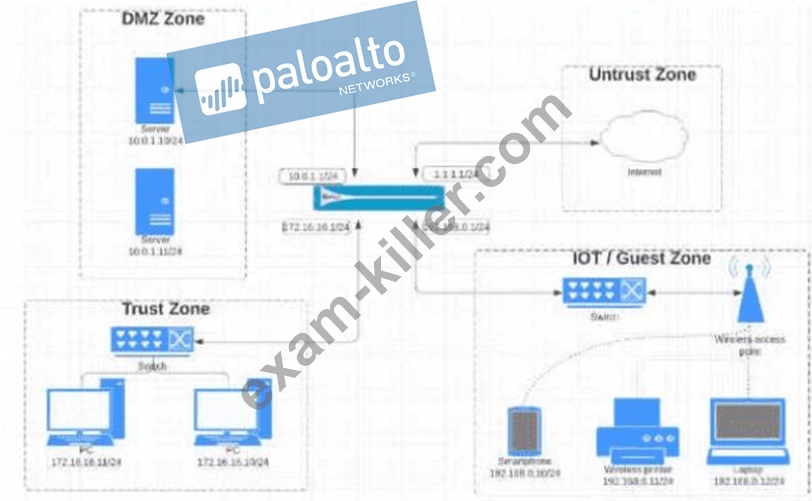
What is the most restrictive yet fully functional rule to allow general Internet and SSH traffic into both the DMZ and Untrust/lnternet zones from each of the lOT/Guest and Trust Zones?
- A.

- B.

- C.

- D.

Answer: C
NEW QUESTION # 22
Which two features implement one-to-one translation of a source IP address while allowing the source port to change? (Choose two.)
- A. Static IP
- B. Dynamic IP and Port (DIPP)
- C. Dynamic IP / Port Fallback
- D. Dynamic IP
Answer: A,B
Explanation:
Static IP and Dynamic IP and Port (DIPP) are two features that implement one-to-one translation of a source IP address while allowing the source port to change. Static IP translates a single source address to a specific public address, and allows the source port to change dynamically1. Dynamic IP and Port (DIPP) translates the source IP address or range to a single IP address, and uses the source port to differentiate between multiple source IPs that share the same translated address2. Both of these features provide a one-to-one translation of IP addresses, but do not restrict the source port. Reference:
Static IP - Palo Alto Networks
Dynamic IP and Port - Palo Alto Networks
NEW QUESTION # 23
You are tasked with analyzing the long-term resource usage trends of a Palo Alto Networks firewall to justify a hardware upgrade. You need to gather specific metrics over the past year, including average and peak session counts, CPU utilization (data plane and management plane), and throughput. Which of the following methods provides the MOST comprehensive and historical data for this purpose, assuming the firewall is managed by Panorama?
- A. Extract 'Resource Monitor' reports directly from the firewall's GUI (Monitor > Reports > Resource Monitor) for various timeframes.
- B. Periodically log into the firewall CLI and run show running resource-monitor all, then manually compile the data into a spreadsheet.
- C. Leverage Panorama's 'Managed Devices' tab, navigate to the specific firewall, and view 'System' and 'Network' dashboards for historical graphs and data summaries.
- D. Configure SNMP traps on the firewall to send resource utilization data to an external monitoring system with long-term data retention capabilities.
- E. Utilize Panorama's 'ACC' (Application Command Center) for 'GlobalProtect', 'Threat', and 'Traffic' monitoring, as these indirectly reflect resource usage.
Answer: D
Explanation:
For long-term, comprehensive, and historical resource usage analysis to justify an upgrade, SNMP with an external monitoring system (Option D) is the most effective. While Panorama (Option C) provides some historical data, its native retention for detailed resource metrics like specific CPU core utilization or granular session counts over a year is often limited by its logging and reporting capacity and configured data retention periods. A dedicated SNMP monitoring system (e.g., SolarWinds, PRTG, Zabbix, Grafana/Prometheus) can collect and store these metrics with much greater granularity and for extended periods, allowing for custom reporting, trend analysis, and predictive modeling for capacity planning. Options A and B are manual and limited in scope/history. Option E focuses on traffic/threats, not direct resource utilization trends for hardware sizing.
NEW QUESTION # 24
Where does a user assign a tag group to a policy rule in the policy creation window?
- A. Actions tab
- B. General tab
- C. Usage tab
- D. Application tab
Answer: B
Explanation:
A user can assign a tag group to a policy rule in the policy creation window by selecting the General tab. A tag group is a collection of tags that can be used to identify and filter policy rules based on different criteria, such as function, location, or priority. A user can create a tag group on Panorama and assign it to a policy rule to apply the same set of tags to multiple firewalls or device groups1. To assign a tag group to a policy rule, the user needs to:
Select the General tab in the policy creation window.
Click the Tag Group drop-down menu and select the tag group that the user wants to assign to the policy rule.
Click OK to save the changes. The policy rule will inherit the tags from the tag group and display them in the Tag column.
References: Assign a Tag Group to a Policy Rule, Policy, Certifications - Palo Alto Networks, Palo Alto Networks Certified Network Security Administrator (PAN-OS 10.0) or [Palo Alto Networks Certified Network Security Administrator (PAN-OS 10.0)].
NEW QUESTION # 25
An internal web application, 'AppX', uses SSL with client certificates for mutual authentication. Users are complaining that they cannot access 'APPX' when SSL Inbound Inspection is enabled on the Palo Alto Networks firewall. The firewall logs indicate 'decryption-failure' with reason 'client-certificate-required'. Which specific configuration adjustment to the SSL Inbound Inspection profile applied to 'APPX' would resolve this issue without compromising the mutual authentication requirement?
- A. Disable 'Block Session on Unsupported Cipher' in the SSL Inbound Inspection profile.
- B. Disable SSL Inbound Inspection for traffic destined to 'AppX'.
- C. In the SSL Inbound Inspection profile, under 'SSL Protocol Settings', change 'Unsupported SSL Version' to 'Allow'.
- D. In the SSL Inbound Inspection profile, under 'SSL Protocol Settings', enable 'Forward Client Certificate' and ensure the firewall's certificate is trusted by AppX.
- E. Import the client certificates into the firewall's trusted certificate store.
Answer: D
Explanation:
Mutual authentication means both the client and the server present certificates to each other for validation. When SSL Inbound Inspection is performed, the firewall terminates the client's connection and then initiates a new connection to the server. If the server (AppX) requires a client certificate, the firewall needs to be able to 'forward' the original client's certificate. The 'Forward Client Certificate' option within the SSL Inbound Inspection profile allows the firewall to re-present the client certificate it received from the original client to the server during the new connection it establishes. Additionally, for the firewall's connection to be trusted by AppX, Appx must trust the certificate the firewall presents (its decryption certificate).
NEW QUESTION # 26
How many zones can an interface be assigned with a Palo Alto Networks firewall?
- A. three
- B. four
- C. two
- D. one
Answer: D
Explanation:
References:
NEW QUESTION # 27
Which two compliance frameworks are included with the Premium version of Strata Cloud Manager (SCM)? (Choose two)
- A. Center for Internet Security (CIS)
- B. Payment Card Industry (PCI)
- C. National Institute of Standards and Technology (NIST)
- D. Health Insurance Portability and Accountability Act (HIPAA)
Answer: B,C
Explanation:
Step 1: Understanding Strata Cloud Manager (SCM) Premium
Strata Cloud Manager is a unified management interface for Strata NGFWs, Prisma Access, and other Palo Alto Networks solutions. The Premium version (subscription-based) includes advanced features like:
* AIOps Premium: Predictive analytics, capacity planning, and compliance reporting.
* Compliance Posture Management: Pre-built dashboards and reports for specific regulatory frameworks.
Compliance frameworks in SCM Premium provide visibility into adherence to standards like PCI DSS and NIST, generating actionable insights and audit-ready reports based on firewall configurations, logs, and traffic data.
Reference: Strata Cloud Manager Documentation
"SCM Premium delivers compliance reporting for industry standards, integrating with NGFW telemetry to ensure regulatory alignment." Step 2: Evaluating the Compliance Frameworks Option A: Payment Card Industry (PCI) Analysis: The Payment Card Industry Data Security Standard (PCI DSS) is a mandatory framework for organizations handling cardholder data. SCM Premium includes a PCI DSS Compliance Dashboard that maps NGFW configurations (e.g., security policies, decryption, Threat Prevention) to PCI DSS requirements (e.g., Requirement 1: Firewall protection, Requirement 6: Vulnerability protection). It tracks compliance with controls like network segmentation, encryption, and monitoring, critical for Strata NGFW deployments in payment environments.
Evidence: Palo Alto Networks emphasizes PCI DSS support in SCM Premium for retail, financial, and e- commerce customers, providing pre-configured reports for audits.
Conclusion: Included in SCM Premium.
Reference: Strata Cloud Manager Premium Features Overview
"PCI DSS compliance reporting ensures cardholder data protection with automated insights." Option B: National Institute of Standards and Technology (NIST) Analysis: NIST frameworks, notably the NIST Cybersecurity Framework (CSF) and NIST SP 800-53, are widely adopted for cybersecurity risk management, especially in government and critical infrastructure sectors. SCM Premium offers a NIST Compliance Dashboard, aligning NGFW settings (e.g., App-ID, User- ID, logging) with NIST controls (e.g., Identify, Protect, Detect, Respond, Recover). This is key for Strata customers needing federal compliance or a risk-based approach.
Evidence: Palo Alto Networks documentation highlights NIST CSF and 800-53 mapping in SCM Premium, reflecting its broad applicability.
Conclusion: Included in SCM Premium.
Reference: Strata Cloud Manager AIOps Premium Datasheet
"NIST compliance reporting supports risk management and regulatory adherence." Option C: Center for Internet Security (CIS) Analysis: The CIS Controls and Benchmarks provide practical cybersecurity guidelines (e.g., CIS Controls v8, CIS Benchmarks for OS hardening). While Palo Alto Networks supports CIS principles (e.g., via Best Practice Assessments), SCM Premium documentation does not explicitly list a dedicated CIS Compliance Dashboard. CIS alignment is often manual or supplementary, not a pre-built feature like PCI or NIST.
Evidence: No direct evidence in SCM Premium feature sets confirms CIS as a standard inclusion; it's more commonly referenced in standalone tools like CIS-CAT or Expedition.
Conclusion: Not included in SCM Premium.
Reference: PAN-OS Administrator's Guide (11.1) - Best Practices
"CIS alignment is supported but not a native SCM Premium framework."
Option D: Health Insurance Portability and Accountability Act (HIPAA)
Analysis: HIPAA governs protected health information (PHI) security in healthcare. While Strata NGFWs can enforce HIPAA-compliant policies (e.g., encryption, access control), SCM Premium does not feature a dedicated HIPAA Compliance Dashboard. HIPAA compliance is typically achieved through custom configurations and external audits, not a pre-configured SCM framework.
Evidence: Palo Alto Networks documentation lacks mention of HIPAA as a standard SCM Premium offering, unlike PCI and NIST.
Conclusion: Not included in SCM Premium.
Reference: Strata Cloud Manager Documentation
"HIPAA compliance is supported via NGFW capabilities, not SCM Premium dashboards." Step 3: Why A and B Are Correct A (PCI): Directly addresses a common Strata NGFW use case (payment security) with a tailored dashboard, reflecting SCM Premium's focus on industry-specific compliance.
B (NIST): Provides a flexible, widely adopted framework for cybersecurity, integrated into SCM Premium for broad applicability across sectors.
Exclusion of C and D: CIS and HIPAA, while relevant to NGFW deployments, lack dedicated, pre-built compliance reporting in SCM Premium, making them supplementary rather than core inclusions.
Step 4: Verification Against SCM Premium Features
SCM Premium's compliance posture management explicitly lists PCI DSS and NIST (e.g., CSF, 800-53) as supported frameworks, leveraging NGFW telemetry (e.g., Monitor > Logs > Traffic) and AIOps analytics.
This aligns with Palo Alto Networks' focus on high-demand regulations as of PAN-OS 11.1 and SCM updates through March 08, 2025.
Reference: Strata Cloud Manager Release Notes (March 2025)
"Premium version includes PCI DSS and NIST compliance dashboards for automated reporting." Conclusion The two compliance frameworks included with the Premium version of Strata Cloud Manager are A.
Payment Card Industry (PCI) and B. National Institute of Standards and Technology (NIST). These are verified by SCM Premium's documented capabilities, ensuring Strata NGFW customers can meet regulatory requirements efficiently.
NEW QUESTION # 28
An organization needs to implement a security rule that allows users to access "Facebook" but prevents them from using "Facebook-Chat." What is the best way to achieve this?
- A. Block the specific IP addresses used by Facebook Chat.
- B. Use an Application Override rule for Facebook traffic.
- C. Create a URL Filtering profile to block the chat URL.
- D. Create a security rule allowing the "Facebook-base" App-ID and another rule blocking the "Facebook- chat" App-ID.
Answer: D
Explanation:
Comprehensive and Detailed 150 to 250 words of Explanation From Palo Alto Networks Network Security Analyst Knowledge:
The power of App-ID lies in its ability to distinguish between different functions within the same web service. Palo Alto Networks provides specific App-IDs for various sub-functions of popular sites.
To achieve the requirement, the analyst should create two security rules (or one rule with a specific exclusion). The first rule, placed higher in the policy, would block the Facebook-chat App-ID. The second rule, placed below it, would allow the Facebook-base App-ID. Because the firewall evaluates rules from the top down, any attempt to use the chat function will hit the block rule first. This provides much higher security and granularity than URL Filtering (Option A), which might struggle to differentiate between the different elements of a dynamic, HTTPS-based site like Facebook. Using App-ID for this purpose ensures that the business can allow the useful parts of social media while mitigating the risks associated with unauthorized file transfers or interactive chat functions.
NEW QUESTION # 29
An administrator needs to create a Security policy rule that matches DNS traffic within the LAN zone, and also needs to match DNS traffic within the DMZ zone The administrator does not want to allow traffic between the DMZ and LAN zones.
Which Security policy rule type should they use?
- A. interzone
- B. intrazone
- C. universal
- D. default
Answer: B
NEW QUESTION # 30
Which object would an administrator create to block access to all high-risk applications?
- A. Vulnerability Protection profile
- B. HIP profile
- C. application group
- D. application filter
Answer: D
Explanation:
Explanation/Reference:
Reference:
https://knowledgebase.paloaltonetworks.com/KCSArticleDetail?id=kA10g000000ClKECA0
NEW QUESTION # 31
A large-scale smart city deployment includes thousands of IoT devices, ranging from smart streetlights to environmental sensors and traffic cameras. The security architect needs to design a scalable and flexible IoT security policy framework on Palo Alto Networks NGFWs, considering future growth and varying security requirements for different device types. Which of the following design principles and configurations are crucial for achieving this scalability and flexibility? (Multiple Response)
- A. Leverage 'Policy Based Forwarding (PBF)' to direct IoT traffic to different security zones based on device vendor, allowing for vendor-specific security profiles.
- B. Define custom 'Application Objects' for every unique IoT device communication pattern, and create one-to-one security rules for each device and its application.
- C. Utilize 'IoT Device Groups' extensively, categorizing devices by type (e.g., 'Streetlight-IoT', 'Traffic-Camera-loT') and applying distinct 'IoT Security Profiles' and security policies to each group, rather than individual IPs.
- D. Implement a hierarchical policy structure, with general 'Allow' rules for common IoT services at the top, followed by more specific 'Deny' rules for known threats or restricted applications at the bottom.
- E. Integrate with a dedicated IoT security platform (e.g., IoT Security by Palo Alto Networks) for enhanced device visibility, behavioral analytics, and automated policy recommendations that feed into the NGFW.
Answer: C,E
Explanation:
For scalability and flexibility in a large IoT deployment:
A: Correct. Using 'IoT Device Groups' is fundamental. It allows grouping similar devices and applying common policies, greatly simplifying management as new devices are added.
B: Incorrect. Security policies should generally follow a 'deny by default' principle, with specific 'allow' rules at the top, followed by more general 'deny' rules. A broad 'allow' at the top defeats the purpose of granular IoT security.
C: Incorrect. PBF is for routing decisions, not for applying security profiles based on device attributes. Security zones are typically based on network segmentation, not vendor.
D: Correct. Dedicated IoT security platforms provide deep visibility and automation that firewalls alone cannot achieve at scale. They enhance Device-ID and provide insights for policy tuning.
E: Incorrect. This approach is not scalable. Managing individual application objects and rules for thousands of devices would be an operational nightmare and negate the benefits of Device-ID and IoT Device Groups.
NEW QUESTION # 32
An administrator needs to allow users to use their own office applications. How should the administrator configure the firewall to allow multiple applications in a dynamic environment?
- A. Create an Application Filter and name it Office Programs, the filter it on the business-systems category, office-programs subcategory
- B. Create an Application Group and add business-systems to it
- C. Create an Application Group and add Office 365, Evernote, Google Docs, and Libre Office
- D. Create an Application Filter and name it Office Programs, then filter it on the business-systems category
Answer: A
Explanation:
An application filter is an object that dynamically groups applications based on application attributes that you define, including category, subcategory, technology, risk factor, and characteristic. This is useful when you want to safely enable access to applications that you do not explicitly sanction, but that you want users to be able to access. For example, you may want to enable employees to choose their own office programs (such as Evernote, Google Docs, or Microsoft Office 365) for business use. To safely enable these types of applications, you could create an application filter that matches on the Category business-systems and the Subcategory office-programs. As new applications office programs emerge and new App-IDs get created, these new applications will automatically match the filter you defined; you will not have to make any additional changes to your policy rulebase to safely enable any application that matches the attributes you defined for the filter.
https://docs.paloaltonetworks.com/pan-os/9-0/pan-os-admin/app-id/use-application-objects-in -policy/create-an-application-filter.html
NEW QUESTION # 33
What are two valid pattern types in a Data Filtering profile? (Choose two.)
- A. Proximity Pattern
- B. Regular Expression
- C. File Properties
- D. Custom Dictionary
Answer: B,C
Explanation:
Comprehensive and Detailed 150 to 250 words of Explanation From Palo Alto Networks Network Security Analyst Knowledge:
In the Palo Alto Networks ecosystem, specifically when utilizing Strata Cloud Manager (SCM) and Enterprise Data Loss Prevention (DLP), Data Filtering profiles are used to identify and protect sensitive information. When an analyst creates a custom data pattern to be used within these profiles, the system allows for two primary methods of identification: Regular Expressions (Regex) and File Properties.
Regular Expressions (D) allow the analyst to define a specific string or numerical pattern, such as a custom employee ID format or a proprietary project code. This is the most flexible and common way to catch sensitive text data within a file or data stream.
File Properties (C) allow the analyst to create patterns based on the metadata or attributes of a file rather than its contents. This includes identifying files based on the "Author," "Title," "Company," or even custom tags embedded in document properties (e.g., Microsoft Word or PDF metadata). By combining these two pattern types, a Network Security Analyst can create a highly granular detection engine. For instance, a policy could block any file where the "Company" property is set to a competitor or any file containing text that matches a specific Regex-defined sensitive data format.
While "Predefined" patterns (like Credit Card numbers) are also a core component, they are not listed as an option here. "Proximity Patterns" are a feature used to reduce false positives by ensuring two patterns appear near each other, but the fundamental "pattern types" for custom definitions are Regex and File Properties.
NEW QUESTION # 34
......
Verified & Correct NetSec-Analyst Practice Test Reliable Source Mar 11, 2026 Updated: https://www.exam-killer.com/NetSec-Analyst-valid-questions.html
Free Palo Alto Networks NetSec-Analyst Exam Files Downloaded Instantly: https://drive.google.com/open?id=1eqqCcmW3H6ZnLItDivdirxbORZ7Y1nH_
