

Dependable HPE7-A06 Exam Dumps to Become HP Certified
Get Ready with HPE7-A06 Exam Dumps (2026)
NEW QUESTION # 35
Refer to the four numborod slops in the exhibit.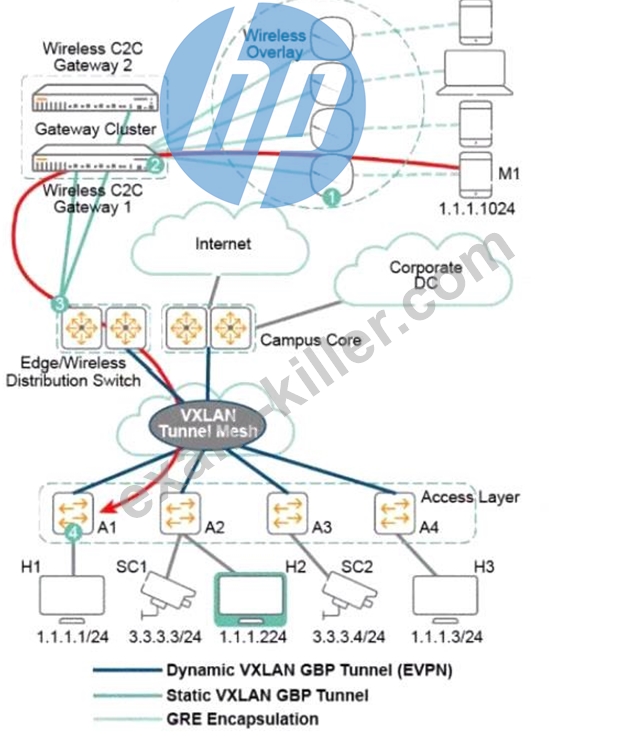
Which action is the fourthstep in applying a role-to-role ACL on thetraffic from mobile device M1 to roleH2?
- A. The AP forwards the packet from M1 to gateway 1.
- B. Gateway 1 forwards thetraffic over the sialic VXLAN tunnel to the edge switch; this packet carries the Group Policy ID corresponding to the role ofM1.
- C. Switch A1 determines the destination role based on destination MAC or destination IP and enforces role-to-role ACLs.
- D. The edge switch acts as the intermediate node and transfers the Group Policy ID over static VXLAN to dynamic VXLAN tunnel and forwards the packet to switch Al.
Answer: C
Explanation:
The question asks for the fourth step in applying a role-to-role ACL on traffic from a mobile device (M1) to a role (H2) in a network using Dynamic Segmentation with VXLAN. This follows question 17, which identified the first step as the AP forwarding the packet to the gateway.
* Analysis of Options:
* Option A:Correct. The fourth step involves the destination switch (Switch A1) determining the destination role (H2) based on the destination MAC or IP address and applying the role-to-role ACL to permit or deny the traffic.
* Option B:Describes an earlier step (likely second or third) where the gateway forwards traffic over a VXLAN tunnel.
* Option C:Describes the first step, as identified in question 17.
* Option D:Describes an intermediate step (likely third) where the edge switch transfers the Group Policy ID over VXLAN.
* Why Option A is Correct:In HPE Aruba Networking's Dynamic Segmentation architecture, the traffic flow for role-based ACLs in a VXLAN environment follows these steps:
* The AP forwards the packet from M1 to the gateway (question 17).
* The gateway assigns the source role (M1's role) and forwards the packet over a VXLAN tunnel with the Group Policy ID.
* The edge switch transfers the Group Policy ID to the destination switch (A1) via VXLAN.
* Switch A1 determines the destination role (H2) based on the destination MAC or IP address and enforces the role-to-role ACL, as defined in the Group-Based Policy (GBP).
The fourth step is critical for policy enforcement, ensuring that traffic complies with the security policies defined between the source and destination roles, providing secure network segmentation.
* Relevance to Certification Objectives:
* Security (10%):Designing and troubleshooting role-based security policies in customer networks.
* Switching (19%):Implementing Layer 2/3 interconnection technologies like VXLAN for policy enforcement.
* WLAN (9%):Troubleshooting wireless traffic flows in Dynamic Segmentation.
References:
HPE Aruba Networking AOS-10 Configuration Guide: Dynamic Segmentation and VXLAN, detailing role- based policy enforcement.
HPE7-A06Study Guide: Covers Group-Based Policy and Dynamic Segmentation workflows.
HPE Aruba Networking Technical Documentation: Tunneled Node and Role-Based ACLs.
NEW QUESTION # 36
You haverecently configured a switch for 802.IX authentication with HPE Aruba Networking ClearPass. A security admin is seeing events withthe following description in ClearPass Event Viewer.
RADIUS authentication attempt from unknown NAD (10.10.1.10:1812)'
Which command should you us to identify theconfiguration issue?
- A. show radius-server shared-secret
- B. show radius-server detail
- C. show aaa authentication-server radius
- D. show ip source-interfaceradius
Answer: D
Explanation:
The ClearPass Event Viewer message "RADIUS authentication attempt from unknown NAD (10.10.1.10:
1812)" indicates that ClearPass received a RADIUS request from the IP address 10.10.1.10, but this IP is not configured as a trusted Network Access Device (NAD) in ClearPass's network device list, or the shared secret doesn't match. The first step in troubleshooting on the switch side is to verify which source IP address the switch is actually using to send these RADIUS requests.
* RADIUS Source IP:AOS-CX switches can be configured to use a specific source IP address for RADIUS packets, often using the ip source-interface radius [vrf <vrf-name>] command. This is important if the switch has multiple IP interfaces or uses VRFs.
* Analysis of Commands:
* A. show ip source-interface radius: This command directly displays the configured source interface and IP address used for RADIUS communications, allowing comparison with the IP configured in ClearPass.
* B. show aaa authentication-server radius: Shows server group configuration, not the source IP used by the switch.
* C. show radius-server shared-secret: Not a standard command; secrets are usually masked in other commands.
* D. show radius-server detail: Shows configured RADIUS server details but doesn't explicitly show the source IP the switch is using to originate packets.
* Conclusion:To identify why ClearPass sees requests from an "unknown NAD" IP (10.10.1.10), the first step on the switch is to confirm which source IP it's using. show ip source-interface radius provides this crucial information.
References:AOS-CX Security Guide (RADIUS Client Configuration, ip source-interface), ClearPass Documentation (NAD Configuration). This relates to "Authentication/Authorization" (9%) and
"Troubleshooting" (10%) objectives.
NEW QUESTION # 37
Exhibit.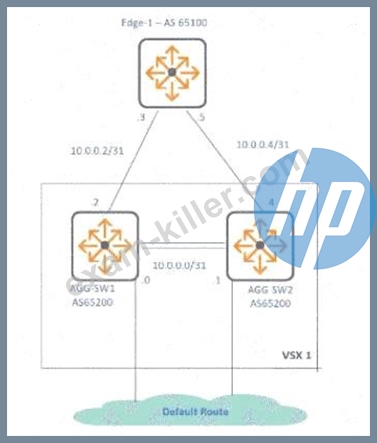
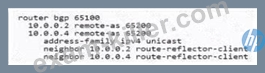
- A.
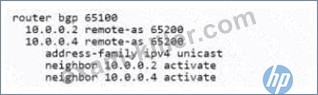
- B.
- C.
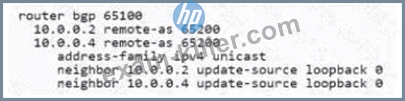
- D.
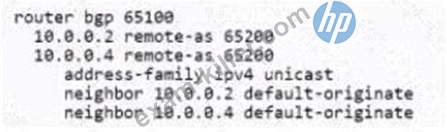
Answer: D
Explanation:
The question involves configuring an OSPF virtual link to extend area 0 across a non-backbone area, based on an exhibit (not provided) and four configuration options (A to D). Since the exhibit is unavailable, I will assume a typical scenario where a virtual link is needed to connect two area 0 segments through a transit area (e.g., area 1).
* Analysis of Options (Assumed Context):A virtual link is configured using the area <transit-area> virtual-link <router-id> command in the OSPF process. The correct option likely includes:
* Option A:Incorrect syntax or incorrect router ID/area for the virtual link.
* Option B:Incorrect configuration, possibly missing the virtual link or using wrong parameters.
* Option C:Correct. Likely includes the proper command, e.g., area 1 virtual-link 2.2.2.2, where area 1 is the transit area and 2.2.2.2 is the router ID of the remote ABR.
* Option D:Incorrect, possibly configuring an unnecessary or incorrect virtual link.
* Why Option C is Correct:OSPF requires all areas to connect to the backbone area (area 0). If two area
0 segments are separated by a non-backbone area (e.g., area 1), a virtual link is configured between the Area Border Routers (ABRs) to logically extend area 0 through the transit area. The command area
<transit-area> virtual-link <remote-router-id> is used, specifying the transit area and the router ID of the remote ABR. Option C is assumed to provide the correct syntax and parameters based on standard OSPF virtual link configurations, ensuring area 0 connectivity and proper route advertisement.
* Relevance to Certification Objectives:
* Routing (16%):Designing and troubleshooting OSPF topologies, including virtual links.
* Troubleshooting (10%):Resolving OSPF area connectivity issues.
References:
HPE Aruba Networking AOS-CX Configuration Guide: OSPF Configuration, detailing virtual link setup.
HPE7-A06Study Guide: Covers OSPF advanced configurations like virtual links.
RFC 2328: OSPF Version 2, explaining virtual link functionality.
NEW QUESTION # 38
Exhibit.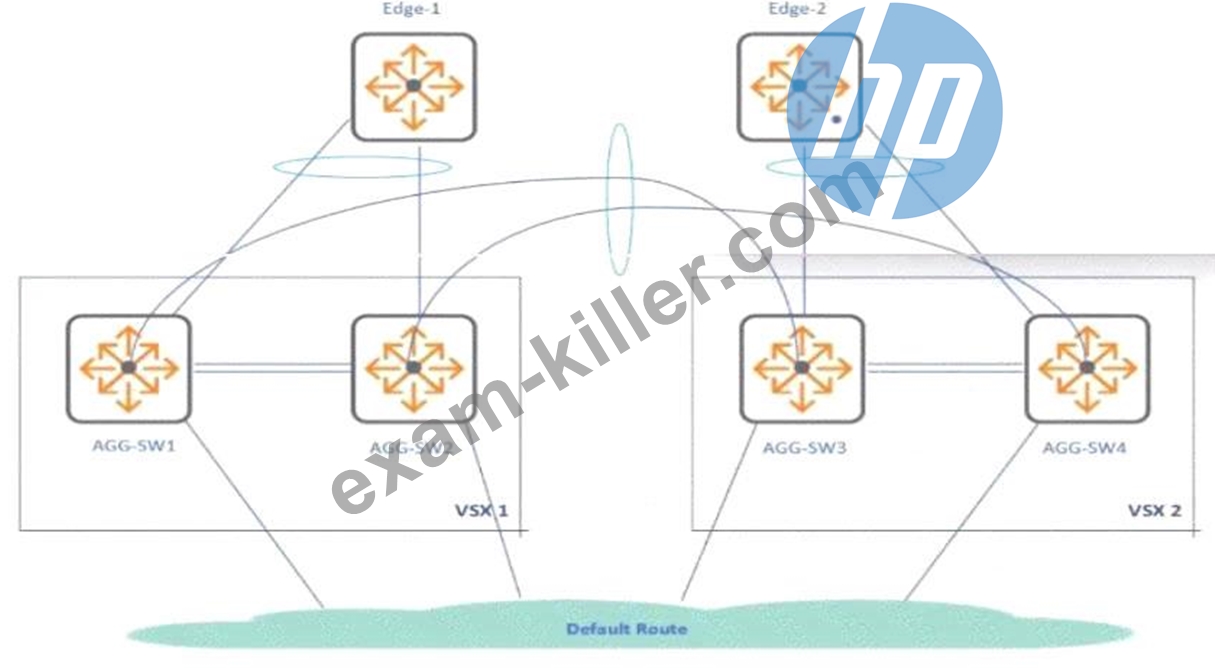
The customer has VSX clusters intwo locations interconnected over an MC-LAG interface.
If active-gateway configuration uses the same virtual IP address and vMAC on each of the VSX nodes, what must you take into consideration0
- A. Transit traffic will Increase over the VSX interconnect MC-LAG.
- B. Outbound traffic will be load-balancedover all VSX members for each session.
- C. The configuration would end up in an async setup.
- D. Each ARP request will result in four responses.
Answer: C
Explanation:
The scenario describes two separate VSX clusters interconnected via MC-LAG, where both clusters are configured to use theexact samevirtual IP address and virtual MAC address for their respective Active Gateway SVIs.
* Active Gateway Scope & Conflict:Active Gateway provides a highly available default gatewaywithina single VSX cluster (L2 domain). The vIP/vMAC combination should be unique within its L2 broadcast domain.
* Interconnecting Clusters with Same vIP/vMAC:When two VSX clusters using the identical Active Gateway vIP/vMAC are interconnected at Layer 2 (even via MC-LAG), this creates a situation where the same active L2 (vMAC) and L3 (vIP) address exists in multiple places within the extended broadcast domain.
* Consequences:This leads to MAC address conflicts and L3 ambiguity. ARP resolution becomes unreliable, potentially causing ARP tables to flap on connected devices. Traffic forwarding becomes unpredictable, as packets destined for the vIP/vMAC might be delivered to the "wrong" cluster. This unstable and unpredictable state is sometimes referred to as an asymmetric or "async" setup.
* Analysis of Options:
* A: ISL traffic might change, but it's a symptom, not the root problem.
* B: Multiple ARP replies would occur, contributing to the confusion.
* C: The configuration results in an "async setup," accurately describing the unstable state caused by duplicate active L2/L3 addresses across the interconnected L2 domain.
* D: Load-balancing happens within a cluster; this setup causes conflict, not predictable load balancing across clusters.
* Conclusion:Reusing the same Active Gateway vIP and vMAC across interconnected VSX clusters is not a valid design and leads to an unstable, asymmetric ("async") environment due to address duplication within the extended L2 domain. Option C best describes this problematic outcome.
References:Aruba VSX Design and Best Practices Guides (Active Gateway uniqueness, Interconnecting VSX clusters). This relates to "Network Resiliency and virtualization" (8%), "Routing" (16%), and
"Troubleshooting" (10%) objectives.
NEW QUESTION # 39
Match the customer requirement with the relevant commands.
Answer:
Explanation: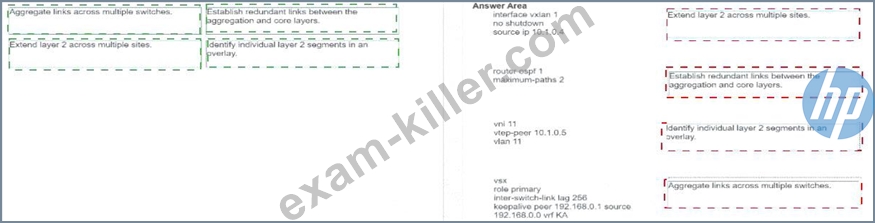
Explanation:
* Aggregate links across multiple switches -->
vsx
role primary
inter-switch-link lag 256
keepalive peer 192.168.0.1 source 192.168.0.0 vrf KA
(Snippet 4)
* Establish redundant links between the aggregation and core layers --> router ospf 1 maximum-paths 2 (Snippet 2)
* Extend layer 2 across multiple sites -->
interface vxlan 1
no shutdown
source ip 10.1.0.4
(Snippet 1)
* Identify individual layer 2 segments in an overlay -->
vni 11
vtep-peer 10.1.0.5
vlan 11
(Snippet 3)
Comprehensive Detailed Explanation along with All References available from related to the HPE Campus Access Switching Expert certification objectives at end of each question below:
* Aggregate links across multiple switches:This requirement describes Multi-Chassis Link Aggregation (MC-LAG), where a device forms a LAG to two separate upstream switches that act as a logical pair. In AOS-CX, VSX (Virtual Switching Extension) enables this functionality. Snippet 4 shows commands related to setting up VSX (vsx, role primary, inter-switch-link, keepalive), which is the foundation for MC-LAG.
References:AOS-CX VSX Guide.Relates to "Network Resiliency and virtualization" (8%), "Switching" (19%).
Establish redundant links between the aggregation and core layers:This often involves Layer 3 routing protocols utilizing multiple paths. Snippet 2 (router ospf 1, maximum-paths 2) configures OSPF to use up to two Equal Cost Multi-Paths (ECMP). If redundant links between aggregation and core result in equal OSPF costs, this command enables load sharing and redundancy at Layer 3.
References:AOS-CX IP Routing Guide (OSPF, ECMP). Relates to "Routing" (16%), "Network Resiliency and virtualization" (8%).
Extend layer 2 across multiple sites:VXLAN (Virtual Extensible LAN) is the standard overlay technology for extending Layer 2 segments over an underlying Layer 3 network, enabling L2 adjacency across different physical locations (sites, racks, pods). Snippet 1 shows the basic configuration of a VXLAN tunnel interface (interface vxlan 1, source ip), which is the core component for VXLAN tunneling.
References:AOS-CX VXLAN Guide.Relates to "Switching" (19%), "Connectivity" (9%).
Identify individual layer 2 segments in an overlay:Within a VXLAN overlay, each separate Layer 2 broadcast domain (typically corresponding to a VLAN) is identified by a unique VXLAN Network Identifier (VNI). This VNI tags the encapsulated traffic. Snippet 3 shows the configuration associating VNI 11 with the local VLAN 11 (vni 11, vlan 11). The vtep-peer command is relevant when using EVPN as the control plane.
This configuration directly maps an L2 segment (VLAN 11) to its identifier (VNI 11) within the overlay.
References:AOS-CX EVPN Guide, AOS-CX VXLAN Guide.Relates to "Switching" (19%), "Connectivity" (9%).
NEW QUESTION # 40
What is the best practice for using Dynamic Segmentation?
- A. Use UBT to create isolated networks foe specific typos of devices.
- B. Use a combination of role-based access and overlay technologies to create a layered security approach.
- C. Use LUR to assign roles to devices based on their location and DUR to assign roles to devices based on their user identity.
- D. Use Dynamic Segmentation only on devices thatare connected to the network via Wi-Fi.
Answer: B
Explanation:
The question asks for the best practice for using Dynamic Segmentation.
* Dynamic Segmentation Overview:It's an architecture that provides unified policy and segmentation for wired and wireless clients by combining role-based access control, traffic tunneling (like UBT), and overlay technologies (like VXLAN/GRE). Policies are enforced centrally, typically at an Aruba Gateway.
* Analysis of Options:
* A: UBT is a component, but Dynamic Segmentation encompasses more than just creating isolated networks with UBT.
* B: Correctly describes the core principle: using a combination of role-based access (for defining whogetswhatpolicy) and overlay technologies (for transporting traffic to the policy enforcement point and providing segmentation). This creates a layered security approach.
* C: Incorrect. A key benefit isunifiedpolicy across both wired and wireless access.
* D: LUR and DUR are role types, but how they are assigned isn't the fundamental description of Dynamic Segmentation itself.
* Conclusion:Option B accurately captures the essence of Dynamic Segmentation as a best practice approach, integrating role-based policies with overlay networking for secure, unified access control.
References:Aruba Dynamic Segmentation Solution Guides, Whitepapers, and Configuration Examples. This relates to "Security" (10%), "Authentication/Authorization" (9%), and "Connectivity" (9%).
NEW QUESTION # 41
Which EAP methods arc supported when configuring The 802.1X supplicant feature on an AOS-CX switch?
(Selecttwo.)
- A. EAP-TEAP
- B. EAP-TTLS
- C. EAP-PEAP
- D. EAP-TLS
- E. EAP-MD5
Answer: C,D
Explanation:
The question asks which EAP (Extensible Authentication Protocol) methods are supported when configuring the 802.1Xsupplicantfeature on an AOS-CX switch (i.e., the switch acting as the client authenticating to another device).
* AOS-CX 802.1X Supplicant:Allows the switch itself to authenticate using 802.1X.
* Supported EAP Methods:Switch implementations typically support a subset of common EAP methods for the supplicant role. Secure methods are preferred. AOS-CX documentation for the dot1x supplicant eap-method command typically lists supported types. Common secure methods found in documentation include EAP-TLS and EAP-PEAP (usually with MSCHAPv2). EAP-MD5 is often supported but insecure.
* Analysis of Options (Select Two):
* A. EAP-TLS: A secure, certificate-based method commonly supported by enterprise supplicants.
Likely supported.
* B. EAP-TTLS: Another secure tunneled method, but PEAP is sometimes more common in switch supplicants. Support needs verification in specific AOS-CX docs.
* C. EAP-MD5: Simple challenge-response, but insecure. Often supported for legacy reasons.
* D. EAP-PEAP: Secure tunneled method using server-side certificate and typically username
/password (MSCHAPv2) inside. Commonly supported.
* E. EAP-TEAP: A newer tunneled method, less likely to be supported than PEAP/TLS in switch supplicants.
* Conclusion:Based on typical enterprise requirements and likely AOS-CX capabilities documented for the supplicant feature, the secure methods EAP-TLS(A) and EAP-PEAP (D) are the most probable supported options among the choices.
References:AOS-CX Security Guide (802.1X Supplicant configuration, supported EAP methods). This relates to "Security" (10%) and "Authentication/Authorization" (9%).
NEW QUESTION # 42
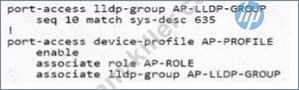
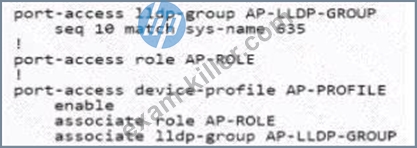
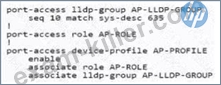
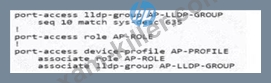
Which setof commands willapply the device profile 'AP'to the device shown in the LLDP neighbor output below?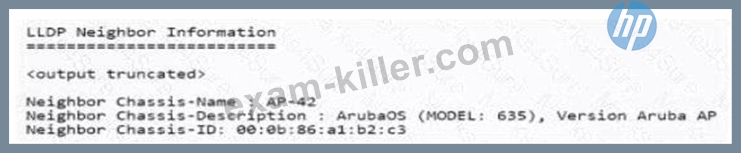
- A.
- B.
- C.
- D.
Answer: A
Explanation:
The goal is to configure the switch to automatically apply a specific device profile (named AP-PROFILE in the options) to ports where an Aruba AP Model 635 connects, using LLDP information for detection.
* LLDP Information:The LLDP neighbor output shows:
* Neighbor Chassis-Description: ArubaOS (MODEL: 635), Version Aruba AP
* Neighbor Chassis-Name: AP-42
* Device Profile Mechanism:This involves creating an LLDP group that matches specific attributes of the desired device, creating a device profile containing the desired port configurations (VLAN, PoE, QoS, Role, etc.), associating the profile with the LLDP group, and enabling the feature globally.
* Analyzing Configuration Options:All options configure an LLDP group AP-LLDP-GROUP and a device profile AP-PROFILE. The key is the matching condition within the LLDP group and the completeness of the profile configuration.
* Matching Condition:
* Options A, C, D use seq 10 match sys-desc 635. This condition checks if the LLDP System Description contains the string "635". Based on the output (...MODEL: 635...), this conditionwill matchthe target AP.
* Option B uses seq 10 match sys-name 635. This checks if the LLDP System Name contains
"635". The output shows Neighbor Chassis-Name: AP-42. This conditionwill not match.
NEW QUESTION # 43
The clientwouldlike to automate the process of troubleshooting issues to have better visibility. Which solution would you recommend for your client?
- A. HPE Aruba Networking Switch Multi-Edit Software
- B. AlOps integrated into HPE Aruba Networking Central
- C. HPE Aruba Networking F3bric Compose
- D. Automate processes with scripting like Python.
Answer: B
Explanation:
The client wants to automate troubleshooting processes and gain better visibility into their network. We need to identify the recommended Aruba solution.
* Analysis of Options:
* A. HPE Aruba Networking Fabric Composer: A tool primarily for data center fabric provisioning and management, not general campus troubleshooting automation.
* B. HPE Aruba Networking Switch Multi-Edit Software: Likely refers to configuration management features (e.g., in Central or NetEdit) for applying changes to multiple switches, not primarily focused on automated troubleshooting or visibility.
* C. Automate processes with scripting like Python: AOS-CX supports on-box scripting (NAE) and REST APIs, enabling custom automation for monitoring and troubleshooting. While powerful, it requires development effort.
* D. AIOps integrated into HPE Aruba Networking Central: Aruba Central's AIOps capabilities are specifically designed to enhance visibility and automate aspects of troubleshooting. It uses AI
/ML to analyze network data, detect anomalies, provide insights into potential issues, correlate events, and offer prescriptive recommendations, directly addressing the client's need for better visibility and automated assistance with troubleshooting.
* Conclusion:While custom scripting (C) allows automation, Aruba Central AIOps (D) is the platform- integrated solution specifically marketed and designed by HPE Aruba Networking to provide enhanced visibility and automated insights fortroubleshooting campus networks. It is the most direct and recommended solution among the options for achieving these goals within the Aruba ecosystem.
References:Aruba Central documentation (AIOps features), AOS-CX NAE and REST API documentation.
This relates to "Troubleshooting" (10%) and "Performance Optimization" (6%) objectives.
NEW QUESTION # 44
You are configuring an SSID thatisusing 802.IX as a security mechanism. Whatis the reason tor using WPA3- Ertorpnse (CCM-128) when deploying Wi-Fi 6 networks?
- A. WPA3-Enterprise(CCM-128) is also called WPA3-EnterpriseOnly Mode. There is no support tor WPA2 clients.
- B. WPA3-Enterprise (CCM-128) is also called WPA3-Ente'prise Transition Mode. It will allow WPA2 clients to conned.
- C. WPA3-Enterprise(CCM-128) is also called WPA3-Eniarpnse Compatibility Mode. It will allow WPA2 clients to connect.
- D. WPA3-Entorprise(CCM-128) is also called WPA3-Entorpnso 192-bit mode. lt is WPA3 only and enforces specific EAP certificate ciphers.
Answer: B
Explanation:
The question asks for the reason for using WPA3-Enterprise (CCM-128) when deploying Wi-Fi 6 networks.
* WPA3-Enterprise Modes:
* CCM-128:Uses AES-CCMP-128 (same cipher as WPA2). Its main purpose is to provide a transition path from WPA2 to WPA3. It allows both WPA3-capable and WPA2-only clients to connect to the same SSID. It enforces Protected Management Frames (PMF, 802.11w) when possible(required for WPA3, optional for WPA2). It's often called "Transition Mode" or
"Compatibility Mode".
* GCMP-256:Uses stronger AES-GCMP-256. It operates in "WPA3-Only Mode" and doesnot allow WPA2 clients.
* Wi-Fi 6 (802.11ax) & WPA3:Wi-Fi 6 certification requires support for WPA3.
* Analysis of Options:
* A: Incorrectly calls CCM-128 "192-bit mode" and "WPA3 only".
* B: Correctly calls CCM-128 "Transition Mode" and states it allows WPA2 clients.
* C: Correctly calls CCM-128 "Compatibility Mode" and states it allows WPA2 clients.
"Compatibility Mode" and "Transition Mode" are used interchangeably for this WPA3 mode.
* D: Incorrectly calls CCM-128 "Only Mode" and states no WPA2 support.
* Conclusion:Both Option B and Option C accurately describe WPA3-Enterprise (CCM-128). It is designed as a transition/compatibility mode to allow environments to adopt WPA3 features (like mandatory PMF for capable clients) while still supporting legacy WPA2 clients on the same network during the migration period. Selecting either B or C would be functionally correct based on common terminology.
References:Wi-Fi Alliance WPA3 specifications, Aruba WPA3 deployment guides, 802.11ax standard information. This relates to the "WLAN" (9%) and "Security" (10%) objectives.
NEW QUESTION # 45
Place the recommended troubleshooting steps in order.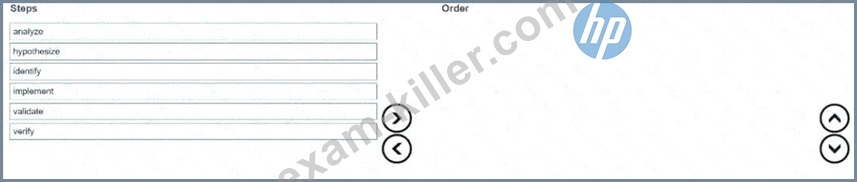
Answer:
Explanation: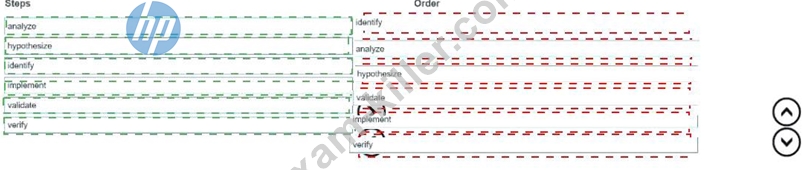
Explanation:
The correct order is:
* identify
* analyze
* hypothesize
* validate
* implement
* verify
This question requires arranging standard troubleshooting steps into a logical sequence. A systematic approach is crucial for effective network troubleshooting.
* identify:The first step is always to clearly identify and define the problem. What are the symptoms?
Who is affected? What is the scope? When did it start? Understanding the problem precisely is essential before proceeding.
* analyze:Once the problem is identified, gather relevant data and analyze the situation. This involves checking logs, looking at configurations, examining network topology diagrams, checking status commands, and potentially capturing packets. This analysis helps build context around the identified issue.
* hypothesize:Based on the identification and analysis, form a hypothesis (or multiple hypotheses) about the probable cause of the problem. This involves using technical knowledge and experience to theorize what might be wrong.
* validate:Test the hypothesis to determine if it's correct. This step involves performing specific tests or checks designed to confirm or refute the theory. For example, if the hypothesis is a bad cable, test the cable. If it's a routing issue, check the routing table and perform trace routes. This step validates the cause before implementing a fix.
* implement:Once the cause has been validated, implement the solution. This could involve replacing hardware, correcting configuration, clearing states, etc.
* verify:After implementing the solution, verify that the original problem is resolved. It's also critical to check that the fix hasn't introduced any new issues. Monitor the system to ensure stability.
References:Standard Network Troubleshooting Methodologies (e.g., CompTIA Network+, Cisco troubleshooting models), ITIL Problem Management processes. This directly relates to the "Troubleshooting" (10%) objective, which emphasizes performing advanced troubleshooting and remediation.
NEW QUESTION # 46
You arc about lo deploy a gateway that is on factory default. ZTP cannot be used for different reasons, but you are searching forvalid alternatives. What are two valid alternatives for ZTP? (Select two.)
- A. Use OTP by connecting to the console port, and use terminal software to complete provisioning. "Full- Setup" should be used.
- B. Use OTP by connecting to port 0/0/1 with a static IP. and use a Web browser to complete provisioning.
- C. Use OTP by connecting to port 0/0/0. and use a Web browser to complete provisioning.
- D. UseOTP by connecting to port 0/0/1. and use a Web browser to completeprovisioning.
- E. Use OTP by connecting lo the console port, and use terminal software to complete provisioning. *Static- Activate" should be used.
Answer: A,D
Explanation:
The question asks for valid alternatives to Zero Touch Provisioning (ZTP) for initially configuring a factory default Aruba gateway when ZTP cannot be used.
* Aruba Gateway Initial Provisioning Methods:
* ZTP:Automated provisioning using Activate/Central.
* One-Touch Provisioning (OTP) / Manual Setup:Involves direct connection for initial configuration.
* Web UI:Connecting a laptop to a specific management or designated setup port (often GE0
/0/1 on many gateway models) allows access to a web-based setup wizard.
* Console Port:Connecting via the serial console port allows CLI access, which includes guided setup scripts or manual configuration.
* Analysis of Options:
* A: Port 0/0/0 is typically the OOBM port, not the standard OTP web UI port.
* B: Port 0/0/1 is commonly used for OTP via Web browser on many Aruba gateway models.
* C: Using the console port with terminal software for initial setup (potentially using a "Full-Setup" wizard or script) is a standard manual method.
* D: "Static-Activate" refers to manual registration with the Activate service, not a console setup mode.
* E: Requires setting a static IP, adding complexity beyond the basic OTP connection method described in B.
* Conclusion:Using the designated OTP Ethernet port (commonly GE0/0/1) with a web browser (Option B) and using the console port with terminal software (Option C) are the standard, valid alternatives to ZTP for initial gateway setup.
References:Aruba Gateway Installation and Quick Start Guides, AOS-10 Fundamentals Guide (Provisioning sections). This relates to "Connectivity" (9%) and "Troubleshooting" (10%) objectives.
NEW QUESTION # 47
Match the network technology to the customer requirement.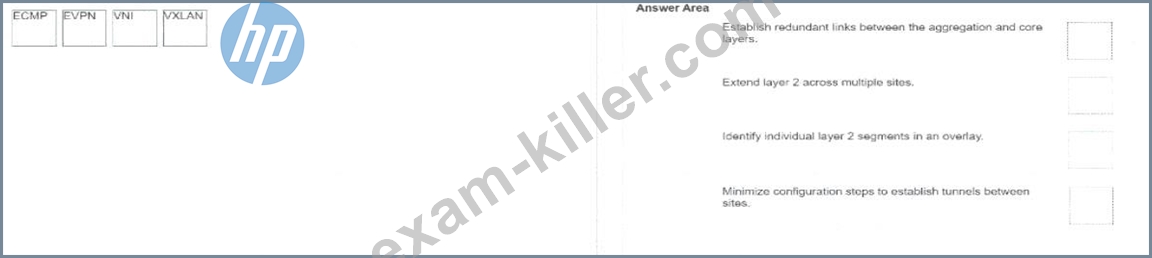
Answer:
Explanation: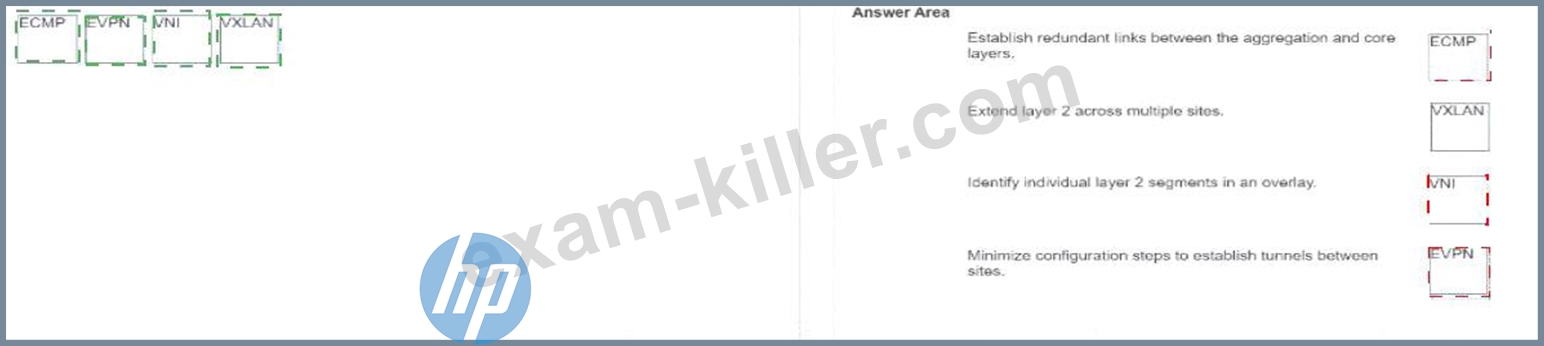
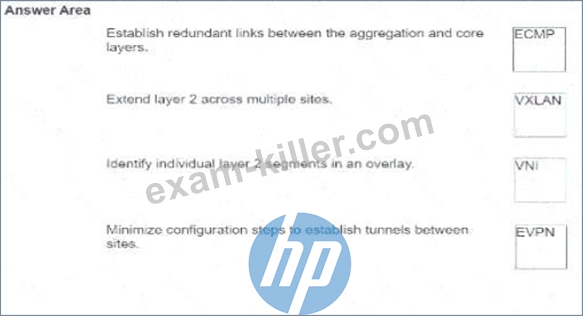
* Establish redundant links between the aggregation and core layers:When using Layer 3 routing between network layers (like Aggregation and Core),ECMP (Equal Cost Multi-Path)allows the routing protocol (e.g., OSPF, BGP) to utilize multiple links simultaneously if they have the same routing cost. This provides both redundancy (if one link fails, traffic uses the others) and load sharing across the links.
References:AOS-CX IP Routing Guide (OSPF, BGP, ECMP). Relates to "Routing" (16%), "Network Resiliency and virtualization" (8%).
Extend layer 2 across multiple sites:VXLAN (Virtual Extensible LAN)is the overlay technology specifically designed for this purpose. It encapsulates Layer 2 Ethernet frames within UDP packets, allowing them to be tunneled across an underlying Layer 3 network infrastructure, effectively stretching Layer 2 domains (VLANs) between physically separate locations.
References:AOS-CX VXLAN Guide.Relates to "Switching" (19%), "Connectivity" (9%).
Identify individual layer 2 segments in an overlay:Inside the VXLAN header, theVNI (VXLAN Network Identifier)serves as the segment identifier. Each unique Layer 2 segment (like a specific VLAN being extended) is mapped to a unique 24-bit VNI, allowing the overlay network to differentiate between traffic belonging to different L2 domains, even when tunneled between the same VTEPs (VXLAN Tunnel Endpoints).
References:AOS-CX VXLAN Guide, RFC 7348 (VXLAN).Relates to "Switching" (19%), "Connectivity" (9%).
Minimize configuration steps to establish tunnels between sites:While VXLAN provides the data plane encapsulation,EVPN (Ethernet VPN)acts as the modern control plane for VXLAN overlays. Using MP-BGP extensions, EVPN dynamically discovers VTEPs and advertises MAC address and IP reachability information. This significantly reduces configuration complexity compared to older static VXLAN or flood- and-learn methods, as VTEP peer relationships and endpoint learning are automated by the control plane, thus minimizing manual steps to establish connectivity.
References:AOS-CX EVPN Guide.Relates to "Routing" (16%), "Switching" (19%), "Connectivity" (9%).
NEW QUESTION # 48
Which minimal configurations must becompleted for MSTP to work correctly? (Select two.)
- A. revision number
- B. creating MSTP instances
- C. MSTPregion
- D. bridge priority number
- E. MSTP enabled interfaces
Answer: A,C
Explanation:
The question asks for the minimal configurations required for Multiple Spanning Tree Protocol (MSTP) to work correctly on AOS-CX switches.
* Analysis of Options:
* Option A:Correct. The MSTP region name must be configured to define the MSTP region and ensure switches belong to the same region.
* Option B:Incorrect. Bridge priority is optional and defaults to 32768; it's not mandatory for MSTP functionality.
* Option C:Correct. The MSTP revision number is required to ensure consistency across switches in the same region.
* Option D:Incorrect. Enabling MSTP on interfaces is automatic for VLAN-enabled ports; explicit configuration is not mandatory.
* Option E:Incorrect. Creating MSTP instances is optional and only needed for specific VLAN-to- instance mappings.
* Why A and C are Correct:MSTP requires a consistent region configuration across all switches to function correctly. The minimal configuration includes:
* MSTP region name:Defines the region (e.g., spanning-tree config-name REGION1) to group switches.
* Revision number:Ensures region consistency (e.g., spanning-tree config-revision 1).
These settings ensure switches form a single MSTP region, allowing VLAN-to-instance mappings (default instance 0 if not specified) and loop prevention. Other settings, like bridge priority or explicit instance creation, are optional and not strictly required for basic MSTP operation.
* Relevance to Certification Objectives:
* Network Resiliency and Virtualization (8%):Designing and troubleshooting MSTP for redundancy and fault tolerance.
* Switching (19%):Implementing Layer 2 technologies like MSTP for loop prevention.
References:
HPE Aruba Networking AOS-CX Configuration Guide: MSTP Configuration, detailing region and revision requirements.
HPE7-A06Study Guide: Covers MSTP setup and best practices.
HPE Aruba Networking Technical Documentation: Spanning Tree Protocols for AOS-CX.
NEW QUESTION # 49
When trying to add a now access switch to the network, theswitch port at the aggregation switch is automatically disabled.
What needs to be done to fix this issue?
- A. Disable spanning tree root-guard at the interface level.
- B. Disable spanning tree bpdu-tilter al the interface level.
- C. Disable spanning tree bpdu-guard at the interface level.
- D. Disable spanning tree loop-guard at the interface level.
Answer: C
Explanation:
The issue involves a new access switch's port being automatically disabled when connected to an aggregation switch, likely due to a Spanning Tree Protocol (STP) protection mechanism.
* Analysis of Options:
* Option A (Disable bpdu-filter):BPDU filtering prevents BPDUs from being sent or processed, which could cause loops, not resolve the issue.
* Option B (Disable root-guard):Root guard prevents a port from becoming the root bridge but does not cause port disablement in this context.
* Option C (Disable loop-guard):Loop guard prevents alternate ports from becoming designated but is unrelated to port disablement.
* Option D:Correct. Disabling BPDU guard on the aggregation switch's interface prevents it from disabling the port when it receives BPDUs from the new access switch.
* Why Option D is Correct:BPDU guard is an STP feature that disables a port if it receives BPDUs, assuming an unauthorized device is connected. When a new access switch isconnected, it sends BPDUs as part of normal STP operation, triggering BPDU guard on the aggregation switch and disabling the port. Disabling BPDU guard on the aggregation switch's interface (e.g., no spanning-tree bpdu-guard) allows the access switch to participate in STP without being disabled, resolving the issue while maintaining network stability.
* Relevance to Certification Objectives:
* Network Resiliency and Virtualization (8%):Involves troubleshooting STP mechanisms for fault tolerance.
* Troubleshooting (10%):Includes diagnosing and remediating STP-related issues in campus networks.
* Switching (19%):Covers Layer 2 technologies like STP and its protection features.
References:
HPE Aruba Networking AOS-CX Configuration Guide: Spanning Tree Configuration, detailing BPDU guard.
HPE7-A06Study Guide: Covers STP troubleshooting and protection mechanisms.
HPE Aruba Networking Technical Documentation: STP Best Practices, explaining BPDU guard behavior.
NEW QUESTION # 50
A client would like to usetheHPE Aruba Networking Switch MultiEdit Software function in HPE Aruba Networking Central. Which option is available?
- A. Apply a configuration to an interface range for selected switches.
- B. Use CLI scripts and apply them to selected switches.
- C. Run the same NAE scripts for selected switches.
- D. Usetemplates and apply them to selected switches.
Answer: B
Explanation:
The question involves a client wanting to use the HPE Aruba Networking Switch Multi-Edit Software function in HPE Aruba Networking Central to manage multiple switches. The task is to identify the available option.
* Analysis of Options:
* Option A (Use templates and apply them to selected switches):Incorrect. Templates are used for configuration management in Central but are not part of the Multi-Edit Software function.
* Option B (Apply a configuration to an interface range for selected switches):Incorrect. Multi- Edit focuses on CLI scripting, not specifically interface range configurations.
* Option C (Run the same NAE scripts for selected switches):Incorrect. Network Analytics Engine (NAE) scripts are for monitoring, not configuration via Multi-Edit.
* Option D:Correct. Multi-Edit Software in Central allows administrators to apply CLI scripts to multiple selected switches for configuration changes.
* Why Option D is Correct:HPE Aruba Networking Central's Multi-Edit Software feature enables administrators to create and apply CLI scripts to multiple AOS-CX switches simultaneously, streamlining configuration tasks. This is particularly useful for bulk changes, such as VLAN configurations or policy updates, across selected switches. The feature supports direct CLI input or script uploads, ensuring consistent application of commands, as per HPE Aruba Networking's management tools. This aligns with the client's need for efficient multi-switch management.
* Relevance to Certification Objectives:
* Connectivity (9%):Developing configurations for multiple devices based on customer requirements.
* Troubleshooting (10%):Applying consistent configurations to resolve network issues.
* Network Stack (4%):Analyzing solutions for network management automation.
References:
HPE Aruba Networking Central User Guide: Multi-Edit Software Feature, detailing CLI script application.
HPE7-A06Study Guide: Covers network management tools in Central.
HPE Aruba Networking Technical Documentation: Multi-Edit Software Best Practices.
NEW QUESTION # 51
AnOSPF router has teamed a path to an external network oy both an El and an E2 advertisement, both routes having the same path cost. Which path -will the router prefer?
- A. The router will use both paths equally by means ofECMP
- B. Both routes will be suppressed until the path conflict has been resolved.
- C. The router will prefer the E1 path.
- D. The router will prefer the E2 path.
Answer: C
Explanation:
The question involves an OSPF router receiving both an E1 (External Type 1) and an E2 (External Type 2) advertisement for an external network with the same path cost. The task is to determine which path the router will prefer.
* Analysis of Options:
* Option A (ECMP):Equal-Cost Multi-Path (ECMP) is used when multiple paths have the same total cost, but E1 and E2 routes have different metric calculations, so ECMP does not apply here.
* Option B (Prefer E2):Incorrect, as E2 routes are preferred only when E1 routes are not present or have a higher total cost.
* Option C (Suppressed):OSPF does not suppress routes due to path conflicts; it selects the best path based on metrics.
* Option D (Prefer E1):Correct. OSPF prefers E1 routes over E2 routes because E1 routes include the internal cost to the ASBR (Autonomous System Boundary Router) plus the external cost, providing a more accurate total cost.
* Why Option D is Correct:In OSPF, external routes are advertised as E1 or E2. E1 routes include both the external cost (advertised by the ASBR) and the internal cost to reach the ASBR, making them more precise for path selection. E2 routes only consider the external cost and are the default for redistributed routes unless explicitly configured as E1. When an OSPF router receives both E1 and E2 routes with the same external cost, it prefers the E1 route because it accounts for the total path cost, including internal network topology. This is per OSPF standards (RFC 2328).
* Relevance to Certification Objectives:
* Routing (16%):Involves designing and troubleshooting OSPF routing topologies, including external route types (E1 vs. E2).
* Troubleshooting (10%):Includes analyzing OSPF path selection to resolve routing issues.
References:
HPE Aruba Networking AOS-CX Configuration Guide: OSPF Configuration, detailing E1 and E2 route types.
HPE7-A06Study Guide: Covers OSPF external route selection and path preference.
RFC 2328: OSPF Version 2, explaining E1 and E2 route metrics and preference.
NEW QUESTION # 52
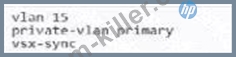
A customer hassot a requirement for VLAN 151 to be an isolated VLAN. A colleague has copied and pasted a partialconfiguration, but you do not achieve the desired outcome. This is the code that was added:
What should be added to the configuration before this code to achieve the desired result?
- A.

- B.
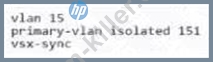
- C.
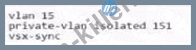
- D.
Answer: D
Explanation:
The customer requires VLAN 151 to be configured as an isolated Private VLAN. A partial configuration was added, but the desired outcome wasn't achieved. We need to determine which configuration snippet should be addedbeforethe (unspecified) partial configuration to correctly set up the Private VLAN structure.
* Private VLAN Configuration Fundamentals:
* APrimary VLANmust be defined. This VLAN carries traffic between promiscuous ports and ports in associated secondary VLANs.
* Secondary VLANs(either isolated or community) are associated with the primary VLAN.
* Ports are then mapped to either the primary VLAN (promiscuous ports, typically router/firewall connections) or a secondary VLAN (host ports). Isolated ports within thesameisolated VLAN cannot communicate with each other.
* Analyzing the Options (Assuming VLAN 15 is the intended Primary):
* A)
vlan 15
private-vlan primary
vsx-sync
This correctly defines VLAN 15 as the Primary Private VLAN. The vsx-sync command ensures this configuration is synchronized across a VSX pair (relevant if applicable). This is the necessary prerequisite before defining VLAN 151 as an isolated secondary VLAN and associating it with VLAN 15.
* B)isolated-vlan primary is incorrect syntax. The command is private-vlan primary.
* C)primary-vlan isolated 151 is incorrect syntax for defining either the primary or secondary VLAN type/association within the primary VLAN context.
* D)private-vlan isolated 151 within the vlan 15 context is incorrect syntax. The private-vlan isolated command belongs under the configuration of the secondary VLAN (VLAN 151 in this case).
* Conclusion:Before configuring VLAN 151 as private-vlan isolated and associating it, the primary VLAN must be defined. Option A correctly shows the command (private-vlan primary) under the intended primary VLAN's configuration (vlan 15) to establish it as the primary VLAN.
References:AOS-CX Security Guide (Private VLAN configuration steps and commands). This relates to the
"Switching" (19%) and "Security" (10%) objectives.
NEW QUESTION # 53
A Python developer could not modify the VLAN database on an AOS-CX switch through the REST API.
Which settings should the developer check first? (Select two.)
- A. SSH settings
- B. SNMP settings
- C. HTTPS settings
- D. local-user settings
- E. REST API settings
Answer: C,D
Explanation:
A Python developer using the REST API cannot modify the VLAN database on an AOS-CX switch. We need to identify the first settings to check.
* REST API Requirements for Modification:
* HTTPS Server:The REST API operates over HTTPS, so the HTTPS server must be enabled on the switch (show https-server status).
* REST Interface:The REST API interface itself must be enabled (it usually is by default, check with show rest-interface).
* Authentication:The API client must provide valid credentials (username/password or token) for a user account configured on the switch.
* Authorization:The authenticated user account must have sufficient privileges to modify the configuration (e.g., belong to the built-in administrators group or a custom role with appropriate permissions). Check user details (show user <name>) and role permissions (show user roles).
* Analysis of Options:
* A. HTTPS settings: Essential for API communication. Check if enabled.
* B. SSH settings: Irrelevant to REST API.
* C. SNMP settings: Irrelevant to REST API.
* D. REST API settings: Check if enabled (show rest-interface), but it's usually enabled by default.
Less likely than A or E to be the initial problem.
* E. local-user settings: Crucial for both authentication (correct credentials used?) and authorization (does the user have modification privileges?).
* Conclusion:When a REST API modification fails, the most critical initial checks involve ensuring the API endpoint is accessible (HTTPS Server enabled - A) and that the user account being used for the API call has the necessary permissions (local-user settings, specifically privileges/roles - E).
References:AOS-CX REST API Guide, AOS-CX Security Guide (User Accounts, Roles, HTTPS Server configuration). This relates to "Security" (10%) and "Authentication/Authorization" (9%).
NEW QUESTION # 54
Match each BGP element to its description.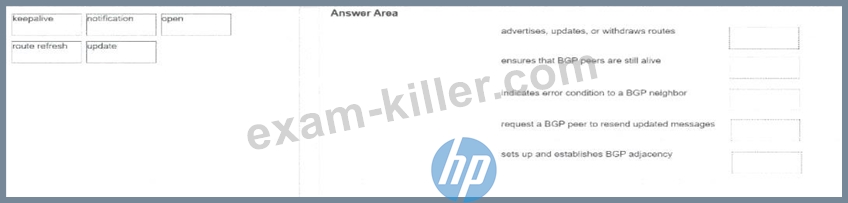
Answer:
Explanation: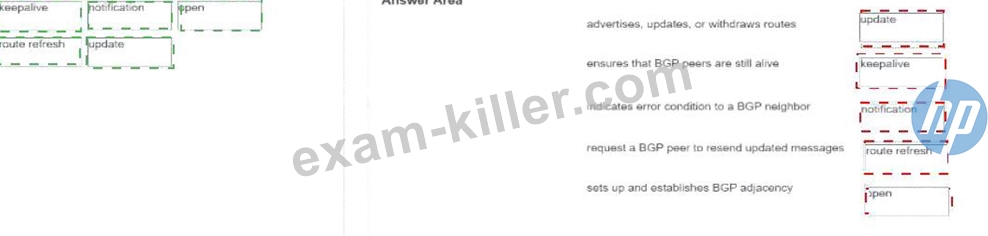
Explanation: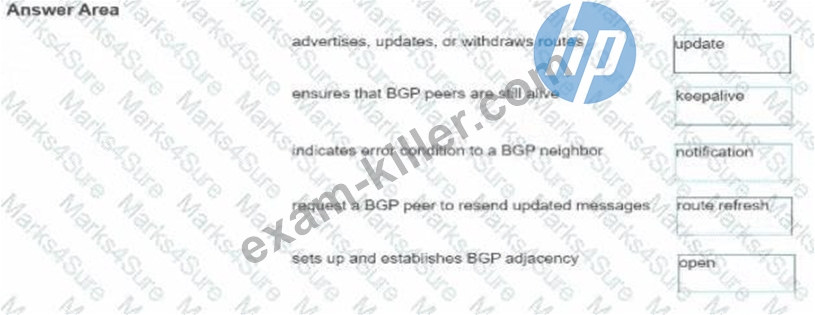
This question requires matching BGP protocol elements (mostly message types) to their primary function or description.
* OPEN Message:This is the first message sent after the TCP connection is established between BGP peers. Routers exchange OPEN messages to negotiate session parameters (AS Number, Hold Time, Router ID, Capabilities). A successful exchange leads to session establishment.
* Matches:"sets up and establishes BGP adjacency"
* UPDATE Message:This message is used to communicate network reachability information (NLRI). It carries prefixes that are being advertised, path attributes associated with those prefixes, and/or prefixes that are being withdrawn.
* Matches:"advertises, updates, or withdraws routes"
* KEEPALIVE Message:These messages are sent periodically between BGP peers within the agreed- upon Hold Time interval. Their primary purpose is to confirm that the peer is still alive and the session is active, especially when there are no UPDATE messages to send.
* Matches:"ensures that BGP peers are still alive"
* NOTIFICATION Message:This message is sent when a BGP error condition is detected (e.g., malformed message, unacceptable parameters in an OPEN message, hold timer expiry). Sending or receiving a NOTIFICATION message immediately causes the BGP session to terminate.
* Matches:"indicates error condition to a BGP neighbor"
* Route Refresh:This is a BGP capability (defined in RFC 2918) that allows a BGP speaker to request its peer to resend its routing updates for a specific address family, typically used after a policy change without requiring a full BGP session reset.
* Matches:"request a BGP peer to resend updated messages"
References:RFC 4271 (BGP4 Specification - Section 4, Messages), RFC 2918 (BGP Route Refresh Capability). This relates to the "Routing" (16%) objective.
NEW QUESTION # 55
......
Download Exam HPE7-A06 Practice Test Questions with 100% Verified Answers: https://www.exam-killer.com/HPE7-A06-valid-questions.html
Realistic HPE7-A06 Dumps are Available for Instant Access: https://drive.google.com/open?id=1L72qv6IJCPi8AUWuI9Y-L9myR5idwPOK
