

[Aug-2026] Microsoft Certified: Azure AI Fundamentals AI-901 Exam Practice Test Questions Dumps Bundle!
2026 Updated AI-901 PDF for the AI-901 Tests Free Updated Today!
Microsoft AI-901 Exam Syllabus Topics:
| Topic | Details |
|---|---|
| Topic 1 |
|
| Topic 2 |
|
NEW QUESTION # 36
You need to create an AI agent in Microsoft Foundry that follows a specific role and behavior when responding to users.
What should you configure?
- A. max completion tokens
- B. tokens per minute (TPM)
- C. temperature
- D. system instructions
Answer: D
Explanation:
To create an AI agent that follows a specific role and behavior, you configure system instructions. Microsoft Foundry Agent Service documentation states that agent instructions define goals, constraints, and behavior.
Option A. tokens per minute (TPM) controls throughput quota, not behavior.
Option C. temperature controls response randomness/creativity, not the agent's role.
Option D. max completion tokens controls response length, not the agent's role or behavioral rules.
Therefore, the correct answer is B. system instructions.
NEW QUESTION # 37
Stating the source of the data used to train a model is an example of which responsible AI principle?
- A. transparency
- B. reliability and safety
- C. privacy and security
- D. fairness
Answer: A
Explanation:
Transparency in AI refers to openly sharing information about how an AI system is designed, trained, and operates. Stating the source of the data used to train a model is an example of transparency, as it provides clarity about the origins of the data and helps stakeholders understand the model's development process.
NEW QUESTION # 38
What are two purposes of instructions when prompting a generative AI model? Each correct answer presents part of the solution.
NOTE: Each correct selection is worth one point.
- A. defines the Azure region where inference occurs
- B. defines the tokens per minute (TPM) allocation for the model
- C. defines constraints on the model's responses
- D. selects which model to use
- E. defines the agent's role and behavior
Answer: C,E
Explanation:
Giving a generative AI model clear, structural instructions (commonly referred to as Prompt Engineering) is the standard method used to define its persona, guide its behavior, and place strict operational boundaries on its responses.This is typically achieved through explicit instruction sets like System Instructions and targeted Prompt Guidelines.
1. Defining the Agent's Role and BehaviorEstablishing a persona prevents the AI from wandering into areas outside its intended scope and ensures the delivery style matches your needs.
2. Defining Constraints on ResponsesConstraints act as guardrails that prevent the AI from hallucinating, rambling, or providing incorrect information.
Reference:
https://ai.google.dev/gemini-api/docs/prompting-strategies
NEW QUESTION # 39
You are building a Conversational Language Understanding model for an e-commerce business.
You need to ensure that the model detects when utterances are outside the intended scope of the model.
What should you do?
- A. Create a new model
- B. Create a prebuilt task entity
- C. Add utterances to the None intent
- D. Export the model
Answer: C
Explanation:
The None intent is a required intent and can't be deleted or renamed. The intent is meant to categorize utterances that don't belong to any of your other custom intents. An utterance can be predicted as the None intent if the top scoring intent's score is lower than the None score threshold.
Reference:
https://learn.microsoft.com/en-us/azure/ai-services/language-service/conversational-language- understanding/concepts/none-intent
NEW QUESTION # 40
You have an Azure subscription.
You need to use Azure Content Understanding in Foundry Tools to extract structured data from invoices.
What should you provision?
- A. a Microsoft Foundry resource
- B. an Azure AI Search service
- C. A Microsoft Foundry project
- D. an Azure OpenAI resource
Answer: A
Explanation:
To use Azure Content Understanding in Foundry Tools, Microsoft lists a Microsoft Foundry resource as a prerequisite. The documentation states that you need a Microsoft Foundry resource created in a supported region, and that the portal lists this resource under Foundry > Foundry.
The invoice scenario is also directly aligned with Content Understanding's intelligent document processing use case: Microsoft states that Content Understanding converts unstructured documents into structured data and gives invoice processing as an example.
Therefore, to extract structured data from invoices by using Azure Content Understanding in Foundry Tools, you should provision a Microsoft Foundry resource.
NEW QUESTION # 41
You have an Azure Machine Learning model that generates a large quantity of false negatives.
You need to reduce the number of false negatives without re-training the model.
What should you do?
- A. Adjust the threshold value.
- B. Use a different Machine Learning model.
- C. Increase the number of training iterations.
- D. Increase the amount of training data.
Answer: A
Explanation:
What are different methods to minimize False Negatives and False Positives in Binary Classification?
Threshold Line
One of the easiest methods to minimize the outcomes of a certain case is simply changing the decision boundary line from the basic 0.5 to above (when reducing False Positives) or below (when reducing False Negatives). It should be noted that by doing this, the possibility of False Positives increases. In other words, by decreasing the False Negatives we are increasing the False Positives.
Reference:
https://www.kaggle.com/discussions/general/376229
NEW QUESTION # 42
What should you use to identify similar faces in a set of images?
- A. Azure AI Language
- B. Azure OpenAI in Foundry Models
- C. Azure AI Vision
- D. Azure AI Custom Vision
Answer: C
Explanation:
Correct:
* Azure AI Vision
Incorrect:
* Azure AI Custom Vision
* Azure AI Language
* Azure OpenAI Service
* Azure OpenAI in Foundry Models
Note: Azure AI Foundry, Vision, Find similar faces
To identify similar faces across different images using Azure, the Azure AI Face service is the most suitable choice. This service leverages AI algorithms to detect, recognize, and analyze human faces, including features like face grouping based on visual similarity.
Reference:
https://learn.microsoft.com/en-us/azure/ai-services/computer-vision/how-to/find-similar-faces
NEW QUESTION # 43
You are reviewing best practices for using AI at your company.
Which Microsoft responsible AI principle is each task an example of? To answer, drag the appropriate principles to the correct tasks. Each task may be used once, more than once, or not at all. You may need to drag the split bar between panes or scroll to view content.
NOTE: Each correct match is worth one point.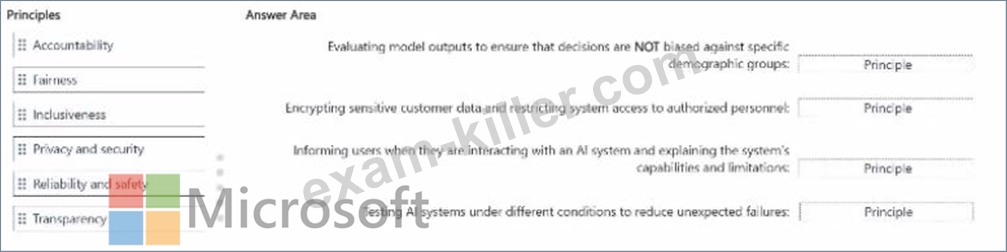
Answer:
Explanation: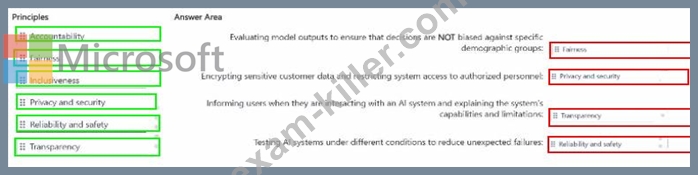
NEW QUESTION # 44
Select the answer that correctly complete the sentence.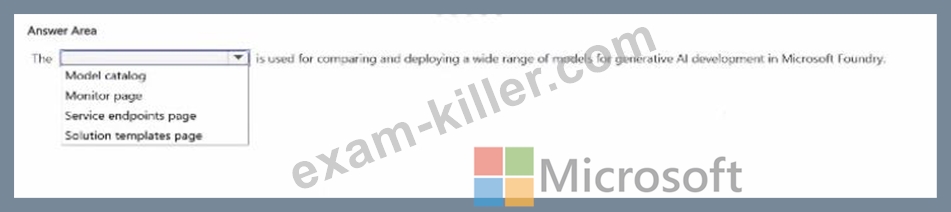
Answer:
Explanation: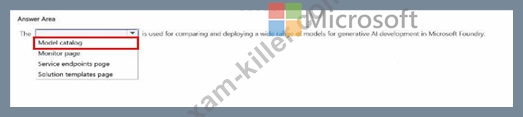
NEW QUESTION # 45
You need to convert written customer notifications into natural-sounding spoken audio that can be played over a phone system.
Which Azure Speech in Foundry Tools capability should you use?
- A. speaker recognition
- B. speech translation
- C. speech synthesis
- D. speech recognition
Answer: C
Explanation:
The requirement is to convert written customer notifications into natural-sounding spoken audio. This is speech synthesis, also known as text to speech.
Microsoft's Azure Speech documentation describes text to speech as a capability that converts text into natural-sounding synthesized speech. Therefore, for playing written notifications over a phone system, the correct Azure Speech capability is speech synthesis.
Why the other options are incorrect:
A . speaker recognition identifies or verifies speakers by voice.
C . speech recognition converts spoken audio into text.
D . speech translation translates spoken audio between languages.
NEW QUESTION # 46
You are developing an application that analyzes voicemail recordings by using Azure Content Understanding in Foundry Tools.
You need to extract a transcript and structured information from the recordings.
Which type of analyzer should you use?
- A. video analyzer
- B. audio analyzer
- C. document analyzer
- D. image analyzer
Answer: B
Explanation:
To extract a transcript and structured information from voicemail recordings, you should use an audio analyzer.In Azure Content Understanding, analyzers are configured based on the type of data being processed. Since voicemail recordings are conversational audio content, an audio analyzer is designed to handle speech-to-text transcription, speaker labeling, and extracting the relevant structured fields.
Reference:
https://learn.microsoft.com/en-us/azure/ai-services/content-understanding/audio/overview
NEW QUESTION # 47
You need to create an AI agent in Microsoft Foundry that follows a specific role and behavior when responding to users. What should you configure?
- A. max completion tokens
- B. tokens per minute (TPM)
- C. temperature
- D. system instructions
Answer: D
Explanation:
In Microsoft Foundry, instructions (formerly referred to as system messages) are the primary way to define the role, behavior, tone, and constraints of your AI agent.
Reference:
https://learn.microsoft.com/en-us/azure/foundry-classic/agents/quickstart
NEW QUESTION # 48
You need to build an AI solution that produces new product images based on written descriptions provided by users. Which AI workload should you use?
- A. object detection
- B. image analysis
- C. optical character recognition (OCR)
- D. image generation
Answer: D
Explanation:
An AI workload that creates entirely new visual content based on written natural language descriptions is defined as image generation, which is a core capability of Generative AI. In the Microsoft Azure ecosystem, this task is primarily handled by generative models like DALL-E or GPT-image via Azure OpenAI Service and Azure AI Foundry.
Reference:
https://learn.microsoft.com/en-us/azure/architecture/data-guide/ai-services/image-video-processing
NEW QUESTION # 49
You are developing an application that analyzes voicemail recordings by using Azure Content Understanding in Foundry Tools.
You need to extract a transcript and structured information from the recordings.
Which type of analyzer should you use?
- A. video analyzer
- B. audio analyzer
- C. document analyzer
- D. image analyzer
Answer: B
Explanation:
Voicemail recordings are audio content. Azure Content Understanding analyzers define what type of content to process, including documents, images, audio, or video, and what elements to extract, including transcripts and structured fields.
Microsoft's custom analyzer documentation also shows an audio example based on prebuilt-audio for processing customer support call recordings, which is the same content type as voicemail recordings.
Therefore, to extract a transcript and structured information from voicemail recordings, you should use an audio analyzer.
NEW QUESTION # 50
You have an Azure subscription.
You need to use Azure Content Understanding in Foundry Tools to extract structured data from invoices.
What should you provision?
- A. a Microsoft Foundry resource
- B. an Azure AI Search service
- C. A Microsoft Foundry project
- D. an Azure OpenAI resource
Answer: A
Explanation:
To extract structured data from invoices using Azure Content Understanding in Foundry Tools, you must provision a Microsoft Foundry resource (often referred to as an Azure AI services resource configured within a supported region).
Reference:
https://learn.microsoft.com/en-us/azure/ai-services/content-understanding/tutorial/create-custom-analyzer
NEW QUESTION # 51
You are using the Azure Speech SDK to develop a Python application that supports real-time spoken conversations.
Which Azure speech class should you use to configure the connection to the Azure Speech service?
- A. SpeechSynthesizer
- B. AuditOutputConfig
- C. AudioConfig
Answer: B
NEW QUESTION # 52
Hotspot Question
Select the answer that correctly completes the sentence.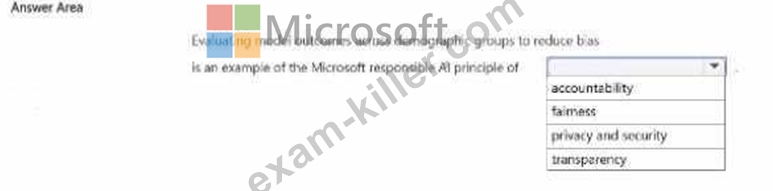
Answer:
Explanation: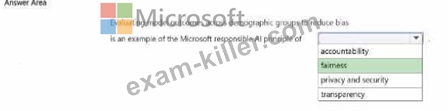
NEW QUESTION # 53
Hotspot Question
For each of the following statements, select Yes if the statement is true. Otherwise, select No.
NOTE: Each correct selection is worth one point.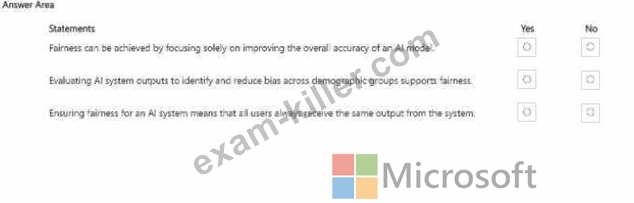
Answer:
Explanation: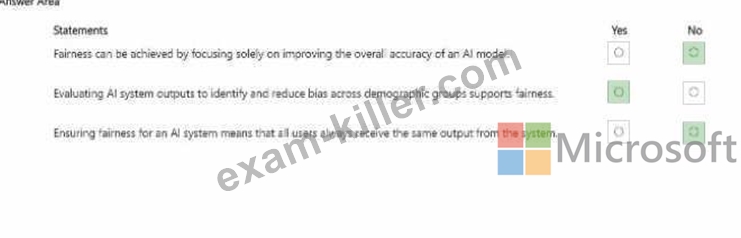
NEW QUESTION # 54
Hotspot Question
Select the answer that correctly completes the sentence.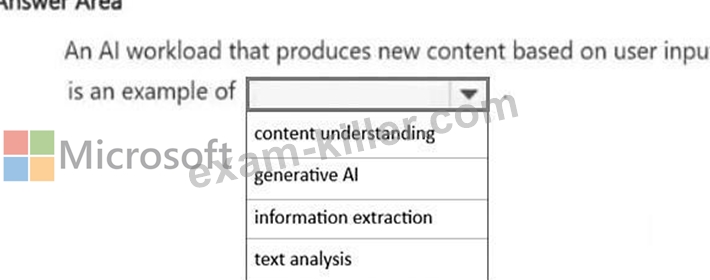
Answer:
Explanation: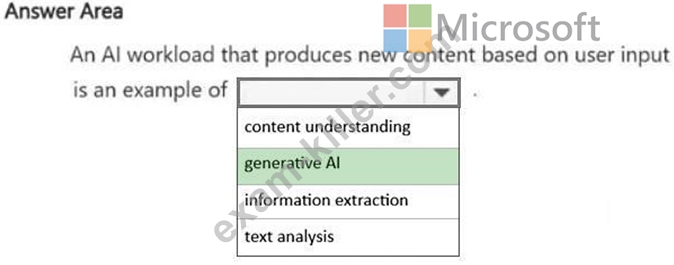
NEW QUESTION # 55
What should you use to explore pretrained generative AI models available from Microsoft and third-party providers?
- A. Azure Synapse Analytics
- B. Azure Machine Learning designer
- C. Language Studio
- D. Azure AI Foundry
Answer: D
Explanation:
Azure AI Foundry Models gives you access to flagship models in Azure AI Foundry to consume them as APIs with flexible deployment options.
Depending on what kind of project you're using in Azure AI Foundry, you might see a different selection of these models. Specifically, if you're using a Foundry project, built on an Azure AI Foundry resource, you see the models that are available for standard deployment to a Foundry resource. Alternatively, if you're using a hub-based project, hosted by an Azure AI Foundry hub, you see models that are available for deployment to managed compute and serverless APIs.
These model selections do overlap in many cases, since many models support the multiple deployment options.
Reference:
https://learn.microsoft.com/en-us/azure/ai-foundry/foundry-models/concepts/models
NEW QUESTION # 56
Hotspot Question
Select the answer that correctly completes the sentence.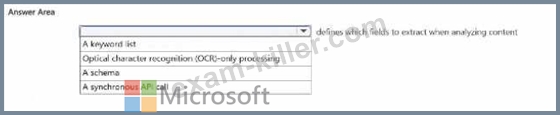
Answer:
Explanation: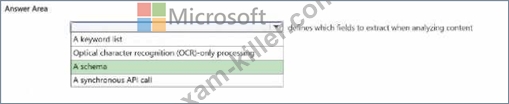
NEW QUESTION # 57
You are developing an AI-powered customer support application.
Which task is an example of the Microsoft responsible AI principle of inclusiveness?
- A. Encrypt stored customer data and restrict access by using role-based controls.
- B. Design the interface to support multiple languages and screen readers.
- C. Provide explanations about how predictions are generated.
- D. Evaluate model outputs across demographic groups to reduce bias.
Answer: B
Explanation:
The Microsoft responsible AI principle of inclusiveness means AI systems should be designed to empower and engage everyone, including people with different abilities, languages, and accessibility needs.
Therefore, designing the interface to support multiple languages and screen readers is an example of inclusiveness.
Why the other options are incorrect:
A . Provide explanations about how predictions are generated = Transparency C . Evaluate model outputs across demographic groups to reduce bias = Fairness D . Encrypt stored customer data and restrict access by using role-based controls = Privacy and security
NEW QUESTION # 58
......
Fully Updated Dumps PDF - Latest AI-901 Exam Questions and Answers: https://www.exam-killer.com/AI-901-valid-questions.html
100% Free AI-901 Exam Dumps to Pass Exam Easily: https://drive.google.com/open?id=1vahS-aqz_Do5_mtkdXIbQ70LZ6s-A8Tf
